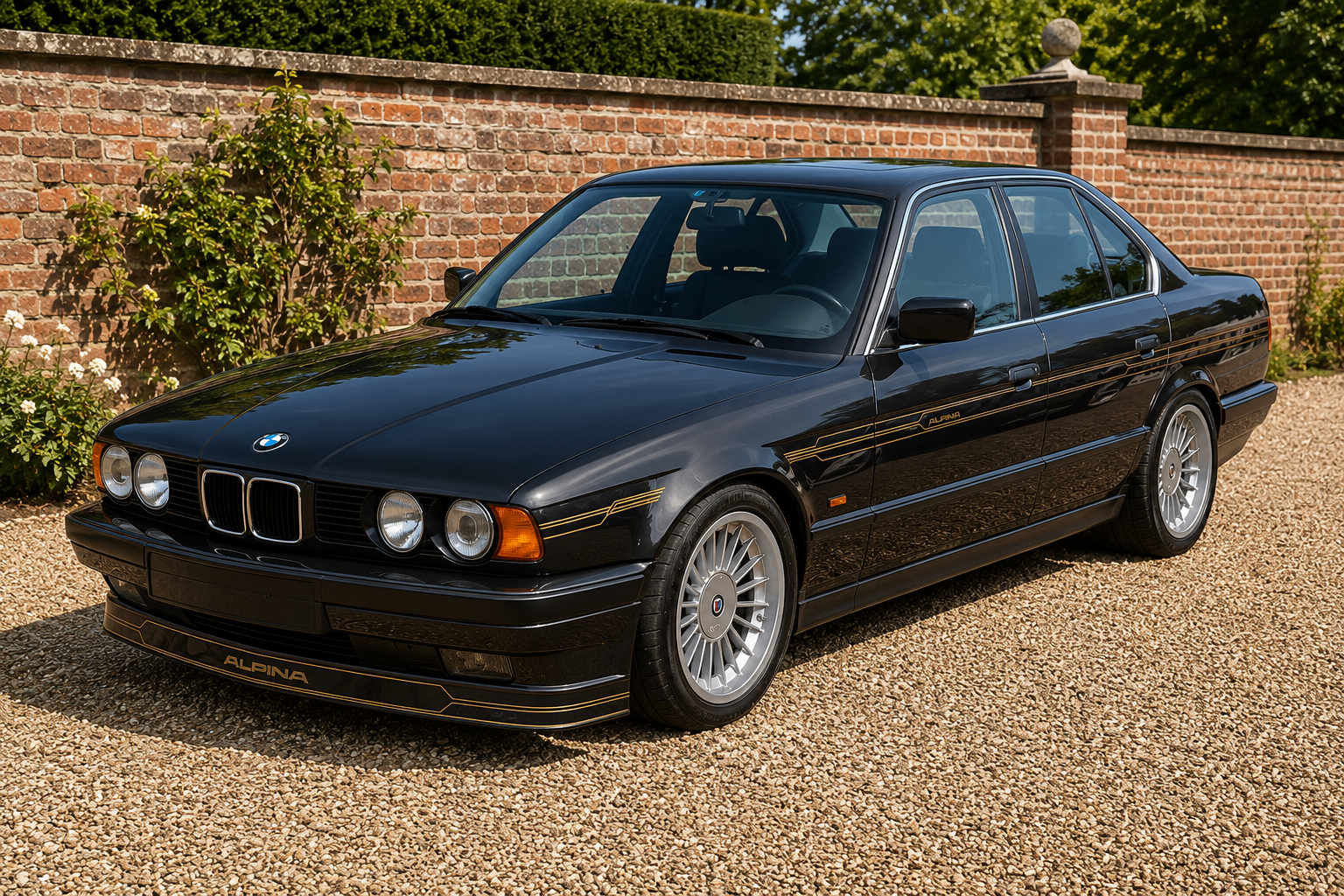
The fastest production sedan in the world at its 1989 Geneva launch — Alpina's twin-turbo E34, 507 units built at Buchloe on the base BMW 535i chassis.
The Alpina B10 Bi-Turbo is Alpina's headline E34 5 Series and one of the defining performance saloons of the early 1990s. Introduced at the March 1989 Geneva Motor Show and priced (per period Alpina marketing) at DM 168,000 — roughly the cost of a Ferrari Testarossa — the B10 Bi-Turbo was, on Alpina's own claim, the fastest production four-door in the world at launch, ahead of the contemporary BMW M5 (E34), the Mercedes-Benz 500 E and the Lotus Carlton/Omega. Production ran from 1989 through August 1994 at Buchloe, ending with the discontinuation of the BMW M30 'big six' in 1993.
The car was built by taking a base BMW 535i (M30B35), stripping the drivetrain and rebuilding it to Alpina specification: the 3,430 cc M30 inline-six was fitted with forged Mahle pistons, revised cylinder head and camshaft, and — the defining spec item — twin water-cooled Garrett T25 turbochargers with an intercooler, giving 355 hp / 360 PS and around 520 Nm / 384 lb-ft (period Alpina figures; various BaT catalogue entries cite 355 hp / 384 lb-ft on the 1991 BaT Lot #214,959 and 355 hp / 348 lb-ft on the 1990 BaT Lot #57,664 — an ongoing inconsistency in period English-language reporting of the peak torque figure). Drive was to the rear wheels through a five-speed Getrag manual (a small number of cars were built with a ZF 4-speed automatic; the vast majority of surviving cars are the desirable manual). Suspension was re-engineered with revised springs and anti-roll bars, Bilstein front dampers, a Sachs self-levelling rear, and 13.1-inch ventilated front brakes with four-piston Lucas-Girling calipers. Wheels were the defining 17-inch multi-spoke Alpina design in staggered widths.
Total production of the E34 B10 Bi-Turbo is 507 units — a figure corroborated across individually numbered cars in public sales ('#284 of 507', '#37 of 507', '#366 of 507') and dealer records ('No 232/507'). No public Alpina factory ledger confirms the total directly, so 507 is best treated as a well-corroborated consensus figure. All 507 cars are LHD by build — the B10 Bi-Turbo was never offered in factory right-hand drive, and no period RHD conversion is known (per theALPINAregister). This is unlike some other E34 Alpinas: the naturally aspirated B10 3.5 and later B10 variants did exist in RHD, and Sytner of Nottingham made RHD conversions of various Alpinas in period — but not the Bi-Turbo. Any RHD 'E34 Alpina' a UK buyer sees is therefore not a B10 Bi-Turbo.
The B10 Bi-Turbo sits at a very specific intersection of the Alpina and E34 5 Series stories. Within the E34 story, it is the definitive non-BMW performance derivative: a Buchloe-engineered rival to the contemporary M5 (E34) that beats the M5 on straight-line pace and repositions the E34 as a grand-touring saloon rather than a homologation-flavoured sports car. Within the Alpina story, it is the last M30-powered Alpina — the closing chapter of the pre-M60/M62 V8 Alpina era, and the direct forerunner of the E39 B10 V8 that replaced it. Its combination of extreme rarity (507 units), 'world's fastest four-door' historical footnote, and the Alpina brand's transition to full BMW ownership from 2026 have driven a meaningful market re-rate over the past five years: BaT prints have moved from mid-USD-30,000s in 2016–2017 into the mid-USD-50,000s in 2021 and now to USD 58,000 for a mid-mileage manual car in October 2025, with strong European dealer asking prices materially above that.
Variants
Range and production
Variant
Years
Production
Notes
Alpina B10 Bi-Turbo (E34) — total production
1989–1994
507
Consensus published figure — 507 total units built at Buchloe on the BMW E34 535i chassis between 1989 and August 1994. Corroborated across every verified primary auction lot's build-number reference: Bring a Trailer Lot #214,959 '#284 of 507' (Oct 2025), Bring a Trailer Lot #57,664 '#37 of 507' (Oct 2021), Bring a Trailer Lot #6,468 '#366 of 507' (Oct 2017), and the Kimbex Dream Cars dealer listing 'No 232/507'. The Alpina-Archive.com register page (alpina-archive.com, ?nmt=B10-BiTurbo&page_id=178) is the closest thing to a primary Alpina Buchloe ledger publicly consulted but was not able to be verified into a numeric total for this guide, so the 507 figure is best treated as a well-corroborated consensus number rather than a directly-verified Buchloe-primary confirmation. Running production change: the final approximately 50 cars are distinguishable by a wider 'V8-style' kidney grille, updated mirrors, a different rear spoiler, leather (rather than cloth) upholstery, and blue-dial instruments; earlier cars have the narrow grille. This is not a separate factory variant.
Buyer's Guide
What to look for
The B10 Bi-Turbo within the Alpina and E34 story
The B10 Bi-Turbo is Alpina's headline E34 and the last M30-engined Alpina. Its position in both programmes matters materially to a purchase decision. Within the Alpina story, it is the closing chapter of the pre-V8 Alpina era — Alpina moved to the M60/M62 V8-engined B10 V8 for the E39 5 Series in 1997 and never returned to a straight-six twin-turbo in the E34 architecture. Within the E34 story, it is the definitive non-M performance derivative and a period rival to the M5 (E34), the Mercedes 500 E and the Lotus Carlton/Omega. Cars trading the market today are almost exclusively LHD German-market originals, with a small population imported to Japan in period and later re-exported to Canada, the UK and the USA. The B10 Bi-Turbo was never offered in factory right-hand drive, and no period RHD conversion is known (per theALPINAregister). This is unlike some other E34 Alpinas: the naturally aspirated B10 3.5 and later B10 variants did exist in RHD, and Sytner of Nottingham made RHD conversions of various Alpinas in period — but not the Bi-Turbo. Any car offered as a 'UK RHD E34 Alpina' is therefore not a B10 Bi-Turbo.
Provenance and documentation
On a 507-unit car, per-car documentation is a material value contributor. Priorities at PPI: original Alpina dash plaque with the build number (BaT lots consistently reference '#XXX of 507' from the plaque — a missing plaque is a red flag; the Oct 2025 BaT Lot #214,959 note 'The numbered Alpina dash plaque is missing' resulted in a $58,000 sale for an otherwise-desirable manual car), original Alpina delivery documentation from Buchloe, the M30 engine's Alpina-specific service record, and an unbroken chain of ownership. Cars that came out of Japan in the 2000s and 2010s (BaT Lot #214,959 spent time in Japan before Canada; the Kimbex Dream Cars 'No 232/507' car) are common and typically well-preserved, but their paper trail through Japanese ownership should be verified. A car with the original Alpina dash plaque, Buchloe delivery paperwork, and a documented engine history clears a premium over a car with any of those items missing.
Mechanical inspection priorities
The M30-based Alpina engine is a mature, robust unit — the M30 is shared with the E32 735i, the E28 M5 and the E34 535i, so parts and specialist knowledge are broadly available through the wider BMW independent trade. Priorities at PPI, in order: turbocharger condition (twin water-cooled Garrett T25s; look for smoke on boost, oil in the intake tract, and shaft play — BaT Lot #57,664 had its turbos rebuilt by CG Motorsports in Richmond, BC at 237,000 km in 2015, which is the kind of documented major work a buyer should be seeking); cooling system integrity (M30 head gasket, radiator, expansion tank, water pump, thermostat — a car older than 5–7 years since its last full cooling refresh should be planned for one); clutch and gearbox (Getrag 5-speed is stout but the clutch is a wear item; BaT Lot #57,664 was fitted with a replacement clutch, flywheel and pressure plate in 2013); Alpina-specific engine management calibration versus a stock 535i; the dash-mounted variable boost controller — verify it operates through its full 0.4–0.8 bar range as intended.
Body, paint and Alpina-specific trim
The E34 shell is steel and does rust — the priorities are the sills, the rear wheel arches, the front valance (BaT Lot #57,664 flagged 'A crack is visible in the front valance' as a specific defect), the boot floor around the fuel filler, and the underside of the front and rear windscreens. On any car with new paint, use a paint-depth gauge over every panel. Alpina-specific bodywork — the front spoiler, side skirts, rear spoiler and (as ordered) multi-colour Alpina pinstripe livery — is essential to value and, where refinished, must be executed correctly by an Alpina-familiar bodyshop. Spotter's point: the final approximately 50 cars received a wider 'V8-style' kidney grille, updated mirrors, a different rear spoiler, leather (rather than cloth) upholstery, and blue-dial instruments; earlier cars have the narrow grille. This is a running production change, not a separate factory variant. The 17-inch multi-spoke Alpina wheels are a defining spec item; incorrect BBS-style aftermarket 5-Series wheels are a red flag. Interior: the Alpina numbered dash plaque, Alpina three-spoke wheel, Alpina-branded VDO cluster (320 km/h speedometer), Alcantara headliner and burl wood are all essential trim items and difficult to source aftermarket.
Specification and market strategy
Because all 507 cars share the same drivetrain architecture, the market's differentiating axes are: LHD/manual/original (the default — every verified primary auction print was LHD manual); build number and Alpina dash plaque present; original colour and Alpina livery (colours seen in the verified throughput include Alpinweiss II with blue Alpina graphics, Sterling Silver with gold Alpina graphics, and Dark Sapphire Blue Metallic — non-standard repaints trade at a discount); Buchloe delivery paperwork; documented major engine work (turbo rebuild, cooling refresh, clutch); and mileage (30,000-mile cars are top of the market — see Kimbex Dream Cars '112,000 km' as a dealer benchmark — while 150,000+ km drivers clear at the lower end). The tiny population of automatic-transmission cars trade at a discount; manual is the collector default. UK RHD conversions are a distinct sub-market and trade case-by-case.
Ownership
Living with it
Typical mileage
1,500–5,000 miles typical for collector use; the B10 Bi-Turbo is genuinely usable as a long-distance GT and was engineered exactly for that role.
Service interval
12 months / 5,000 miles at a recognised M30/Alpina specialist; annual oil and filter change is non-negotiable regardless of mileage, and turbo oil-feed lines should be inspected annually.
Annual running cost
$3,500 – $7,500
Fuel economy
~15–20 mpg imperial combined; low-teens under boost or in traffic.
Insurance
Agreed-value cover with limited mileage and secure storage is standard. US premiums typically US$1,000–US$2,000/yr on agreed-value cover; UK premiums are case-by-case given the LHD-only build and the aftermarket-RHD sub-population.
Maintenance planning
The Alpina-tuned M30 inline-six is a mature engine architecture — the base M30 is shared with the E32 735i, E28 M5 and E34 535i. Priorities to plan for: twin Garrett T25 turbocharger service (oil feeds, seals, shaft play — turbos are rebuildable through the wider Garrett T25 specialist trade), M30 head gasket and cooling refresh every 5–7 years (radiator, expansion tank, thermostat, water pump, hoses), Getrag 5-speed clutch service, and the Alpina-specific engine management and boost-controller calibration. Alpina-specific service items — Alpina damper spec, Alpina wheels, Alpina interior trim, Alpina numbered dash plaque — are sourced through Alpina Buchloe (Alpina still supports its historic cars directly) and a small pool of independent Alpina-familiar specialists in Germany and the UK.
Parts and specialist access
General M30 parts (gaskets, cooling, ignition, service items) are cheap and abundant through the BMW E28/E32/E34 specialist trade. Alpina-specific parts — the 17-inch Alpina multi-spoke wheels, Alpina three-spoke steering wheel, Alpina-branded VDO 320 km/h cluster, Alpina numbered dash plaque, Alpina-tune ECU and boost controller, Alpina spoilers and side skirts — are sourced through Alpina Buchloe and a small specialist pool. Turbochargers are Garrett T25 water-cooled units and rebuildable through the wider Garrett T25 specialist trade (e.g. CG Motorsports of Richmond, BC completed a documented rebuild on BaT Lot #57,664 at 237k km). Confirm parts availability for any missing Alpina-specific hardware before purchase — a car missing its dash plaque or original Alpina wheels is materially devalued and expensive to correct.
Common Problems
Known issues by system
Engine — twin Garrett T25 turbochargers
Turbo wear on a 30+ year forced-induction Alpina — the single most consequential service item
Critical$4,500 – $9,000 (rebuild both Garrett T25 turbochargers at a recognised Garrett T25 specialist)
Symptoms — Blue smoke on boost, oil in the intake tract, shaft play at the compressor wheel, boost drop-off at high load, oil consumption above M30 baseline.
Inspection — Full boost-pressure test at PPI through the dash-mounted variable boost controller (0.4–0.8 bar); compressor-wheel shaft play check on both turbos; verify any prior turbo rebuild in the service file. BaT Lot #57,664 had its turbos rebuilt by CG Motorsports of Richmond, BC at 237k km — that kind of documented rebuild is a value contributor.
Engine — M30 cooling system
Aged radiator, expansion tank, water pump, thermostat, hoses — routine on any 30+ year M30
Symptoms — Slow warm-up, temperature climb in traffic, coolant loss at the expansion tank, weeping water pump, head-gasket weep.
Inspection — Full cold and hot cooling-system pressure test at PPI; verify any previous full cooling refresh in the service file; on a car older than 5–7 years since its last refresh, plan for a full refresh regardless of visual condition.
Body — E34 corrosion
E34 shell corrosion at the sills, rear arches, front valance and boot floor
Major$3,000 – $12,000 (targeted E34 corrosion repair plus reinstatement of Alpina-specific bodywork and livery)
Symptoms — Bubbling at sill seams, corrosion at the rear wheel arches, bloom around the rear windscreen, cracks in the front valance (BaT Lot #57,664 explicitly flagged 'A crack is visible in the front valance').
Inspection — Full paint-depth gauge over every panel at PPI; underside inspection on a lift; specific inspection of sills, rear arches, front valance, boot floor and windscreen surrounds. E34 body repair is well-understood but Alpina-specific bodywork (spoilers, side skirts, pinstripe livery) needs an Alpina-familiar shop.
Transmission — Getrag 5-speed manual and clutch
Clutch wear on the Alpina-specification Getrag 5-speed; synchro wear on higher-mileage cars
Moderate$1,800 – $3,500 (clutch, flywheel, pressure plate and slave cylinder at a recognised specialist)
Symptoms — High biting point, clutch slip under full boost, gearbox whine, synchro crunch on cold 2nd gear.
Inspection — Full road test through every gear cold and warm; specific test of full-throttle upshifts in 3rd, 4th and 5th under boost; verify any previous clutch, flywheel and pressure plate service in the file (BaT Lot #57,664 had a full clutch service at CG Motorsports in November 2013 as a documented benchmark).
Chassis — Alpina suspension and brakes
Aged Bilstein front dampers, Sachs self-levelling rear, Alpina spring rates; 13.1-inch front brake service
Moderate$2,500 – $5,500 (targeted damper, spring and brake refresh at Alpina spec)
Symptoms — Nose dive under braking, floaty rear on load, Alpina damper leaks, brake judder from warped rotors, worn Lucas-Girling four-piston caliper seals.
Inspection — Full chassis inspection at PPI; verify Alpina-specific dampers and springs are original Alpina, not a later BMW M-Sport swap; full brake pad, rotor and caliper inspection.
Wheels — 17-inch Alpina multi-spoke set
Curbed, cracked or refurbished Alpina wheels; incorrect aftermarket replacements
Moderate$2,500 – $6,000 (refurbishment or replacement of a full set of Alpina 17-inch wheels)
Symptoms — Curb rash at multiple corners, cracks around the barrel, non-original wheel design fitted.
Inspection — Photographic inspection of each wheel at PPI; verify wheels are original Alpina 17-inch multi-spoke set in the correct staggered widths, not aftermarket 5-Series wheels. Correct Alpina wheels are expensive to source and a defining spec item.
Interior — Alpina-specific trim, plaque and instrument cluster
Moderate$1,500 – $6,000 (targeted trim refresh; Alpina dash plaque and VDO cluster sourcing is separate and specialist-only)
Symptoms — Missing dash plaque (BaT Lot #214,959 explicitly flagged 'The numbered Alpina dash plaque is missing' at its $58,000 sale), aftermarket wheel fitted, dashboard pixel dropout in the Alpina VDO cluster, worn burl wood trim.
Inspection — Photographic inspection of every Alpina-specific interior item at PPI against period Alpina brochure. The Alpina numbered dash plaque is the single most visible provenance item; its absence is a material value hit and difficult to replace correctly.
Electrical — 30+ year BMW electronics and Alpina boost controller
Symptoms — Intermittent warning lights, dashboard dot-matrix pixel dropout, HVAC or audio faults, boost controller failing to modulate through the full 0.4–0.8 bar range.
Inspection — Test every switched item at PPI; scan for stored fault codes on the Alpina-tune ECU with a BMW-capable diagnostic tool; specifically verify the dash-mounted variable boost controller operates through its full range. Alpina-specific management should be diagnosed by an Alpina-capable specialist rather than a generic BMW indie.
Auctions
Recent results
Date
Auction
Car
Mileage
Result
2025-10-15
Bring a Trailer
Online auction, Lot #214,959
1991 Alpina B10 Bi-Turbo (#284 of 507; Sterling Silver with gold Alpina graphics)
Offered at no reserve; approximately 94,000 km indicated. The numbered Alpina dash plaque is missing.
—
US$58,000
Sold
Every result above was verified directly from the auction platform's own listing page (Bring a Trailer at bringatrailer.com, and Bonhams|Cars Online at carsonline.bonhams.com) at the URLs cited in each individual note. The B10 Bi-Turbo was never offered in factory right-hand drive and no period RHD conversion is known (per theALPINAregister), so any UK RHD B10 Bi-Turbo offered at auction is by definition an aftermarket conversion. This is unlike some other E34 Alpinas: the B10 3.5 and later B10 variants did exist in RHD, and Sytner of Nottingham made RHD conversions of various Alpinas in period — but not the Bi-Turbo. No primary-source public hammer for a concours-grade sub-50,000-km original-paint B10 Bi-Turbo was located for this guide; cars in that bracket currently trade via European Alpina specialist dealers (Kimbex Dream Cars in Poland is one of the visible current benchmarks) rather than at open auction, so the concours tier in the valuation table is authored from broker experience and dealer asking-price context rather than a verified hammer. The 507-unit total production figure is universally cited across all verified primary auction lots' '#XXX of 507' catalogue references but was not directly confirmed from a verified Alpina Buchloe production ledger for this guide, and is best treated as a well-corroborated consensus figure rather than a Buchloe-primary confirmation — Verify against the Alpina-Archive.com register (alpina-archive.com, ?nmt=B10-BiTurbo&page_id=178) if a buyer requires primary-source confirmation.
Investment
Long-term outlook
Strong HoldHorizon: 5–10 years
The B10 Bi-Turbo combines four collector-market tailwinds into a single 507-unit E34: 'world's fastest production four-door at 1989 Geneva launch' historical footnote; the closing chapter of the pre-V8 Alpina engineering era; a genuine period rival to the M5 (E34), the Mercedes 500 E and the Lotus Carlton/Omega — all of which have re-rated meaningfully over the past five years; and the transition of Alpina to full BMW ownership from 2026, which firms the collector case for the last pre-transition Alpinas. The upside case is well-supported by the verified auction trajectory (BaT $33k bid 2017 → $52k sold 2021 → $58k sold 2025) and by the visible European dealer premium above BaT throughput. The downside case is manageable but real: turbo rebuild and E34 corrosion are the two cost items that must be planned for; the LHD-only build means any UK RHD car is an aftermarket conversion and must be evaluated separately; and the missing-Alpina-plaque discount is significant — buyers should default to cars with the plaque present. Best buys are LHD manual cars with the Alpina numbered dash plaque, original Alpina wheels, complete Buchloe delivery paperwork and a documented Garrett T25 turbo rebuild in the file — cars in that spec at the current mid-USD-USD 60,000s to mid-EUR-EUR 80,000s band are the clearest hold, with concours-grade sub-50,000-km cars now the natural next leg of the market.
Our view, not advice. This section is Car Collector International's editorial judgement on where this model sits in the collector market, based on the production, specification and market data set out in this guide. It is not a recommendation to buy or sell and it is not investment advice. Values can fall as well as rise.