
Modern Classic · 1984–1996

Ferrari Testarossa

Pininfarina's flat-twelve poster car — the wide-body 1980s Ferrari that defined the decade.

Coupe
Car Collector International Editorial
Ferrari Testarossa
Overview

Why this car matters

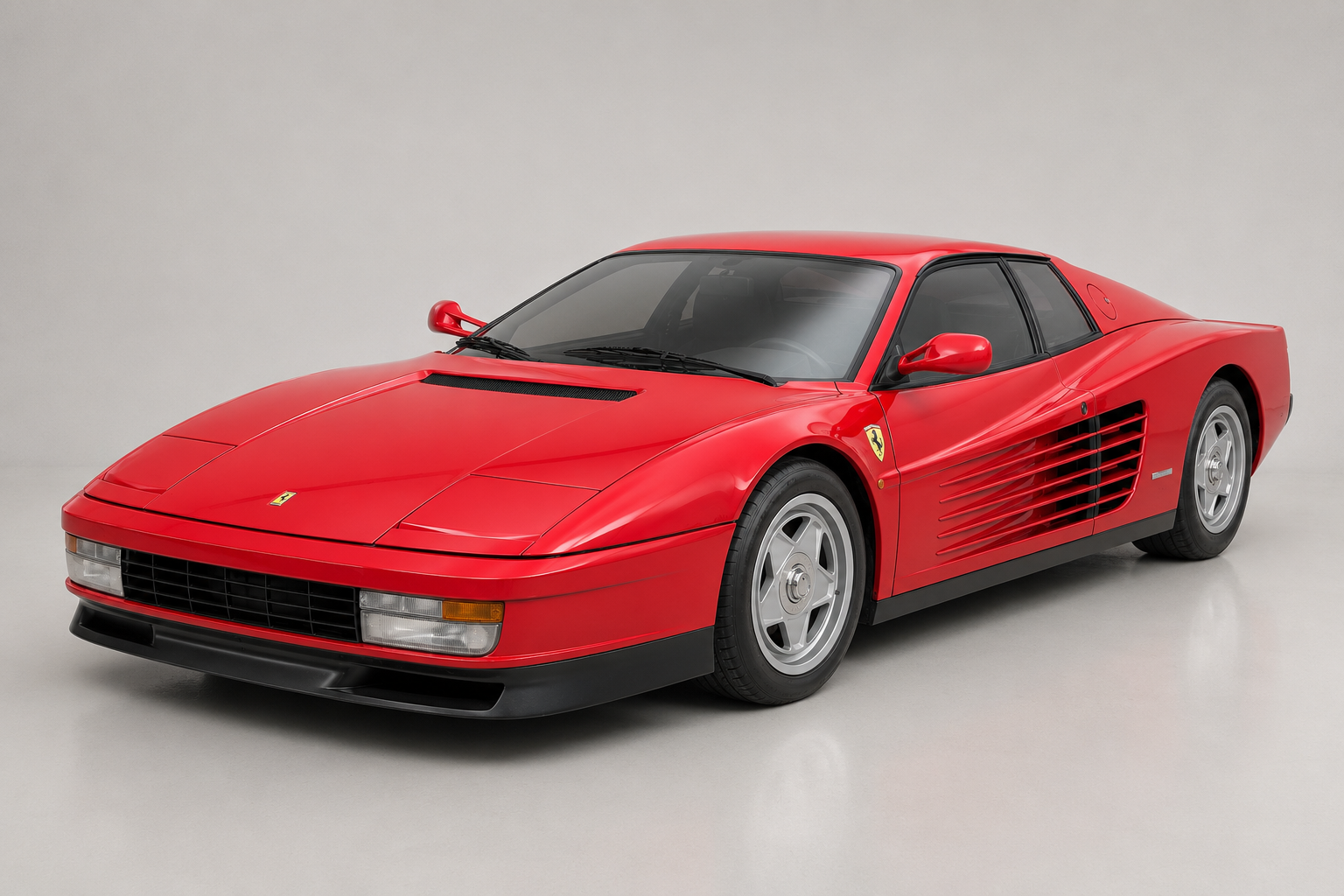
Launched at the 1984 Paris Salon, the Testarossa replaced the 512 BBi with a Pininfarina-styled wedge featuring its signature side strakes channelling air to the side-mounted radiators. Power came from a 4.9-litre flat-12 producing 390 hp.

The Testarossa ran through to 1991 before evolving into the 512 TR and the final 512 M, with progressive chassis, brake and power upgrades.

The Testarossa is the most recognisable Ferrari shape of the 1980s and the cultural focal point of the decade's supercar boom.

Variants

Range and production

VariantYearsProductionNotes
Testarossa (monospecchio)1984–1986Earliest cars; single high-mounted mirror, single-bolt centre wheels.
Testarossa (dual-mirror)1986–1991Twin mirrors, five-bolt wheels; majority of production.
512 TR1991–1994Major upgrade: 428 hp, revised chassis and brakes.
F512 M1994–1996Final 440 hp evolution; fixed headlamps; rarest of the family.
Buyer's Guide

What to look for

Provenance and originality

Start with identity, paperwork and originality. For the Ferrari Testarossa, the strongest cars have continuous ownership history, matching numbers where applicable, original books and tools, factory build documentation and evidence of work by manufacturer-approved specialists. Engine-out major service within 5 years, original paint, original specification (single mirror / single bolt on earliest cars), full books and tools.

Mechanical inspection priorities

The F113 flat-12 is durable but the engine-out major service (cam belts, clutch) is the dominant cost; budget accordingly. A proper pre-purchase inspection includes cold-start behaviour, ECU diagnostics and fault-code history (where applicable), leak-down or compression testing, underbody photography, suspension and chassis inspection, brake condition and a long enough road test to expose heat-related faults. Deferred maintenance on a car of this class is almost always more expensive than buying a better-sorted example.

Body, paint and accident history

Use a paint-depth gauge, lift access and a specialist familiar with the model's factory panel gaps and finish standards. Collector value is dramatically affected by structural repairs, refinished panels, poor paintwork and missing factory trim or option content. Documented cosmetic refresh is acceptable; concealed accident or fire damage must be priced severely.

Specification strategy

Mono-spec early 'monospecchio / monodado' Testarossas have collector premium; clean 512 TR cars are the connoisseur's pick. Specification, colour, options and limited-build variants move values significantly. Buy the best-documented example in the most desirable specification you can justify, rather than a tired example of a rarer derivative that will need years of corrective work.

Pricing

What to pay

Driver Testarossa
USD$120,000 – $170,000
GBP£95,000 – £135,000
EUR€110,000 – €155,000
Honest 1980s/early-1990s cars with documented history.
Excellent Testarossa / 512 TR
USD$180,000 – $290,000
GBP£145,000 – £230,000
EUR€165,000 – €265,000
Engine-out-serviced cars, original paint, clean cosmetics.
F512 M / early monospecchio
USD$320,000 – $550,000
GBP£255,000 – £440,000
EUR€290,000 – €500,000
Rarer derivatives with documented history.

Regional ranges authored independently — each reflects its local market, not an FX conversion

Ownership

Living with it

Typical mileage
1,000–4,000 miles typical for collector use
Service interval
12 months; mileage interval varies by model and use
Annual running cost
$3,500 – $10,000
Fuel economy
15–28 mpg depending on use
Insurance
Use an agreed-value collector or specialist supercar policy with limited mileage, secure storage, documented photography and an annual value review. Premiums vary sharply by age, storage location, declared value and driver profile.

Maintenance planning

Budget annually even if the car is used sparingly. Fluids age, tyres and date-coded rubber components must be replaced regardless of mileage, and stored cars need exercise. A documented maintenance rhythm protects both reliability and resale value.

Parts and specialist access

Use Ferrari-experienced specialists with documented flat-12 engine-out experience. Before purchase, confirm parts availability for model-specific bodywork, electronics, gearbox and engine components. A discounted car waiting on unobtainable parts or a factory service slot is rarely a saving in collector ownership.

Common Problems

Known issues by system

Engine

Lapsed engine-out major service

Critical$8,000 – $15,000
Symptoms — No record of engine-out service in 5+ years.
Inspection — Documented engine-out cam belt + clutch service.
Cooling

Side-radiator hose and seal degradation

Major$2,500 – $6,500
Symptoms — Coolant loss, temperature creep in traffic.
Inspection — Cooling pressure test and visual inspection of side radiator hardware.
Electrics

Earthing and switchgear failures

Moderate$1,500 – $4,500
Symptoms — Intermittent gauges, blown fuses, lighting issues.
Inspection — Specialist electrical sweep.
Valuation

Current value bands by region

Concours
USD
$240,000
GBP
£190,000
EUR
€220,000
+4% 12-mo
Excellent
USD
$175,000
GBP
£140,000
EUR
€160,000
+2% 12-mo
Good
USD
$130,000
GBP
£104,000
EUR
€120,000
+1% 12-mo
Fair
USD
$85,000
GBP
£68,000
EUR
€78,000
0% 12-mo
Project
USD
$55,000
GBP
£44,000
EUR
€50,000
-3% 12-mo

Each region quoted in its local currency — independent market readings, not FX conversions

The Testarossa market has matured. Engine-out-serviced, original-paint cars now lead; tired examples needing engine-out work change hands at a meaningful discount once the cost of the service is priced in.

Auctions

Recent results

DateAuctionCarMileageResult
2025-05-10
RM Sotheby's
Villa Erba
1996 F512 M
8,500 km
€512,000
Sold
2024-08-17
Gooding & Co.
Pebble Beach
1985 Testarossa monospecchio
14,000 mi
$291,500
Sold
2025-03-15
Bring a Trailer
Online
1991 Testarossa
32,000 mi
$182,000
Sold
Investment

Long-term outlook

Strong HoldHorizon: 5–10 years

Iconic shape, defined production, mature collector base. Early monospecchio cars and F512 M lead; standard mid-production cars track the wider 1980s supercar market.

Recommended

The trusted network

Specialists

  • Ferrari factory-approved specialist
    View →
    UK / Europe
    Ferrari Testarossa inspections, major service planning and originality reviews.
  • Model-focused independent
    View →
    United States
    Pre-purchase inspections, scheduled service and market-correct preparation for the Testarossa.
  • Concours preparation studio
    View →
    International
    Paint correction, PPF, detailing, preservation and sale preparation for premium collector cars.
  • Hagerty
    View →
    USA / UK / EU
    Agreed-value collector and supercar insurance with global recognition.
  • Lockton Performance
    View →
    UK / EU
    Specialist agreed-value cover for modern hypercars and limited-production supercars.

Storage

  • Windrush Car Storage
    View →
    Cotswolds, UK
    Climate-controlled storage and collection management for high-value classic and supercars.
  • Autovault
    View →
    Bicester, UK
    Secure climate-controlled storage at Bicester Heritage with inspection programmes.
  • Classic Car Club Manhattan
    View →
    New York, NY
    Secure urban storage for collector and modern performance cars.

Transport

  • CARS UK
    View →
    UK & Europe
    Enclosed event, concours and collection transport across Europe.
  • Reliable Carriers
    View →
    USA (national)
    Enclosed coast-to-coast transport for premium supercars and classics.
  • FERRLOG
    View →
    Italy / Europe
    Air-ride enclosed transport for Italian and European collector cars.

Own a Ferrari Testarossa?

Join Car Collector International's owners register for valuation updates, auction alerts and members-only events.

Register interest