
Car Collector International
Classic · 1957–1958

Ferrari 335 S

A works sports racer built to answer the Maserati 450S — four cars, one of the most consequential entries in Ferrari's competition history.

Car Collector International Editorial
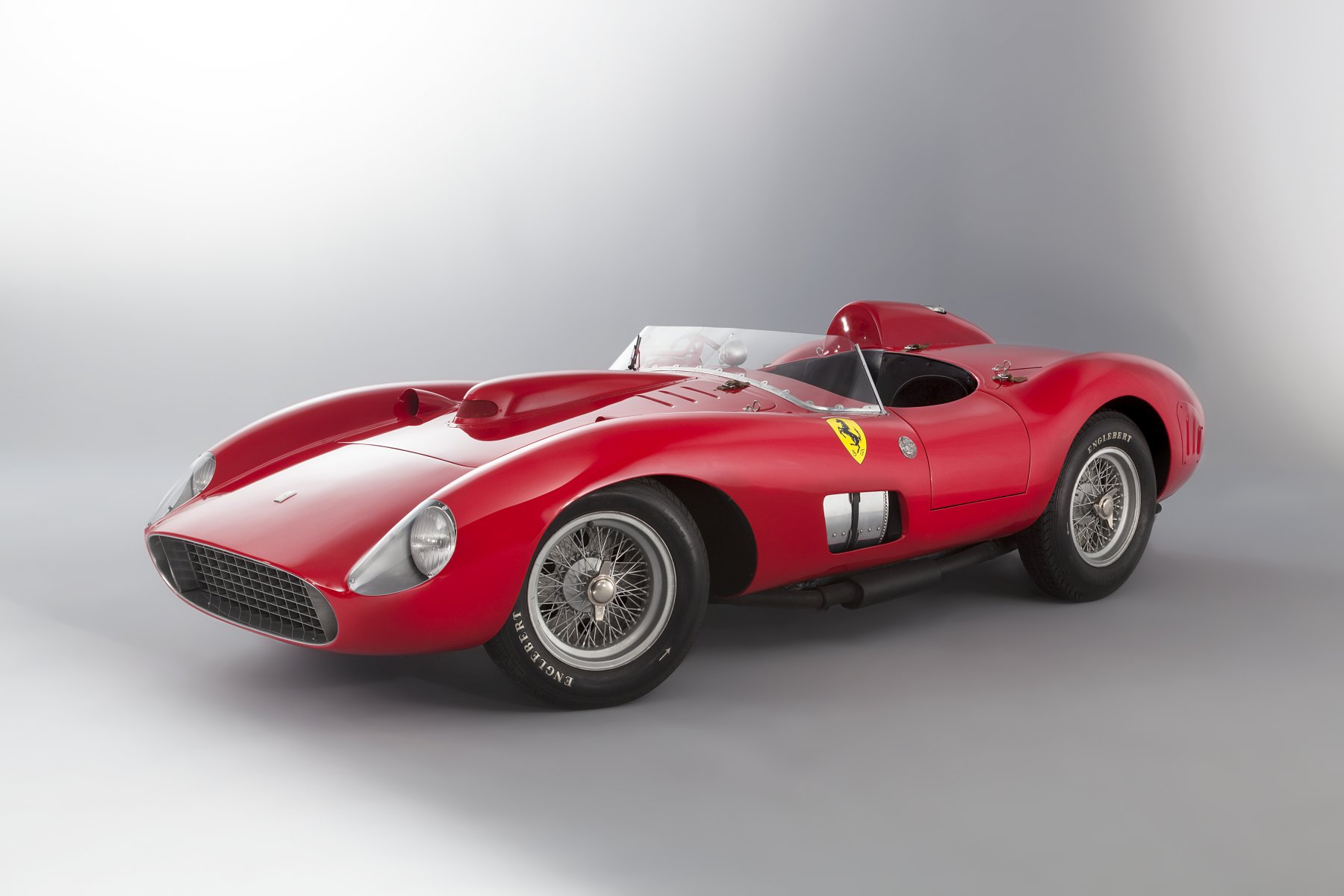
Red Ferrari 335 S barchetta photographed in a studio, front three-quarter view showing a low aluminium body by Scaglietti, twin faired-in headlamps, a small oval grille, a raised head-fairing behind the driver's seat, a low aero-screen, side-exit exhausts and Borrani-style wire wheels — a factory-yellow-shielded prancing horse on the flank.
Overview

Why this car matters

The 335 S was built in four cars — chassis 0674, 0676, 0700 and 0764 — as a direct response to the Maserati 450S, whose 4.5-litre engine was threatening the 3.8-litre 315 S and the 3.5-litre 290 MM. The first two chassis were 315 S cars converted to 335 S specification. Bodywork is a Scaglietti barchetta in aluminium, closely similar to the 315 S. The car was known in period as the 'Super Testarossa'.

On its World Championship debut at the 1957 Mille Miglia, 335 S number 531 (chassis 0676) was running third when a tyre failed on the straight between Cerlongo and Guidizzolo. The car left the road and struck spectators. Alfonso de Portago — who had replaced an ill Luigi Musso — his navigator Edmund Nelson, and nine spectators, five of them children, were killed. A further twenty were injured. The car was destroyed. The Mille Miglia was cancelled from the following year. The other 335 S, chassis 0700, driven by Peter Collins and Louis Klemantaski, had broken down while leading; victory went to a 315 S.

A works sports racer from the front rank of Ferrari's competition history, built in the smallest of series. Chassis identity, period record and continuity of ownership determine value entirely. Cars at this level transact rarely and largely privately.

Variants

Range and production

VariantYearsProductionNotes
335 S1957–19584Four cars: chassis 0674, 0676, 0700 and 0764. The first two were 315 S cars converted to 335 S specification. Evolution of the 315 S. Jano V12 'Tipo 141', 4,023.32cc, DOHC, six Weber carburettors, twin-spark ignition with four distributors, dry sump. Multi-disc clutch, four-speed gearbox. Estimated top speed around 300 km/h. The Jano V12 family (introduced 1956) combined elements of the Colombo and Lampredi designs and also served the 290 MM, 290 S, 315 S, 312 S, 412 MI and 412 S. Tubular steel frame, independent front suspension, De Dion rear axle, drum brakes all round. Scaglietti aluminium barchetta body, closely similar to the 315 S. Known in period as the 'Super Testarossa'. VERIFY: power — 400 PS / 395 hp (Wikipedia) vs 390 hp (Ferrari-affiliated sources), both at 7,400 rpm. VERIFY: top speed — 186 mph vs 190 mph. VERIFY: production years — 1957 vs 1957–1958. VERIFY: one source states the model was driven by Mike Hawthorn and Stirling Moss — single source. VERIFY: number built — four (majority position: 0674, 0676, 0700, 0764, with 0676 destroyed at the 1957 Mille Miglia) vs five with four remaining (minority position) — unresolved; do not state a single figure as settled. TRAP — DO NOT REPEAT: Wikipedia states the February 2016 chassis 0674 sale resulted from a bidding war between Cristiano Ronaldo and Lionel Messi. The contemporaneous record does not support it — bidding opened at €20,000,000, reached €26,000,000 within a minute, and after roughly ten further minutes an international bidder in the room prevailed over the last telephone bidder; the buyer was subsequently reported as a US property developer. This claim must not appear in any field.
Buyer's Guide

What to look for

Chassis identity and continuity of ownership

Works sports racers of this era transact almost entirely on chassis identity, period race record and continuity of ownership. For the 335 S specifically, the corpus is four cars — 0674, 0676, 0700, 0764 — with the first two converted from 315 S, one destroyed at the 1957 Mille Miglia and each of the remaining chassis individually documented. Any commercial discussion begins and ends with chassis identity, Ferrari Classiche certification and continuity of ownership. Establish these facts through Ferrari Classiche before any commercial discussion.

Period race record and body construction

Confirm the car's period race history against contemporary entry lists, results and period photography. Verify body construction and any converted-from-earlier-specification history against Ferrari Classiche's factory records.

Preparation, eligibility and campaigning

Event eligibility for the FIA and ACO historic-race calendar (Mille Miglia, Le Mans Classic, Goodwood Revival, Monaco Historique) depends on chassis identity and specification against period regulations. Preparation and event entry belong with a Ferrari Classiche-approved historic race preparer.

Insurance, transport and paddock security

Insurance, enclosed transport, paddock security and event coverage are budgeted as part of the annual campaign. Confirm the car's current storage and campaign infrastructure with the seller before purchase.

Pricing

What to pay

Chassis-by-chassis
Four cars were built and one was destroyed in period. A single public result exists. Cars at this level transact privately and are priced individually against chassis history.

Regional ranges authored independently — each reflects its local market, not an FX conversion

Ownership

Living with it

Typical mileage
Event-based use; road mileage not typical
Service interval
Per event and per Ferrari Classiche-approved race preparer
Annual running cost
Event- and campaign-dependent; budgeted by season with a Ferrari Classiche-approved race preparer
Fuel economy
Not applicable — competition car
Insurance
Agreed-value historic-racing policy with event coverage, secure transport and secure paddock storage. Works-supported early Ferrari sports racers are underwritten as historic-competition assets in the highest specialist tier.

Chassis identity and continuity of ownership

Works sports racers of this era transact almost entirely on chassis identity, period race record and continuity of ownership. Ferrari Classiche certification, unbroken chassis provenance and complete period documentation are the base requirements before any commercial discussion.

Race-preparer and event eligibility

Preparation, running and event entry belong with a Ferrari Classiche-approved historic race preparer with a direct relationship to the FIA / ACO historic-race calendar. Event eligibility (Mille Miglia, Le Mans Classic, Goodwood Revival, Monaco Historique) is defined by chassis identity and specification against period regulations.
Common Problems

Known issues by system

Valuation

Current value bands by region

Each region quoted in its local currency — independent market readings, not FX conversions

Chassis 0674 sold in February 2016 for €32,075,200 including premium, against a €28,000,000–€32,000,000 estimate, having been offered from a long-held private collection. The result set a world record in euros and sterling; in dollar terms the 1962 250 GTO sold in 2014 remains higher, because the euro had weakened between the two sales. With four cars built and one destroyed in period, there is no market in the ordinary sense.

Auctions

Recent results

DateAuctionCarMileageResult
2016-02-05
Artcurial
Rétromobile, Paris
1957 335 S Spider Scaglietti, chassis 0674
Hammer €28,000,000; €32,075,200 / $35,711,359 / £24,693,782 with premium, against a €28,000,000–€32,000,000 estimate. Offered from the Pierre Bardinon collection. A world record IN EUROS AND STERLING ONLY — the 1962 250 GTO sold for $38,115,000 in 2014 and remains higher in dollar terms, as the euro had weakened between the two sales. Do not describe this as the most expensive car ever sold at auction without that qualification.
€32,075,200
Sold
Investment

Long-term outlook

Blue ChipHorizon: 10+ years

A works sports racer from the front rank of Ferrari's competition history, built in the smallest of series. Chassis identity, period record and continuity of ownership determine value entirely. Cars at this level transact rarely and largely privately.

Our view, not advice. This section is Car Collector International's editorial judgement on where this model sits in the collector market, based on the production, specification and market data set out in this guide. It is not a recommendation to buy or sell and it is not investment advice. Values can fall as well as rise.

Recommended

The trusted network

Specialists

  • Ferrari Classiche (Maranello)
    View →
    Maranello, Italy
    Factory certification and chassis records for pre-1975 Ferrari sports racers.
  • Historic race preparer (FIA / ACO calendar)
    View →
    International
    Ferrari Classiche-approved preparation, event entry and campaign management for historic Ferrari sports racers.
  • Concours preparation studio
    View →
    International
    Concours-level detail, PPF and event preparation.

Storage

  • Windrush Car Storage
    View →
    Cotswolds, UK
    Climate-controlled storage for high-value collector cars.
  • Autovault
    View →
    Bicester, UK
    Secure climate-controlled storage at Bicester Heritage.
  • Hagerty Garage + Social
    View →
    USA (multiple locations)
    Climate-controlled storage in key US collector markets.

Transport

  • CARS UK
    View →
    UK & Europe
    Enclosed event and concours transport across Europe.
  • Reliable Carriers
    View →
    USA (national)
    Enclosed coast-to-coast transport for collector cars.
  • Intercity Lines
    View →
    USA
    Enclosed transport with dedicated supercar handling.
Related

Enjoyed this guide?

Get new buyer's guides and collector market intelligence delivered to your inbox. No spam. We respect your inbox.

The valuation figures in this guide are for research purposes only and do not constitute financial or investment advice. See our full disclaimer.