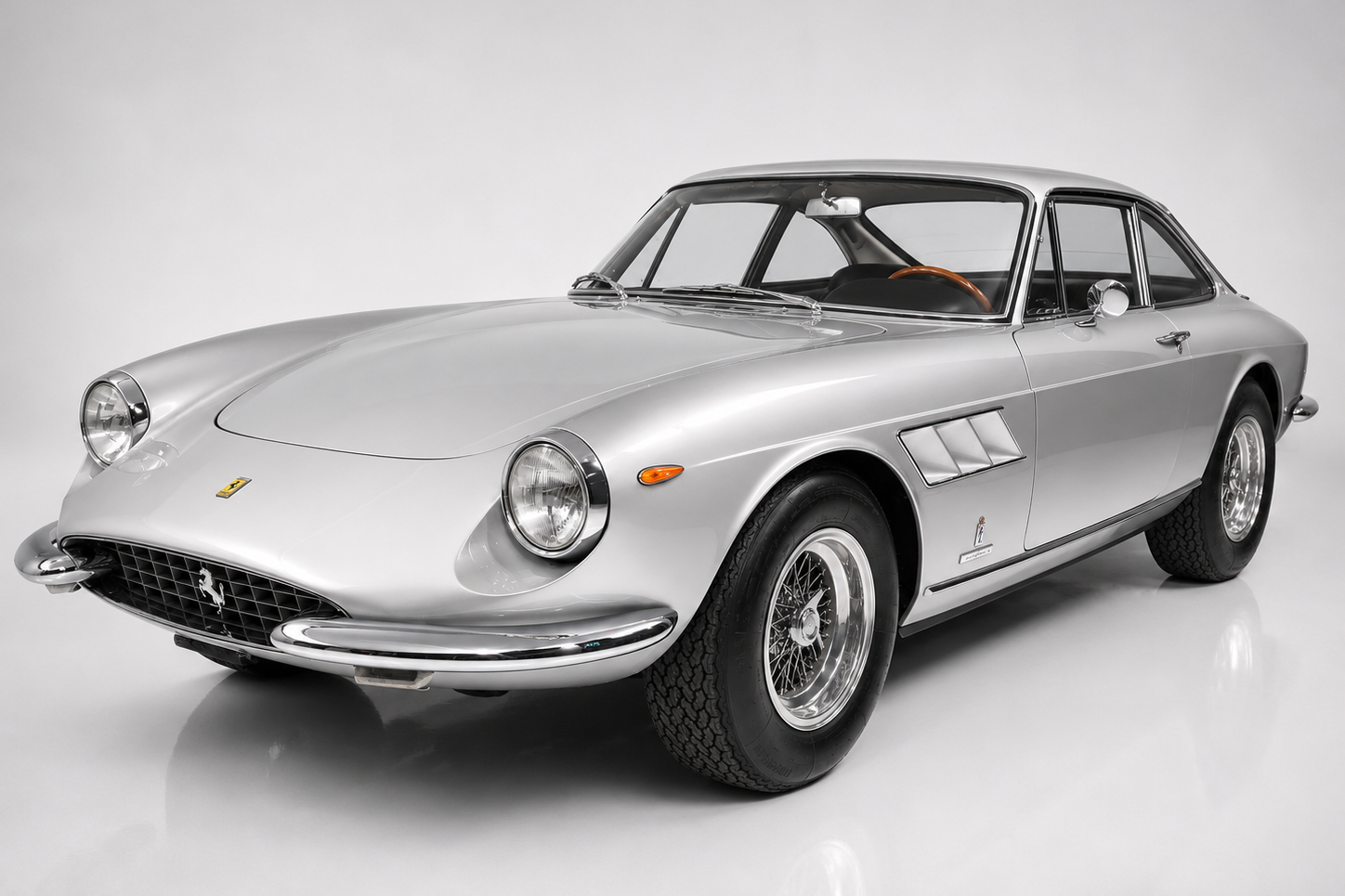
Ferrari's mid-1960s 4.0-litre Colombo-derived V12 family — the 330 America, 330 GT 2+2, and the Pininfarina-bodied 330 GTC and GTS that share their short-wheelbase chassis with the 275 GTB.
The Ferrari 330 designation spans a family of front-engined V12 road cars produced between late 1963 and 1968, all powered by the 4.0-litre Tipo 209 Colombo-derived V12 (300 PS). The family opens with the transitional 330 America of 1963 — 50 LHD cars combining the outgoing 250 GT/E's Pininfarina 2+2 body and four-speed-with-overdrive gearbox with the new 4.0-litre engine — and the four-headlamp 330 GT 2+2 introduced at Brussels in January 1964 with a wheelbase 50 mm longer than the 250 GT/E.
The 2+2 evolved through three sub-variants: a four-speed-plus-overdrive Series I; a short-lived Series I 'Interim' from 1965 with the new five-speed Tipo 571/65 gearbox, hanging pedals and a single Dunlop brake booster; and the two-headlamp Series II from late 1965 with revised bumpers, standard alloy wheels, power windows, optional air-conditioning and power steering. In parallel, at Geneva in March 1966 Ferrari introduced the two-seat 330 GTC berlinetta by Pininfarina, sharing the 2,400 mm short wheelbase of the 275 GTB with a rear-mounted five-speed transaxle; six months later the open 330 GTS Spider joined it at the Paris Salon. Both remained in production until the end of 1968.
The 330 GTC and GTS are the direct short-wheelbase siblings of the 275 GTB — same chassis, same transaxle architecture, same body proportions — but with the more torquey 4.0-litre engine and a materially different ride and refinement character. The 330 GT 2+2 in turn was the volume Ferrari of the mid-1960s and remains the most affordable route into a matching-numbers 1960s V12 front-engined Ferrari. Together the family carries the Colombo lineage from the 250 GT/E to the 365 GT 2+2, 365 GTC and 365 GTC/4 that followed.
Variants
Range and production
Variant
Years
Production
Notes
330 America 2+2 (Pininfarina)
1963
50
Transitional model, all LHD, serial numbers 4953–5125. Combines the outgoing 250 GT/E Series III Pininfarina 2+2 body and 4-speed + overdrive gearbox with the new 4.0-litre Tipo 209 V12. Production of 50 confirmed by the independent 330 GT Registry (330gt.com).
330 GT 2+2 Series I (four-headlamp, 4-speed + overdrive)
1964–1965
503
Tom Tjaarda-designed four-headlamp Pininfarina body, floor-mounted pedals, 4-speed + overdrive gearbox, dual Bonaldi brake boosters. Serial numbers 5263–6883; 453 LHD + 50 RHD per the 330 GT Registry. Some compilations bundle the 124 Interim cars into a rolled-up Series I total of 625 — treat 503 (registry) as the Series I figure and 124 (registry) as the Interim figure separately.
330 GT 2+2 Series I 'Interim' (four-headlamp, 5-speed)
1965
124
Short-run transitional Series I with the new Tipo 571/65 5-speed gearbox, suspended (hanging) pedals eliminating floorboard rust risk, single Dunlop brake booster, hydraulic clutch and wider 7×15" RW 3812 wire wheels. Serial numbers 6911–7547; 115 LHD + 9 RHD per the 330 GT Registry. Only 330gt.com documents this sub-variant discretely.
330 GT 2+2 Series II (two-headlamp, 5-speed)
1965–1967
460
Two-headlamp Pininfarina restyle, 3-piece bumpers, left-side fuel filler, standard alloy wheels (wire optional), standard power windows, optional air-conditioning and power steering. Serial numbers 7553–10193; 424 LHD + 36 RHD per the 330 GT Registry. Sources conflict — the registry (330gt.com) and Gooding & Company's Amelia Island 2025 catalogue (Lot 49) give 460; RM Sotheby's Monterey 2021 catalogue explicitly attributes the 460 total to marque historian Marcel Massini; Ferrari.com's official model page states 474; and one published compilation gives 455. The 330 GT Registry is the primary chassis-by-chassis source and Massini's attribution gives 460 stronger independent authority, so 460 is treated as the preferred figure here.
330 GTC (Pininfarina berlinetta)
1966–1968
598
Two-seat short-wheelbase berlinetta by Pininfarina, sharing the 2,400 mm chassis of the 275 GTB with a rear-mounted 5-speed transaxle. Debuted Geneva March 1966. Sources give 598 (RM Sotheby's Munich 2025 Lot 150 'the 383rd of 598 examples built', and RM Sotheby's Amelia Island 2023 Lot 134 'one of 598 examples built') or 600 (Ferrari.com's official model page, rounded). RM Sotheby's London 2024 (Lot 329) separately confirms 579 built in left-hand drive, implying ~19 RHD.
330 GTC Speciale (Pininfarina one-offs)
1966–1967
4
Four Pininfarina one-off coupés on the 330 GTC chassis blending 365 California and other Pininfarina cues; debuted at the 1967 Brussels and Geneva shows. Original owners included Princess Liliane de Réthy and the wife of Pietro Barilla; chassis 9653 was delivered to Dr Michael DeBakey. Production of 4 confirmed by Gooding & Company's own lot page for the Christie's × Gooding sale of chassis 9653 (goodingco.com / bid.goodingco.com Lot 150).
330 GTS Spider (Pininfarina)
1966–1968
100
Open two-seat Spider on the same short-wheelbase chassis as the GTC; debuted Paris October 1966. Production of 100 confirmed by Bonhams' own lot page for the 2020 Goodwood Speedweek sale of chassis 10113 ('only 100 were produced by the factory between 1966 and 1968'), and RM Sotheby's Arizona 2024 catalogue for chassis 11027 ('number 86 of 100 produced').
Collector Variants
Limited & special editions
The models below represent the most significant limited and special edition variants — factory-produced cars that command meaningful premiums over standard examples and warrant specific attention from serious collectors.
330 LMB (Le Mans Berlinetta) · 1963
4
Distinguishing features
Factory-built competition GT campaigned by Scuderia Ferrari from Sebring 1963. Long-nose Pininfarina/Scaglietti berlinetta body derived from the 250 GTO / 250 Lusso lineage over a Tipo 163 chassis, 4.0-litre Tipo 209 V12 producing approximately 400 hp — effectively the '4-litre GTO' bridging the 250 GTO and 250 P programmes.
Value premium
Museum-grade — trades on a chassis-by-chassis basis in the multi-million range, an order of magnitude above any road-going 330. Public appearances are rare; the four cars are individually tracked.
Inspection points
All four chassis are catalogued in the Ferrari and Barchetta.cc registers. Demand a complete Ferrari Classiche Red Book and continuous ownership / competition file back to 1963.
Authentication
Bodystyle has been recreated on other 330 chassis. Only the four original Tipo 163 LMB chassis numbers are genuine; verify against Ferrari Classiche and the marque registers.
Approx. 14–16 total across the four generations: ~4 x 330 P (1963–64), ~4 x 330 P2 (1965), ~3 x 330 P3 (1966), 3 x 330 P4 plus 1 x P3/4 conversion (1967)
Distinguishing features
Pure factory works endurance-racing prototypes campaigned exclusively by Scuderia Ferrari — never sold as customer cars new (unlike the contemporary 250 LM). 330 P4 achieved the famous 1-2-3 finish at the 1967 Daytona 24 Hours and 1-2 at Monza. Each generation is a distinct chassis and bodyshell — not evolutions of the road cars.
Value premium
Blue-chip works racer market — 330 P4 chassis 0858 sold for approximately $14 million+ (Villa d'Este 2013); subsequent private trades reportedly higher. Not comparable to the road 330 family.
Inspection points
Each car is catalogued individually by chassis; demand full Ferrari Classiche Red Book, period FIA papers and continuous works / privateer history.
Authentication
Several P3/P4 replicas and 412 P conversions exist. Only the original works chassis numbers qualify; verify against Ferrari Classiche and the works race records.
Buyer's Guide
What to look for
Provenance and originality
Start with identity, paperwork and originality. For the Ferrari 330, the strongest cars have a continuous ownership file, matching numbers where applicable, original manuals, invoices and evidence of work by recognised marque specialists. Ferrari Classiche Red Book, matching-numbers engine, gearbox and body (bodies were numbered by Pininfarina on GTC/GTS and Scaglietti-derived Pininfarina designs on the 2+2), original colour combination, complete Marcel Massini history file for GTC/GTS chassis, and correct engine-bay presentation to Pininfarina's 1966 specification.
Mechanical inspection priorities
The Tipo 209 4.0-litre single-cam-per-bank Colombo V12 is a robust design when correctly maintained, but is unforgiving of cooling neglect, worn valve guides, tired distributors and incorrect carburettor synchronisation on the three Weber 40 DFI (2+2) or 40 DCZ/6 (GTC/GTS) carburettors. The five-speed transaxle in the GTC/GTS is a distinct service item from the front-mounted 5-speed in the 2+2 Series I Interim and Series II. A proper pre-purchase inspection includes cold-start behaviour, leak-down or compression testing where appropriate, underbody photography, suspension and chassis-point inspection, brake condition and a road test long enough to expose heat-related faults. Deferred maintenance is almost always more expensive than buying a better-sorted car.
Body, paint and accident history
Use a paint-depth gauge, lift access and a specialist familiar with the model's factory seams and panel gaps. Collector value is dramatically affected by structural repairs, poor paintwork, corrosion, incorrect panels and missing factory trim. Documented cosmetic restoration is acceptable; concealed accident repair must be priced severely.
Specification strategy
For the collector, the 330 GTS Spider (100 built) is the blue-chip open car; the 330 GTC (598 built) is the connoisseur's short-wheelbase coupé; the 330 GT 2+2 Series II with five-speed gearbox and alloy wheels is the most usable and value-accessible entry point; the 330 America and Series I 'Interim' are the rare transitional variants that reward chassis-by-chassis research. Specification, colour, transmission and limited-build variants move values significantly. Buy the best-documented example in the most desirable specification you can justify rather than a tired example of a rarer derivative that will need years of corrective work.
Ownership
Living with it
Typical mileage
1,500–4,000 miles typical for collector use
Service interval
12 months; mileage interval varies by model and use
Annual running cost
$4,000 – $12,000
Fuel economy
15–24 mpg depending on use
Insurance
Use an agreed-value collector policy with limited mileage, secure storage, documented photography and an annual value review. Premiums vary sharply by age, storage location and declared value.
Maintenance planning
Budget annually even if the car is used sparingly. Fluids age, tyres date out, fuel systems suffer from ethanol, batteries fail and stored cars need exercise. A documented maintenance rhythm protects both reliability and resale value.
Parts and specialist access
Front-engined V12 Colombo work belongs with Ferrari Classiche-approved specialists — DK Engineering, GTO Engineering, Bell Sport & Classic, Foreign Cars Italia, Motion Products in the US — rather than general Ferrari garages; incorrect engine-bay re-plating, non-original carburettor jetting, wrong-spec wire wheels and non-Classiche repainted bodies materially depress value at re-sale. Before purchase, confirm parts availability for model-specific trim, suspension, fuel system, electronics and engine components. A cheap car waiting on unobtainable parts is rarely cheap in collector ownership.
Common Problems
Known issues by system
Engine
Tipo 209 V12 valve-guide wear, cooling neglect and carburettor sync
Major$40,000 – $90,000 for a correct Tipo 209 top-end and cooling refresh; $120,000+ for a full rebuild
Symptoms — Blue smoke on start-up and overrun, running hot in traffic, uneven idle across the three Webers, low oil pressure hot.
Inspection — Compression and leak-down test, hot oil-pressure reading, radiator core inspection, carburettor synchronisation on a rolling road, dated evidence of a recent Classiche-grade top-end rebuild.
Body
Sill, floor and A-pillar corrosion behind Pininfarina steel bodywork
Critical$70,000 – $220,000 for correct bare-metal Pininfarina body restoration
Symptoms — Filler visible under paint-depth gauge, misaligned doors and bootlid, bubbling around sill returns, rear-arch corrosion, evidence of poor previous paintwork on the underside.
Inspection — Lift inspection by a Ferrari Classiche-approved bodyshop; paint-depth gauge across every panel; probe sills, floors and A-pillars from underneath; check Pininfarina body number against the AMHT-equivalent Ferrari body register.
Identity
Non-matching engine, gearbox or body — or 'Spider conversion' of a coupé
CriticalPricing impact only — non-matching cars trade at material discount; converted 'GTS' cars are effectively rebodied 330 GTCs
Symptoms — Engine, chassis, gearbox or Pininfarina body-plate numbers that do not agree with Ferrari's factory build sheet or the Marcel Massini history file. Cut-and-shut 'GTS conversions' of 330 GTC coupés circulate; only the 100 genuine GTS chassis numbers are real.
Inspection — Ferrari Classiche Red Book application before deposit; cross-check chassis, engine, gearbox and body numbers against Ferrari's build records and the Massini file; verify against the 330 GT Registry (330gt.com) for 2+2 sub-variant.
Drivetrain
Rear transaxle wear on 330 GTC / GTS
Major$25,000 – $55,000 for a correct GTC / GTS transaxle rebuild
Symptoms — Whine from the rear on overrun, notchy gearchange when hot, oil leakage from the transaxle casing, propshaft vibration.
Inspection — Cold and hot road test, listen for whine on the trailing throttle, evidence of a recent transaxle rebuild by a marque specialist.
Electrics
Marelli distributor / dynamo age-out, Veglia instrumentation and Lucas switchgear
Moderate$5,000 – $18,000 for progressive re-wiring, distributor rebuild and instrument refurbishment
Symptoms — Poor cold-start behaviour, intermittent gauges, dim panel lights, temperamental horns and wipers, hot loom smell in the engine bay.
Inspection — Bench-test major circuits; inspect loom in engine bay; verify Marelli distributor curves and dynamo output; check Veglia gauge sender values.
Brakes / suspension
Dunlop disc wear and tired front suspension bushes
Moderate$4,500 – $14,000 for full front-end and brake refresh
Symptoms — Long pedal travel, pulling under braking, front-end knock over bumps, uneven front tyre wear.
Inspection — Pedal-feel test, disc thickness measurement, wheels-off inspection of front suspension bushes and ball joints.
Provenance
Repainted engine bays, non-original wire wheels, incorrect interior trim
ModeratePricing impact plus $10,000 – $40,000 for correct trim, wheels and engine-bay re-presentation
Symptoms — Over-restored engine-bay presentation, incorrect wheel offsets or wrong-spec Borrani wire wheels, non-original leather grain or dash veneer.
Inspection — Reference photographs from Pininfarina archive or the Massini file; check Borrani wheel date stamps and RW part numbers against build date.
Auctions
Recent results
Date
Auction
Car
Mileage
Result
2025-11-22
RM Sotheby's
Munich 2025, Lot 150
1968 330 GTC by Pininfarina (chassis 10841, matching-numbers engine and gearbox, 2025 engine rebuild, Grigio Fumo, Ferrari Classiche certified, ex-Fritz Kroymans collection)
Catalogue copy states '383rd of 598 examples built'.
—
€466,250
Sold
2025-08-16
RM Sotheby's
Monterey 2025, Lot 230
1966 330 GT 2+2 Series II by Pininfarina (chassis 8551, Verde Pino, Borrani wire wheels, German first delivery)
Catalogue copy states 'one of 474 Series II examples' — see Variants for the 460 vs 474 discrepancy.
1966 330 GT 2+2 Series II by Pininfarina (chassis 8639, matching-numbers engine, Luigi Chinetti US delivery, 330 GT Registry documented, sold without reserve)
Catalogue copy states 'one of just 460 Series II examples built'.
—
$296,500
Sold
2024-11-01
RM Sotheby's
London 2024, Lot 329
1966 330 GTC by Pininfarina (chassis 8873, matching-numbers engine, Swiss first delivery, believed 25th GTC built)
—
£376,250
Sold
2024-09-06
RM Sotheby's
Cliveden House 2024, Lot 309
1967 330 GTS by Pininfarina (chassis 10845, matching-numbers engine, offered from The Dee Collection)
—
£1,242,500
Sold
2024-08-16
Bonhams
The Quail Auction 2024, Lot 154
1967 330 GTC by Pininfarina (chassis 10007, matching-numbers engine)
Result inclusive of buyer's premium.
—
$692,500
Sold
2024-01-25
RM Sotheby's
Arizona 2024, Lot 117
1966 330 GT 2+2 Series II by Pininfarina (chassis 8487, matching-numbers engine, gearbox 70/66, body 519)
—
$346,000
Sold
2023-08-19
RM Sotheby's
Monterey 2023, Lot 328
1967 330 GTS by Pininfarina (chassis 10359, matching-numbers engine)
—
$2,975,000
Sold
2023-08-18
Bonhams
The Quail Auction 2023, Lot 56
1966 330 GT 2+2 Series II (chassis 8947, matching-numbers engine, sold without reserve)
Result inclusive of buyer's premium.
—
$357,000
Sold
2023-03-04
RM Sotheby's
Amelia Island 2023, Lot 134
1967 330 GTC by Pininfarina (chassis 10927, matching-numbers engine, 2023 engine rebuild in Italy)
—
$610,000
Sold
Investment
Long-term outlook
Strong HoldHorizon: 5–10 years
The 330 GTC and GTS are established blue-chip 1960s V12 Ferraris and should hold their positions long-term, but Hagerty's US Price Guide has printed a –19.6% YoY move on the 1967 GTC and both unsold 2024–2025 GTS consignments suggest the market is currently selective on condition, provenance and Ferrari Classiche certification. Correctly-restored matching-numbers GTC and GTS examples with full Massini history files should lead any recovery, and the 330 GT 2+2 remains the accessible entry into a 1960s V12 Ferrari — a Series II with 5-speed, alloy wheels and Classiche Red Book at $300,000–$470,000 is materially better value per pound of engineering than a comparable 250 GT/E or 365 GT 2+2. The 330 GTC Speciale, 330 LMB and works 330 P-series prototypes trade in an entirely different market and are covered under Collector Variants.
Our view, not advice. This section is Car Collector International's editorial judgement on where this model sits in the collector market, based on the production, specification and market data set out in this guide. It is not a recommendation to buy or sell and it is not investment advice. Values can fall as well as rise.