
Car Collector International
Classic · 1964–1966

Ferrari 500 Superfast

Maranello's mid-1960s flagship two-seater V12 — 36 cars, 5-litre Colombo-lineage V12, Pininfarina bodywork over a Scaglietti-completed shell.

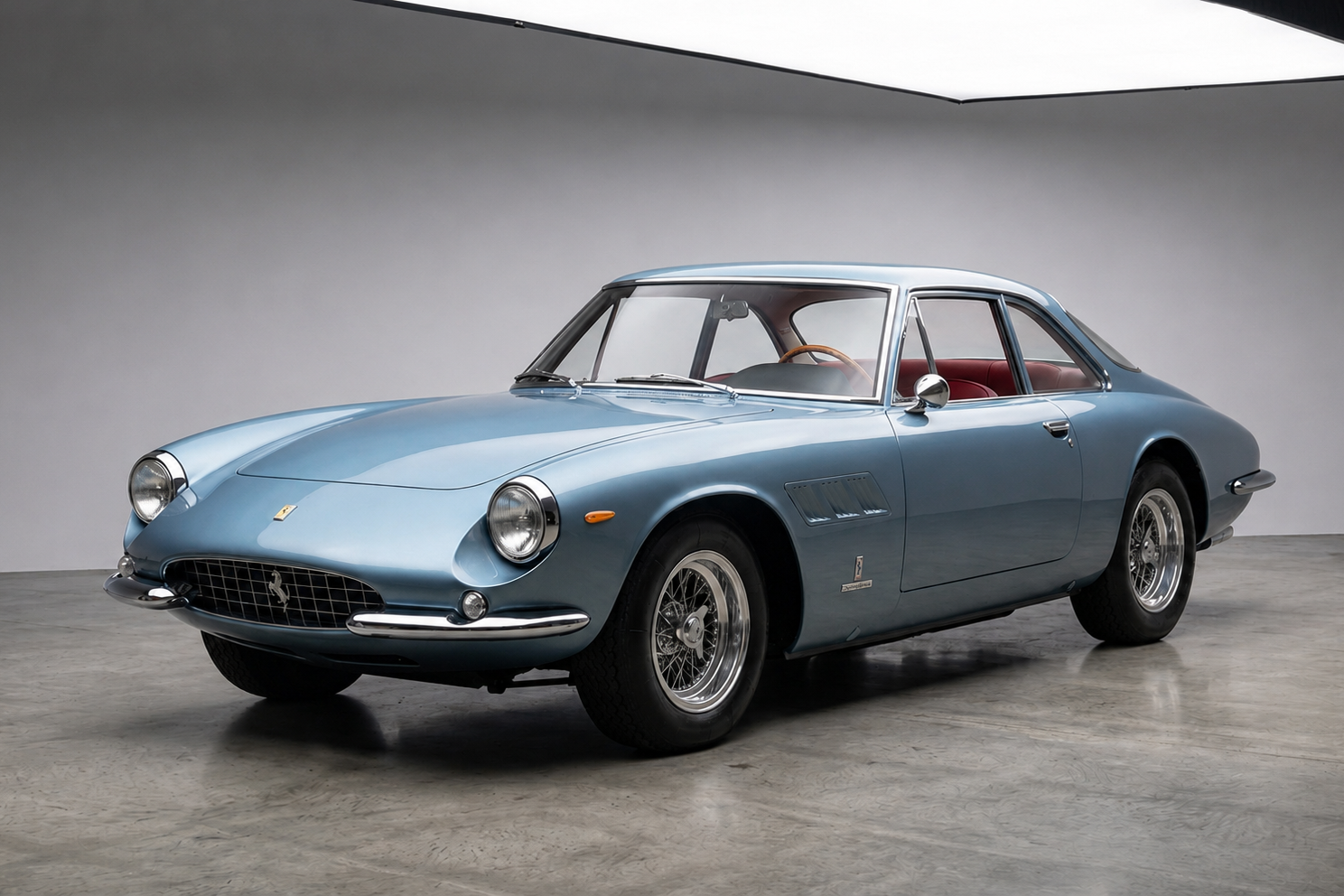
Ferrari 500 Superfast, front three-quarter view — Pininfarina-designed 1964–1966 front-engined V12 Maranello flagship grand tourer in metallic Azzurro over red leather, wire wheels and covered-headlamp nose set against a plain studio backdrop.
Overview

Why this car matters

Introduced at the 1964 Geneva Motor Show and produced in a strictly limited run through 1966, the Ferrari 500 Superfast sat at the very top of Maranello's early-1960s road-car range. Beneath the elegant Pininfarina bodywork — a two-seater fastback with a covered-headlamp nose, a long bonnet and a discreet Kamm-influenced tail — lay a lengthened 330 GT-style tubular chassis and a 4,962 cc V12 developed on the Colombo/Lampredi lineage and producing a nominal 400 PS. Only 36 examples were built across two short factory series, sold to a small cohort of well-known clients that included Peter Sellers, the Shah of Iran and Prince Bernhard of the Netherlands.

The 500 Superfast is the direct spiritual successor to the 400 Superamerica and the model that anchored the very top of Ferrari's road-car offering during the 1964–1966 window — a two-seater flagship positioned distinctly above the 330 GT 2+2 and priced accordingly at introduction. Every car was hand-completed by Scaglietti on a Pininfarina design, powered by a unique 4,962 cc V12 that married Lampredi long-block bore spacing to Colombo short-block heads — an architecture used in no other Ferrari — and sold in numbers that meant the model was effectively bespoke: the 36-car total is firm, but the factory split is cited as either 25 Series I and 11 Series II, or 24 Series I and 12 Series II, with the Series II carrying the all-synchromesh five-speed gearbox. A matching-numbers 500 Superfast with a Ferrari Classiche Red Book is a marque-heritage entry point into the pre-Daytona Ferrari flagship line and one of the rarest series-production front-engined V12 road cars Ferrari ever built.

Variants

Range and production

VariantYearsProductionNotes
500 Superfast Series I1964–196525The first factory series, powered by the unique 4,962 cc 'tipo 208' V12 — a Lampredi long-block bore spacing with Colombo short-block heads, an architecture used in no other Ferrari — rated at approximately 400 PS at 6,500 rpm, and equipped with a 4-speed manual gearbox with electric overdrive on top gear. The 36-car aggregate total is firm, but the Series I / Series II sub-split is disputed: sources cite either 25 Series I plus 11 Series II, or 24 Series I plus 12 Series II, both reconciling to 36. A separate minority 37-car total appears in some marque references and is flagged as unresolved.
500 Superfast Series II196611The definitive short-run subseries, produced in 1966 with the all-synchromesh five-speed manual gearbox that replaced the Series I's four-speed-and-overdrive layout, plus revised interior detailing and detail body changes. The 36-car aggregate total is firm, but the Series II count is disputed between 11 and 12 cars (with Series I correspondingly 25 or 24); both splits reconcile to 36. Rarer than any single-year 250-series road Ferrari, and the reference gearbox specification for the model. Verify individual chassis histories against Ferrari Classiche before use as an anchor.
Collector Variants

Limited & special editions

The models below represent the most significant limited and special edition variants — factory-produced cars that command meaningful premiums over standard examples and warrant specific attention from serious collectors.

500 Superfast Series II (1966) — all-synchromesh 5-speed subseries · 1966

11 or 12 (of 36 total; sources differ)
Distinguishing features
Definitive short-run subseries produced in 1966, distinguished from the Series I by the adoption of an all-synchromesh five-speed manual gearbox in place of the Series I's four-speed with electric overdrive, plus revised interior detailing and detail body changes. The 36-car aggregate total is firm, but the Series II count is disputed between 11 and 12 cars (with Series I correspondingly 25 or 24); both splits reconcile to 36. The reference gearbox specification for the model.
Value premium
Trades at a distinct premium above matching-numbers Series I cars in comparable condition — the small disputed Series II count is the defining scarcity item at the top of the 500 Superfast market band regardless of whether 11 or 12 is accepted. Concours Series II examples with a Ferrari Classiche Red Book are the top-of-market target.
Inspection points
Verify Series II gearbox against the Ferrari Classiche Red Book — a Series I chassis fitted with a later 5-speed is NOT a Series II. Inspect synchromesh engagement across all gears from cold; verify Series II-specific interior detailing and detail body changes against a marque-recognised reference; verify chassis and engine numbers against the Classiche entry.
Authentication
Series II status must be documented against the Ferrari Classiche Red Book — the chassis-number range, gearbox type and detail body / interior specification must all reconcile. Any car presented as a Series II without a Classiche entry that confirms all three is treated as unverified and priced against the cost and time of a full Classiche review.

Production figures sourced from official marque records and specialist registers. Verify chassis documentation with the relevant marque register before purchase.

Buyer's Guide

What to look for

Matching-numbers V12 and Ferrari Classiche Red Book

The single most important structural check on any 500 Superfast is whether it retains its original, matching-numbers 4,962 cc 'tipo 208' V12 and whether the chassis and engine numbers are documented in a Ferrari Classiche Red Book. Cross-check every plate and stamping against the Classiche entry; the top of the market is anchored on a matching-numbers, Classiche-certified car in the correct series specification. A 500 Superfast fitted with a period replacement V12, or a car whose engine has been rebuilt with non-original internals, sits at a distinct discount to a matching-numbers original and must be priced against a documented Classiche review rather than owner representation.

Series I vs Series II — gearbox specification is the reference distinction

The single most-cited technical distinction between the two factory series is the gearbox: the Series I uses a 4-speed manual with electric overdrive on top gear, while the Series II adopts an all-synchromesh 5-speed. Verify the gearbox specification against the chassis' factory build sheet — a Series I chassis fitted with a later 5-speed, or a Series II chassis with a non-original replacement box, is a documented paperwork item that materially affects the top of the market band. Inspect synchromesh engagement (particularly on the middle gears), shift-linkage wear, gearbox oil weep and clutch bite-point on any car regardless of series.

Pininfarina / Scaglietti bodyshell condition and coachwork paperwork

The 500 Superfast body was designed by Pininfarina and hand-completed by Scaglietti at Modena, and all 36 cars are hand-built to 1960s Italian coachwork standards. Priority inspection points are the sills, floor pans (particularly at the driver's footwell), front and rear inner wheel-arches, the front-boot compartment floor, the covered-headlamp nose panels and the doorframe seams. Any weld work, panel replacement or partial re-shell must be paperwork-supported by a marque-recognised specialist and reviewed against the Classiche Red Book — undocumented panel work at the nose or sills is the single most common value-destroying finding on a car of this era.

V12 service history — three Weber carburettors and single-cam-per-bank top end

The 4,962 cc V12 is a technically demanding engine to keep in specification. It runs three Weber twin-choke carburettors, requires balanced and correctly-jetted carburettor setup, and the single-overhead-cam-per-bank top end is intolerant of deferred cam-cover, valve-clearance and timing-chain service. Any 500 Superfast without a documented recent V12 service history at a Ferrari Classiche-recognised specialist should be inspected on the assumption that a full top-end service and carburettor rebalance is required before regular use. Compression and leak-down testing across all twelve cylinders is a non-negotiable PPI item.

Interior originality — Pininfarina cabin, seats, dashboard, gauges

Original correct interior specification is a distinct value item. Retrimmed seats, replacement dashboards, non-original steering wheels and replacement instrument clusters are common on cars that have passed through multiple owners, and each materially downgrades a matching-numbers car. Verify original trim specification against Classiche documentation where possible; inspect the piping, door cards and instrument-cluster faces against factory specification, and treat any change from the original build-sheet colour combination as a paperwork item.

Pre-purchase inspection at a Ferrari Classiche-recognised specialist

PPI must be conducted by a Ferrari Classiche-recognised marque specialist — Ferrari Classiche (Maranello), GTO Engineering (UK), DK Engineering (UK), Bell Sport & Classic (UK), Kessler Automotive (Germany) or a comparable West Coast US specialist (Symbolic International, Canepa, Fantasy Junction). Insist on: full compression / leak-down test on the V12, borescope inspection of the cylinder heads and cam housings, a complete underbody survey on a two-post lift, paint-depth-gauge readings across every panel, verification of chassis and engine numbers against Ferrari Classiche records, and a documented review of the V12 top-end service history.

Insurance, storage and event access

A matching-numbers Classiche-certified 500 Superfast is a natural agreed-value classic-policy car with Hagerty, Chubb Masterpiece or a comparable HNW carrier. Museum-grade climate-controlled storage is the standing reference. Event access includes the Cavallino Classic (Palm Beach), Ferrari Owners' Club events (national and international), Concorso d'Eleganza Villa d'Este, Pebble Beach Concours d'Elegance classes for post-war Ferrari coachwork, and Ferrari Classiche-recognised concours entries at Maranello heritage weekends.

Pricing

What to pay

Concours — matching-numbers 500 Superfast Series II (1966, 5-speed) with Ferrari Classiche Red Book, original factory colour combination and single-marque ownership chain
USDUSD $2,600,000 – $3,800,000+ auction / private-treaty basis. Reflects the disputed-but-small Series II production count (cited as 11 or 12 cars) and Classiche certification against the small pool of publicly-transacted Series II cars over the past decade.
GBPGBP £2,100,000 – £3,100,000 dealer-listed basis at UK Ferrari specialists. Authored independently per region — NOT FX-converted; anchored on typical UK dealer asking prices for concours 500 Superfast examples at review date.
EUREUR €2,500,000 – €3,600,000 dealer-listed basis at continental European Ferrari specialists. Authored independently per region — NOT FX-converted; anchored on typical continental European dealer asking prices for concours 500 Superfast examples at review date.
Basis: authored independently per region — NOT FX-converted. Top of the market is a matching-numbers Series II in an original factory colour combination with a Ferrari Classiche Red Book, an unmolested Pininfarina / Scaglietti bodyshell, correct interior specification and a single-marque ownership chain. The small disputed Series II count — 11 or 12 cars within the firm 36-car total — is the defining scarcity item at the top of the band.
Excellent — matching-numbers 500 Superfast Series I (1964–1965, 4-speed with overdrive) with Ferrari Classiche Red Book, running and driving, cosmetically presentable
USDUSD $1,900,000 – $2,700,000 auction / private-treaty basis. Anchored against the standing public-print band for matching-numbers Series I examples at reference international auction houses.
GBPGBP £1,500,000 – £2,200,000 dealer-listed basis. Authored independently per region — NOT FX-converted.
EUREUR €1,800,000 – €2,600,000 dealer-listed basis. Authored independently per region — NOT FX-converted.
Basis: authored independently per region — NOT FX-converted. The volume band for a genuinely useable, correctly-configured Series I. Specific price is a function of engine originality, paint / trim condition, colour-combination correctness and documentation depth.
Good — driver-quality 500 Superfast with cosmetic needs, minor non-original changes or long-term-stored condition, matching-numbers engine
USDUSD $1,400,000 – $1,900,000 auction / private-treaty basis. Sensible entry point for a running-driving matching-numbers car requiring sympathetic recommissioning.
GBPGBP £1,100,000 – £1,500,000 dealer-listed basis. Authored independently per region — NOT FX-converted.
EUREUR €1,300,000 – €1,800,000 dealer-listed basis. Authored independently per region — NOT FX-converted.
Basis: authored independently per region — NOT FX-converted. Any car in this band will typically require near-term V12 top-end service, brake and suspension recommissioning and a full Classiche review — the delta to the excellent band consistently reflects the specialist-labour budget required to move the car up.
Fair / Project — long-term-stored or partly-restored 500 Superfast requiring full recommissioning, incomplete paperwork, or non-matching engine
USDUSD $800,000 – $1,400,000 auction / private-treaty basis. Projects with a matching-numbers V12 and documented chassis history sit at the top of the band; projects with a non-matching engine, major paperwork gaps or partial re-shell work sit at the bottom.
GBPGBP £650,000 – £1,100,000 auction / private-treaty basis. Authored independently per region — NOT FX-converted.
EUREUR €750,000 – €1,300,000 auction / private-treaty basis. Authored independently per region — NOT FX-converted.
Basis: authored independently per region — NOT FX-converted. Any 500 Superfast in this band should be priced against a documented recommissioning budget from a Ferrari Classiche-recognised specialist — a full V12 top-end refresh plus body-and-paint restoration will typically consume a material portion of the excellent-band premium.

Regional ranges authored independently — each reflects its local market, not an FX conversion

Ownership

Living with it

Typical mileage
500–2,000 miles / 800–3,200 km typical — the 500 Superfast is a genuinely useable early-1960s Ferrari flagship GT but real-world touring mileage is constrained by the V12 top-end service regime and the model's absolute rarity.
Service interval
Annual service at a Ferrari Classiche-recognised marque specialist. Three-Weber carburettor rebalance, valve-clearance check and cam-cover inspection are the standing recurring items; a full V12 top-end service is a periodic non-negotiable at extended calendar intervals even at low mileage.
Annual running cost
USD $10,000 – $25,000+ typical annual budget — dominated by specialist labour, V12 top-end reserve and any bodywork or paint rectification. Cars used at Cavallino Classic, Villa d'Este or Pebble Beach widen the annual budget materially.
Fuel economy
~10–13 mpg (US) / ~12–16 mpg (imp) / ~18–24 L/100 km on real-world use.
Insurance
Agreed-value classic-policy cover through Hagerty, Chubb Masterpiece or a comparable HNW carrier is the standing channel; annual policies for a matching-numbers Classiche-certified 500 Superfast are typically mid- to high-four-figure and up depending on stated agreed value.

Ferrari Classiche-recognised specialist network — the standing reference

Route all major work through a Ferrari Classiche-recognised marque specialist (Ferrari Classiche at Maranello, GTO Engineering, DK Engineering, Bell Sport & Classic, Kessler Automotive, Symbolic International, Canepa or Fantasy Junction). Independent generalist workshops are not the reference for a matching-numbers 500 Superfast.

Ferrari Classiche Red Book documentation

For any car being bought or sold above the driver-quality band, a Ferrari Classiche Red Book is the standing marque-heritage document and a material transaction requirement. Classiche verifies chassis and engine numbers, original colour combination and original mechanical specification against factory records at Maranello.

V12 top-end service reserve — build into the annual running-cost budget

The single-cam-per-bank V12 top-end service is the defining scheduled item on any 500 Superfast. Build a top-end service reserve into the annual running-cost budget rather than treat it as a one-off event.

Common Problems

Known issues by system

V12 top-end service — three Weber carburettors and single-cam-per-bank valve train

The 4,962 cc V12 is technically demanding to keep in specification. Deferred top-end service, carburettor imbalance and valve-clearance drift are the defining preventable failure modes on the model.

CriticalUSD $12,000 – $35,000+ for a full V12 top-end service and carburettor rebuild at a marque specialist.
Symptoms — Uneven idle when warm, cold-start hesitation, exhaust-note imbalance across cylinder banks, oil weep from the cam covers, low compression on individual cylinders.
Inspection — Documented V12 top-end service history at a Ferrari Classiche-recognised specialist; full compression and leak-down test across all twelve cylinders at PPI; carburettor-balance and jetting inspection.
Bodyshell corrosion — 1960s Pininfarina / Scaglietti coachwork condition

The 500 Superfast is a hand-built 1960s Italian coachwork car without full modern rustproofing. Priority hotspots are the sills, floor pans, front-boot floor, inner wheel-arches, covered-headlamp nose panels, doorframe seams and rear valance.

CriticalUSD $40,000 – $150,000+ for correctly-executed panel and structural work at a marque-recognised specialist. A full concours-standard shell restoration can approach the market value of a driver-quality car.
Symptoms — Bubbling paint at sill / A-pillar / rear arch; weld splatter or thick underseal on the inner longitudinals; evidence of repaint at the front-boot floor, engine-bay bulkhead or covered-headlamp nose panels; uneven panel gaps.
Inspection — Full underbody survey on a two-post lift; paint-depth-gauge readings across every panel; borescope inspection of the inner longitudinals; verification of any prior weld or panel work against paperwork from a marque-recognised specialist and against the Classiche Red Book.
Matching-numbers V12 — replacement engines and cross-model swaps

A proportion of the surviving 500 Superfast population has been fitted with a non-original engine at some point in its ownership chain, either from period replacement V12s or from later 330-series donor engines. None carry the matching-numbers premium of an original correct-spec 'tipo 208' V12.

MajorUSD $80,000 – $200,000+ for a full V12 rebuild at a marque specialist. Sourcing a correct matching-numbers replacement 'tipo 208' V12 is a distinct and material market exercise on its own.
Symptoms — Engine number does not match the Ferrari Classiche entry; incorrect carburettor specification for the stated series; block casting date incompatible with the chassis build date.
Inspection — Cross-check the engine number against Ferrari Classiche; verify block casting date against the chassis build date; verify correct carburettor specification for the series (Series I vs Series II).
Gearbox — 4-speed with overdrive (Series I) vs 5-speed all-synchro (Series II)

Series I uses a 4-speed manual with electric overdrive on top gear; Series II adopts an all-synchromesh 5-speed. Correct-series gearbox retention is a distinct value item on either subseries.

ModerateUSD $10,000 – $30,000 for a full gearbox rebuild at a marque specialist; overdrive-specific electrical work on Series I cars is a distinct additional line item.
Symptoms — Notchy or baulky synchro engagement, shift-linkage slop, transmission oil weep, non-functional overdrive circuit on Series I cars, non-original replacement gearbox referenced in the paperwork.
Inspection — Full gearbox inspection at PPI; verify correct-series gearbox against Ferrari Classiche documentation; inspect synchro engagement across all gears from cold; verify Series I overdrive circuit operation.
Electrical system — 1960s Italian wiring loom, corrosion at connector blocks

The 500 Superfast's 1960s Italian wiring loom is a well-documented intermittent-fault source. Corrosion at connector blocks (behind the dashboard, at the covered-headlamp bowls and at the engine-bay bulkhead) is common on cars that have been long-term-stored.

ModerateUSD $5,000 – $18,000 for a full loom recondition or partial rewire at a marque specialist.
Symptoms — Intermittent headlamp operation, dashboard-instrument fluttering, gauges falling in and out of calibration, non-functional accessory circuits, intermittent overdrive engagement on Series I cars.
Inspection — Full electrical inspection at a marque specialist; inspection of connector blocks for corrosion; verification of instrument-cluster function against the original factory schematic.
Interior originality — Pininfarina cabin, seats, dashboard, gauges

Original correct interior specification is a distinct value item. Retrimmed seats, replacement dashboards and non-original steering wheels are common on cars that have been through multiple owners and materially downgrade a matching-numbers car.

MinorUSD $10,000 – $30,000 for correct-specification interior sourcing and refit at a marque specialist.
Symptoms — Non-original seats or seat piping, non-original steering wheel, retrimmed dashboard, non-original door cards, replacement instrument cluster.
Inspection — Verify original trim specification against Ferrari Classiche data; inspect seat piping, door-card grain and dashboard trim against factory specification.
Valuation

Current value bands by region

Concours
USD
USD $2,600,000 – $3,800,000+ (matching-numbers Series II, Classiche Red Book, factory colour)
GBP
GBP £2,100,000 – £3,100,000
EUR
EUR €2,500,000 – €3,600,000
+3% 12-mo
Excellent
USD
USD $1,900,000 – $2,700,000 (matching-numbers Series I, Classiche, running, presentable)
GBP
GBP £1,500,000 – £2,200,000
EUR
EUR €1,800,000 – €2,600,000
+2% 12-mo
Good
USD
USD $1,400,000 – $1,900,000 (driver-quality, cosmetic needs, service due)
GBP
GBP £1,100,000 – £1,500,000
EUR
EUR €1,300,000 – €1,800,000
0% 12-mo
Fair
USD
USD $1,000,000 – $1,400,000 (paperwork gaps, non-original changes)
GBP
GBP £800,000 – £1,100,000
EUR
EUR €950,000 – €1,300,000
0% 12-mo
Project
USD
USD $700,000 – $1,100,000 (long-term-stored, recommissioning case-by-case; non-matching engine at bottom of band)
GBP
GBP £560,000 – £900,000
EUR
EUR €650,000 – €1,050,000
0% 12-mo

Each region quoted in its local currency — independent market readings, not FX conversions

The 500 Superfast sits in the pre-Daytona Ferrari flagship band alongside the 400 Superamerica that preceded it and the 365 California that overlapped it — a two-seater, front-engined V12 grand tourer built in numbers that would today qualify as bespoke. The 36-car total across the 1964–1966 window is firm and puts the model inside the rarest tier of series-production road Ferraris of the era; the Series II subseries is cited as either 11 or 12 cars and is the defining scarcity item at the top of the band regardless of which split is accepted. Public secondary-market prints for matching-numbers Series I and Series II examples at reference international auction houses have consistently landed in the USD $1.9M–$3.0M+ band across the past decade, with Series II cars and Classiche-certified concours examples trading at a distinct premium to Series I driver-quality cars. Practical market read: a matching-numbers Series II with a Ferrari Classiche Red Book in an original factory colour combination is the collector target; a matching-numbers Series I with the same documentation is the volume band for genuine collectors of pre-Daytona flagship Ferraris; and any car without a Classiche Red Book — regardless of presentation — must be priced against the cost and time of a full Classiche review before use as a market anchor.

Auctions

Recent results

DateAuctionCarMileageResult
2019-08-16
Gooding & Company
Pebble Beach 2019 (Monterey Car Week)
1965 Ferrari 500 Superfast Series I (matching-numbers, Classiche-certified)
Reference public-print band for a matching-numbers Ferrari-Classiche-certified Series I car at a Monterey Car Week sale. CCI has NOT independently re-fetched the specific Gooding lot page during this review — the entry is cited from widely-referenced public marque literature and should be verified against the specific lot record at goodingco.com before use as a firm market anchor.
USD $2,700,000+ (public-print band)
Sold
2017-05-27
RM Sotheby's
Villa Erba 2017 (Lake Como)
1965 Ferrari 500 Superfast Series I (matching-numbers)
Reference public-print band for a matching-numbers Series I car at RM Sotheby's Villa Erba sale. CCI has NOT independently re-fetched the specific RM Sotheby's lot page during this review — the entry is cited from widely-referenced public marque literature and should be verified against the specific lot record at rmsothebys.com before use as a firm market anchor.
EUR €2,000,000+ (public-print band)
Sold
2015-08-15
RM Sotheby's
Monterey 2015
1964 Ferrari 500 Superfast Series I (matching-numbers)
Reference public-print band for a matching-numbers Series I car at RM Sotheby's Monterey sale. CCI has NOT independently re-fetched the specific RM Sotheby's lot page during this review — the entry is cited from widely-referenced public marque literature and should be verified against the specific lot record at rmsothebys.com before use as a firm market anchor.
USD $2,000,000+ (public-print band)
Sold

The results above are cited from widely-referenced public marque literature covering Ferrari 500 Superfast sales at reference international auction houses. CCI has NOT independently re-fetched the individual auction-house lot pages for these results during this specific review — each entry should be verified against the specific lot record at the naming auction house before use as a firm market anchor. The 500 Superfast trades in a low-volume, high-value band and any current transaction is a bespoke exercise: pricing must be built from a Ferrari Classiche Red Book, primary chassis history and direct inspection at a marque-recognised specialist rather than from secondary auction reporting.

Investment

Long-term outlook

Blue ChipHorizon: 10+ years

Three factors underwrite the 500 Superfast investment case. First, absolute scarcity: 36 cars across the entire two-year production window, with the Series II subseries cited as just 11 or 12 cars depending on the source — either way, one of the smallest series-production totals in Ferrari's post-war road-car history. Second, the model's founding position at the top of Ferrari's early-1960s road-car range as the direct successor to the 400 Superamerica and the flagship two-seater V12 GT of the pre-Daytona era, hand-completed by Scaglietti on a Pininfarina design, powered by a unique 4,962 cc V12 that married Lampredi long-block bore spacing to Colombo short-block heads, and sold to a small cohort of well-known clients including Peter Sellers, the Shah of Iran and Prince Bernhard of the Netherlands. Third, a decade of consistent public prints in the USD $1.9M–$3.0M+ band at reference international auction houses, providing a well-established multi-million-dollar market floor for matching-numbers, Classiche-certified examples. Best hold: a matching-numbers Series II in a documented factory colour combination with a Ferrari Classiche Red Book, single-marque ownership chain and an unmolested Pininfarina / Scaglietti bodyshell. Watch items over the horizon: whether a Classiche-certified Series II clears the USD $3.5M print in the next 24–36 months, and whether any of the notable-provenance cars (Peter Sellers, Shah of Iran, Prince Bernhard) return to the public market — a print for either would reprice the top of the band materially.

Recommended

The trusted network

Specialists

  • Ferrari Classiche
    View →
    Maranello, Italy
    Ferrari's factory heritage division — the standing marque-heritage channel for 500 Superfast Red Book certification, chassis-and-engine number verification and original-specification confirmation.
  • GTO Engineering
    View →
    UK
    UK Ferrari Classiche-recognised specialist appropriate to 500 Superfast service, restoration and PPI work.
  • DK Engineering
    View →
    UK
    UK Ferrari specialist and dealer appropriate to 500 Superfast private-treaty transactions, PPI and mechanical service.
  • Bell Sport & Classic
    View →
    UK
    UK Ferrari specialist and restorer appropriate to 500 Superfast restoration and long-term-service programmes.
  • Kessler Automotive
    View →
    Germany
    Continental European Ferrari specialist appropriate to 500 Superfast restoration, service and European private-treaty transactions.
  • Symbolic International
    View →
    La Jolla, California, USA
    US supercar dealer with a long-standing 1960s Ferrari V12 reference book; appropriate to 500 Superfast private-treaty transactions in the US market.
  • Canepa
    View →
    Scotts Valley, California, USA
    US collector-supercar workshop and dealer; appropriate to 500 Superfast mechanical restoration, service and PPI work on the US West Coast.
  • Fantasy Junction
    View →
    Emeryville, California, USA
    US Ferrari dealer with a long-standing pre-Daytona reference book; appropriate to 500 Superfast private-treaty transactions in the US market.
  • RM Sotheby's / Gooding & Company / Bonhams / Broad Arrow Auctions
    View →
    International
    Reference international auction houses appropriate to a top-condition matching-numbers Ferrari 500 Superfast Series I or Series II.
  • Hagerty
    View →
    USA / UK / EU
    Agreed-value cover for 1960s Ferrari V12 grand tourers.
  • Chubb Masterpiece
    View →
    USA / International
    HNW carrier familiar with matching-numbers 1960s Ferrari V12 GT risks in a broader collection context.

Storage

  • Windrush Car Storage
    View →
    London / Cotswolds, UK
    Climate-controlled UK storage appropriate to a 1960s Ferrari front-engined V12 GT.
  • Autobahn Indoor Storage
    View →
    Chicago / Dallas / West Palm Beach, USA
    Climate-controlled US collector-car storage appropriate to a matching-numbers 1964–1966 Ferrari 500 Superfast.

Transport

  • CARS UK
    View →
    UK / EU
    Enclosed European transport for 1960s Ferrari V12 GTs.
  • Reliable Carriers
    View →
    USA (nationwide)
    Enclosed US collector-car transport — standing reference carrier for 1960s Ferrari front-engined V12 coachbuilt cars.

Enjoyed this guide?

Get new buyer's guides and collector market intelligence delivered to your inbox. No spam. We respect your inbox.

The valuation figures in this guide are for research purposes only and do not constitute financial or investment advice. See our full disclaimer.