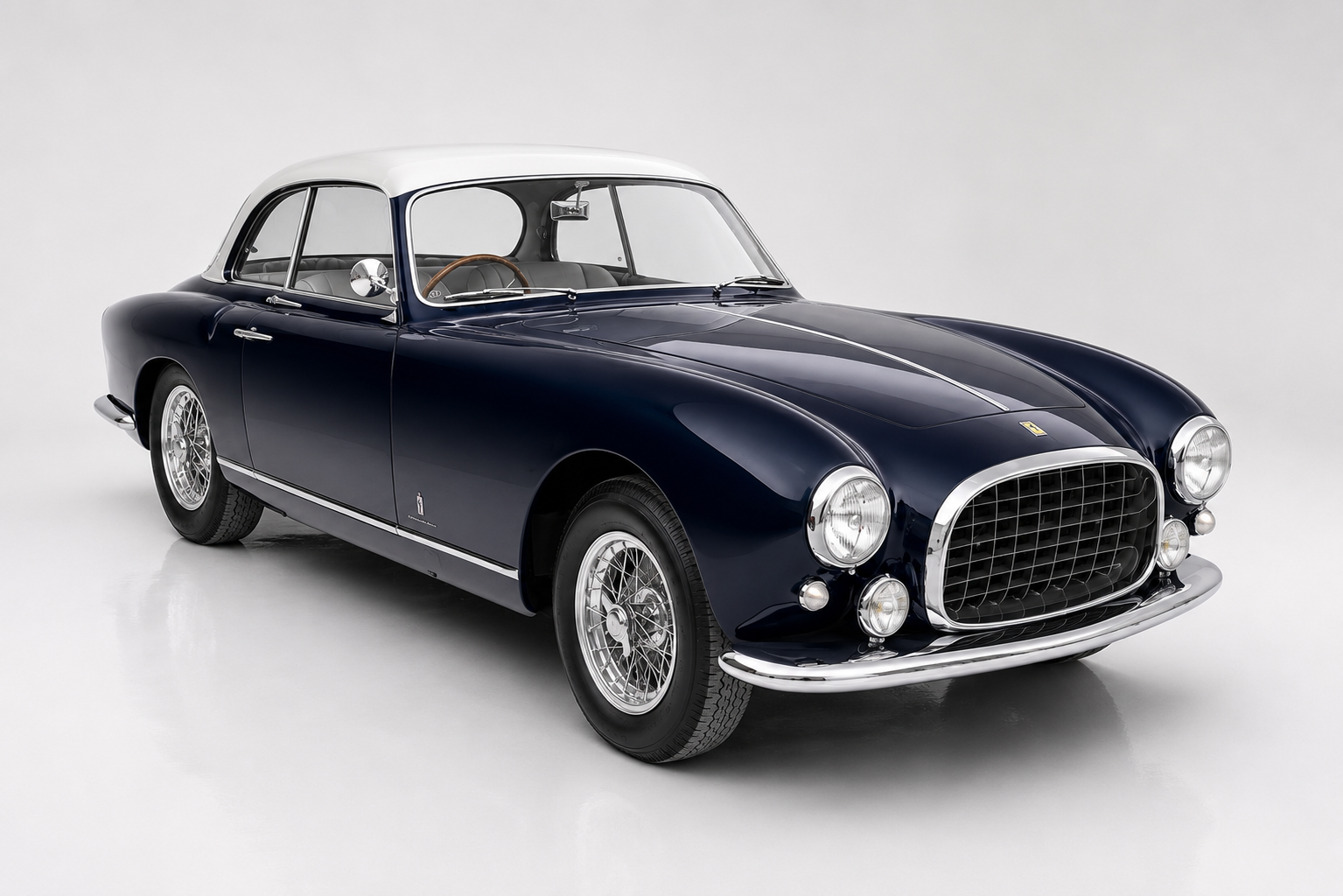
The 212 Inter replaced both the 166 and 195 Inter as Ferrari's road-car offering. It was the most prolific of Ferrari's early production cars, with the widest range of body styles — berlinetta, cabriolet and coupé — and drew work from Touring, Ghia, Ghia-Aigle, Vignale, Stabilimenti Farina, Motto and Fontana. Vignale bodied the largest share.
It was also the first Ferrari bodied by Pinin Farina — the start of the relationship that defined the marque; neither Enzo Ferrari nor Pinin Farina would approach the other to ask for the business. Two 212 Inter Vignale coupés finished 1–2 at the 1951 Carrera Panamericana, driven by Taruffi/Chinetti and Ascari/Villoresi. Autocar recorded over 116 mph on what it called the first production 212 while limiting the engine to 6,500 rpm out of respect for a new car. Owners included Gianni Agnelli and Roberto Rossellini; chassis 0253EU — the last Barchetta built by Touring — was acquired by the Ford Motor Company for Henry Ford II as research toward Ford's answer to the Corvette, and is now in the Petersen Automotive Museum. Chassis 0223EU was fitted with the 2.7-litre engine on a long-wheelbase chassis, creating a one-off sometimes called the 225 Inter or 225 Europa, bodied by Vignale to a Michelotti design.
The 212 Inter was the car that turned Ferrari into a road-car maker rather than a racing team that sold cars, and the first Ferrari bodied by Pinin Farina. Coachbuilder, body style and documented history separate these cars entirely; the identity of the carrozzeria matters more than the specification.
Variants
Range and production
Variant
Years
Production
Notes
212 Inter
1951–1953
82
Road car. Presented at the Brussels Motor Show, January 1951. 2,562cc (2,562.51cc) Colombo V12, bore 68 mm × stroke 58.8 mm. 130–150 bhp depending on carburettor specification (single Weber 36DCF standard; triple carburettors optional), per Ferrari. Improved cylinder heads raised output by 5 PS in 1952. Five-speed gearbox (non-synchromesh). Wheelbase 2,600 mm — 350 mm longer than the 212 Export's 2,250 mm competition chassis. Suspension: double wishbones front, live axle rear, carried over from 166 and 195 Inter. Later cars used the tubular 'Tuboscocca' chassis for greater rigidity. THE FIRST FERRARI BODIED BY PININ FARINA — the start of the relationship that defined the marque; neither Enzo Ferrari nor Pinin Farina would approach the other to ask for the business. Coachbuilders: Touring, Ghia, Ghia-Aigle, Vignale, Stabilimenti Farina, Motto, Fontana. Vignale bodied the largest share. Two Vignale coupés finished 1–2 at the 1951 Carrera Panamericana (Taruffi/Chinetti and Ascari/Villoresi). Autocar recorded over 116 mph, 0–60 in 10.5 s and 0–100 in 22.5 s on a car limited to 6,500 rpm out of respect for a new car. Chassis 0253EU (last Touring Barchetta) acquired by Ford for Henry Ford II as research for Ford's answer to the Corvette, now in the Petersen Automotive Museum. Chassis 0223EU fitted with a 2.7-litre engine on a long-wheelbase chassis, sometimes called the 225 Inter or 225 Europa, bodied by Vignale to a Michelotti design. The 212 Export is a SEPARATE competition variant and is NOT covered in this guide.
Buyer's Guide
What to look for
Chassis records and Ferrari Classiche
Any purchase of an early coachbuilt Ferrari should begin at Ferrari Classiche in Maranello. Confirm chassis and engine identity, coachbuilder attribution and every body-specific record before pricing. For the 212 Inter specifically, coachbuilder identity — Touring, Ghia, Ghia-Aigle, Vignale, Stabilimenti Farina, Motto, Fontana or the debut Pinin Farina body — is the primary purchase decision, ahead of any specification-side detail.
Coachbuilder attribution and body-specific documentation
Early Ferraris are individually coachbuilt cars. Confirm the specific coachbuilder — Vignale, Ghia, Touring, Motto, Pinin Farina — against Ferrari Classiche's records and period photography, and reject any car whose bodywork attribution cannot be documented.
Restoration history and originality
Restoration standard is a decisive factor. Confirm the extent of any body, trim or mechanical restoration, the coachbuilder-competence of the shop that carried it out, and the originality of the engine, gearbox and driveline against Ferrari Classiche's records.
Ownership continuity and provenance
Ownership continuity is a material value driver on cars of this era. Confirm the ownership record, matching identity of engine and chassis, and any period competition or concours record against the Ferrari Classiche archive.
Ownership
Living with it
Typical mileage
200–1,500 miles typical
Service interval
Annual by time, or per marque-specialist recommendation
Annual running cost
Specialist-dependent; contact a Ferrari Classiche-approved specialist for a per-car budget
Fuel economy
Not published
Insurance
Agreed-value early-Ferrari policy with limited mileage and secure storage. Coachbuilt early Ferraris sit in the most specialist tier of pre-war-and-early-post-war underwriting; body-specific documentation is a material factor.
Ferrari Classiche and chassis records
Any purchase of an early coachbuilt Ferrari should be preceded by cross-checking the chassis records through Ferrari Classiche in Maranello. Chassis identity, engine identity and coachbuilder attribution determine the car as a subject; no service or restoration plan should be committed to before those facts are established.
Coachbuilder-competent restoration
Body, trim and interior work on an early Ferrari must be carried out by a shop competent in the specific coachbuilder's construction methods. A car bodied by Vignale, Ghia, Touring, Motto or Pinin Farina should be worked on by a restorer whose portfolio demonstrates that coachbuilder's practice.
Auctions
Recent results
Date
Auction
Car
Mileage
Result
2026-01-17
Mecum
Kissimmee
1951 212 Inter 2+2 Berlina (chassis 0185EL)
—
$440,000
Sold
2020-01-16
Bonhams
Scottsdale
1951 212 Inter (Lot 54)
—
$1,930,000
Sold
2019-08-16
Gooding & Company
Pebble Beach
1952 212 Inter (Lot 151)
—
$1,600,000
Sold
Investment
Long-term outlook
Strong HoldHorizon: 10+ years
The 212 Inter was the car that turned Ferrari into a road-car maker rather than a racing team that sold cars, and the first Ferrari bodied by Pinin Farina. Coachbuilder, body style and documented history separate these cars entirely; the identity of the carrozzeria matters more than the specification.
Our view, not advice. This section is Car Collector International's editorial judgement on where this model sits in the collector market, based on the production, specification and market data set out in this guide. It is not a recommendation to buy or sell and it is not investment advice. Values can fall as well as rise.