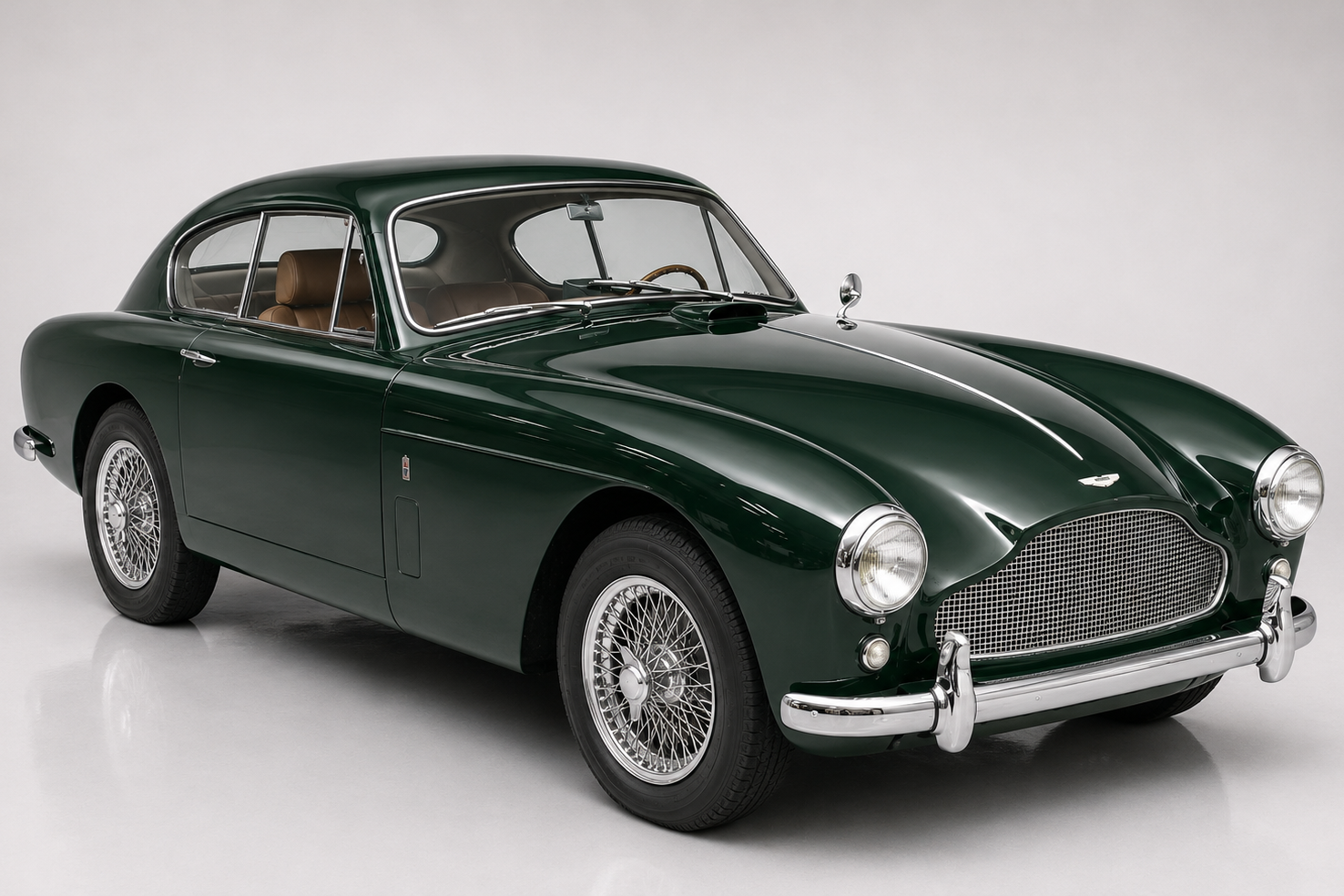
The DB Mark III — properly the DB2/4 Mark III, but normally called simply 'DB Mark III' even at introduction — is the last road-going Aston Martin built at Feltham, and the last with the Bentley-era Lagonda straight-six. It is not to be confused with the DB3, a sports-racing car.
A total of 551 cars were built across all bodies between 1957 and 1959: 462 2+2 hatchback saloons, 84 Tickford drophead coupés, and 5 fixed-head coupés. A further 14 chassis were designated DBR for racing and are counted separately from the 551 road cars. The engine is Tadek Marek's redesign of the 2.9-litre Lagonda six — stiffer block, stronger crank, new head with bigger valves — offered as the 162 bhp single-pipe DBA (178 bhp with the optional twin-pipe exhaust), the triple-SU 180 hp DBD (fitted to 47 cars — Verify) and the ten-car DBB. Girling front disc brakes became standard after the first 100 cars; a single competition example received a 214 hp racing engine.
Bert Thickpenny at Tickford adapted the grille shape first seen on the DB3S; that shape carried through to the DB4, DB5, DB6 and the V8 cars, and remains recognisable on Aston Martins today. The Mark III is also the Aston Martin Ian Fleming put James Bond in, in the original Goldfinger novel, before the film changed it to a DB5.
The DB Mark III is a pivotal transition car. It is the last Feltham road car and the last powered by the Bentley-era Lagonda six; it is the first Aston with Marek's revised head and (after chassis 100) with front disc brakes; and it introduced the DB3S-derived grille shape that has defined every road-going Aston Martin since. It is also the Bond car of the original Goldfinger novel — the true 'original Bond Aston' before the DB5 took the role on screen.

Variants
Range and production
Variant
Years
Production
Notes
DB Mark III Saloon
1957–1959
462
The volume Mark III body — a 2+2 hatchback saloon by Tickford. 2.9L Tadek Marek DBA / DBB / DBD straight-six; Girling front discs after the first 100 cars. Bert Thickpenny's DB3S-derived grille debuted on this car and carried through to the DB4 / DB5 / DB6 and V8 cars. Total DB Mark III production of 551 across all bodies confirmed by dbmkiii.com and Wikipedia; saloon share is 462 by subtraction against known Tickford sub-totals.
DB Mark III Drophead Coupé (Tickford)
1957–1959
84
Open Tickford body; 84 cars — Verify against AMHT build sheet for a specific chassis.
DB Mark III Fixed Head Coupé (Tickford)
1957–1959
5
The rarest catalogued Mark III body — only 5 built (Verify).
DBA / DBB / DBD engine specifications (option list, not separate models)
1957–1959
—
Engine options were offered against the 551 total: DBA — 162 bhp with single-pipe exhaust; 178 bhp with the optional twin-pipe exhaust. DBD — triple SU 1.75" carburettors and dual exhaust, 180 hp, fitted to 47 cars (Verify). DBB — 10 cars; the 195 bhp figure sometimes quoted is DISPUTED (one source prints 195 bhp alongside a '511' production total that is a transparent typo for 551; another confirms the 10-car count but publishes no power figure). A separate competition car received a 214 hp racing engine. Only 5 automatic cars from the 551 (Verify).
DBR racing chassis (separate from the 551)
1957–1959
14
14 chassis designated DBR for racing use — counted separately from the 551 Mark III road cars and not included in the road-car production totals.
Buyer's Guide
What to look for
Provenance — AMHT build sheet and matching numbers
Feltham-era Aston Martins passed through many hands and non-original engines, gearboxes and bodies circulate freely. For the DB Mark III specifically, the disc-brake / overdrive / DBA vs DBB vs DBD engine specification for the car's build date matters — a DBD (47 built) or the very rare DBB (10 built) reconciled against factory records is a materially different proposition from a standard DBA. Cross-check chassis, engine and gearbox numbers against the Aston Martin Heritage Trust build sheet and, where possible, the AMOC register before deposit.
Body and structural corrosion
Hand-built steel bodies on tubular chassis rust in the sills, floors, A-posts and rear inner arches. A lift inspection with paint-depth gauge is non-negotiable; superficial paintwork over unresolved structural corrosion is common.
Lagonda six — the engine that defines the car
The W.O. Bentley / Willie Watson Lagonda six (2.6 / 2.9 VB6E / VB6J) and Tadek Marek's DBA / DBB / DBD revision are robust when correctly rebuilt but unforgiving of cooling neglect, incorrect head torque and non-original internals. Correct engine number for the build date matters both for value and parts.
Coachbuilder plate and originality
Mulliners of Birmingham (early cars) and Tickford of Newport Pagnell (later cars) each carried their own body plates; re-skinned panels, wrong-plate bodies and non-original interiors are difficult to unwind and materially reset value.
Pricing
What to pay
Driver saloon
USD$110,000 – $170,000
GBP£85,000 – £130,000
EUR€95,000 – €145,000
Usable driver-condition Mark III saloons. Regional figures reflect independent local markets rather than an FX conversion; non-observed bands are approximate equivalents.
Excellent matching-numbers Tickford saloon
USD$170,000 – $260,000
GBP£125,000 – £190,000
EUR€145,000 – €215,000
Correctly-restored, matching-numbers Tickford saloons with full documentation.
Drophead Coupé (84 built) / Fixed Head Coupé (5 built)
No qualifying public results have been located for either body style; both are priced individually against provenance, originality and coachbuilder documentation — Verify.
Regional ranges authored independently — each reflects its local market, not an FX conversion
Ownership
Living with it
Typical mileage
1,500–4,000 miles typical
Service interval
12 months by time or 3,000 miles, whichever first
Annual running cost
$8,000 – $20,000 depending on condition and use
Fuel economy
14–18 mpg
Insurance
Agreed-value classic policy with limited mileage and secure storage. Feltham-era Aston Martins are well-understood by specialist classic underwriters.
Body and structural corrosion
Hand-built steel bodies on tubular chassis rust in sills, floors, A-posts and rear wheel arches. Any car with fresh paint should be inspected on a lift with a paint-depth gauge — cosmetic-only restorations that leave structural corrosion untouched are common.
Marque-specialist support
Feltham-era work belongs with genuine Aston Martin specialists (Aston Service Dorset, Davron, R.S. Williams, Pugsley & Lewis, Rex Woodgate in the US) rather than general classic garages; correct DBA/DBB/DBD engine internals and original coachbuilder plates matter for value and parts.
Common Problems
Known issues by system
Provenance
Matching-numbers reconciliation against the AMHT build sheet
CriticalNot applicable — market impact only
Symptoms — Missing or unreconciled chassis, engine or gearbox numbers; incorrect coachbuilder plate.
Inspection — Aston Martin Heritage Trust build sheet and AMOC register cross-check.
Body / structure
Sill, floor, A-post and rear-arch corrosion
Critical$50,000 – $200,000+
Symptoms — Bubbling paint, sill perforation, door mis-alignment, filler visible under paint-depth gauge.
Inspection — Full lift inspection with paint-depth gauge by a Feltham-era Aston specialist.
Engine
Lagonda / Marek six-cylinder wear and cooling neglect
Each region quoted in its local currency — independent market readings, not FX conversions
Matching-numbers Tickford saloons with full documentation lead the standard-body market, at $176,000 in October 2024 and £120,750 in November 2025. No qualifying public results have been located for the 84 drophead coupés or the five fixed-head coupés — both are priced individually.
Auctions
Recent results
Date
Auction
Car
Mileage
Result
2024-10-11
RM Sotheby's
Hershey 2024, Lot 374
1958 DB2/4 Mk III by Tickford (chassis AM300/3/1514, one of 197 LHD saloons, matching-numbers engine, sympathetic mechanical restoration completed 2019)
Confirmed directly from RM Sotheby's own lot page (rmsothebys.com/auctions/hf24/lots/r0124...).
—
$176,000
Sold
2025-11-04
RM Sotheby's
London 2025, Lot 156
1958 DB2/4 Mk III by Tickford (chassis AM300/3/1554, matching-numbers DBA/1204 engine and DBLCW/0/189 gearbox, original interior, first-owner Welsh Bugatti racer A.H.L. Eccles, £60,000+ recent marque-specialist work, Davron engine rebuild 2023)
Confirmed directly from RM Sotheby's own lot page (rmsothebys.com/auctions/lf25/lots/r0044...). Addendum notes UK export licence required.
—
£120,750
Sold
Both results independently fetched and cross-checked against the auction house's own lot page at time of publication; sale dates approximated to auction-week where the lot page states only the sale name (RM Sotheby's Hershey 2024, London 2025).
Investment
Long-term outlook
Strong HoldHorizon: 10+ years
Correctly-restored matching-numbers Tickford saloons with the DB3S-derived grille shape sit at the natural centre of the DB Mark III market; DBD and DBB engine specifications, and the Fixed Head Coupé sub-series, are separate collector propositions.
Our view, not advice. This section is Car Collector International's editorial judgement on where this model sits in the collector market, based on the production, specification and market data set out in this guide. It is not a recommendation to buy or sell and it is not investment advice. Values can fall as well as rise.