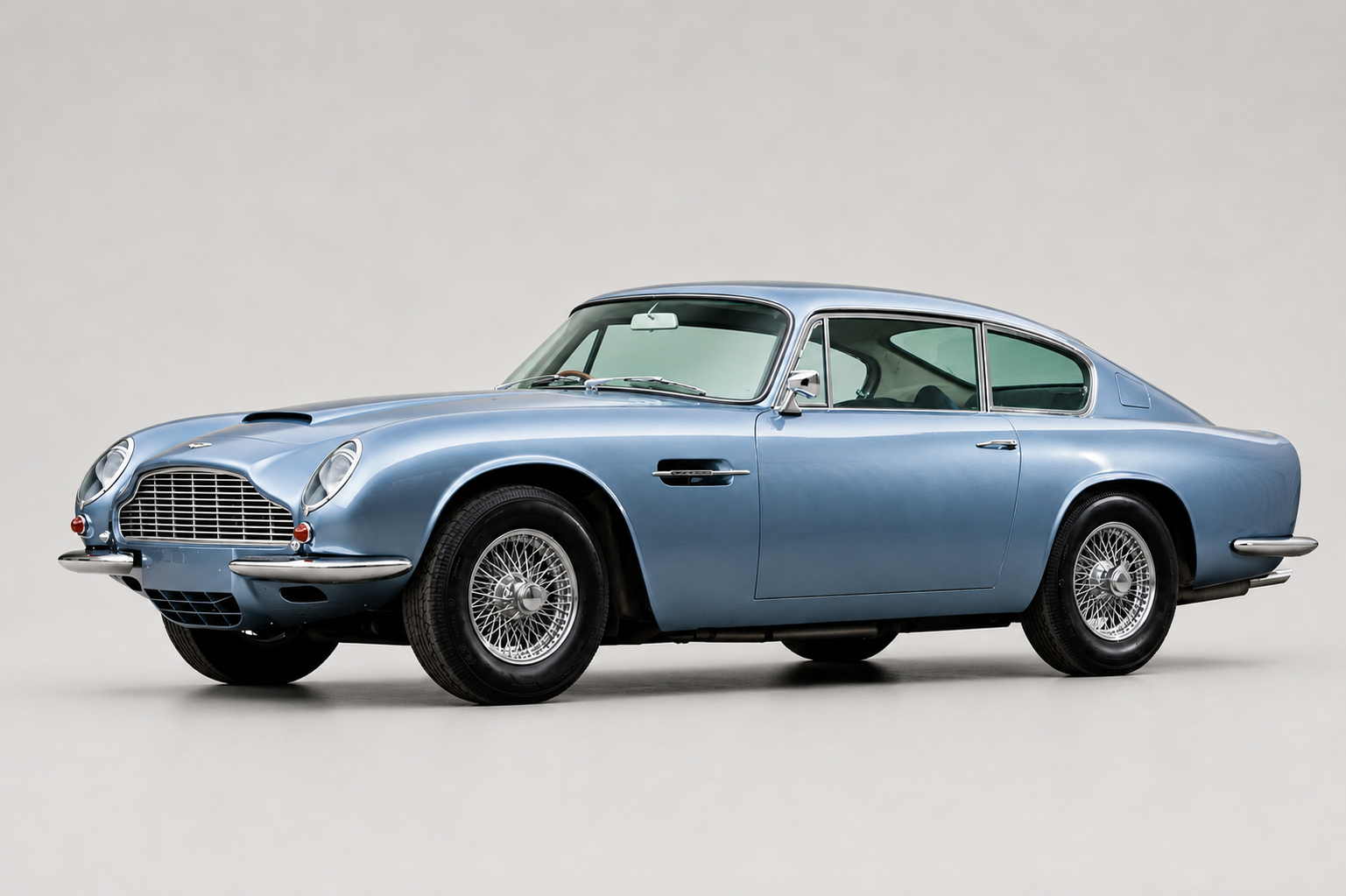
Introduced at the 1965 London Motor Show, the DB6 was a comprehensive revision of the DB5 rather than a clean-sheet design. The wheelbase was lengthened by 3.75 inches to liberate genuine rear-seat space, the roof was raised, and the tail was chopped into a Kammback spoiler to counter the aerodynamic lift that had troubled the earlier fastback shape. The car retained the Tadek Marek 4.0-litre twin-cam straight-six, the ZF five-speed gearbox and — for the Vantage — the triple-Weber high-compression head good for a quoted 325 bhp.
Production ran until November 1970 and split into two clear generations: the original DB6, built from September 1965; and the DB6 Mk II, announced on 21 August 1969, identified by flared arches for wider DBS-derived wheels and available with the AE-Brico electronic fuel injection option that almost no one specified. The Volante convertible arrived a year after the coupe at the 1966 London Motor Show, and a handful of Shooting Brake conversions were built externally by Harold Radford and FLM Panelcraft.
While the DB5 has monopolised public attention for six decades, the DB6 is the more usable car — larger inside, better on a fast road, and materially cheaper to buy. It is also the last Aston Martin engineered under David Brown's Newport Pagnell tenure to carry the Touring silhouette, before William Towns's DBS took the marque in a heavier, more American direction. Values sit clearly below the DB5 and often below the DB4, which for many collectors is precisely the point.
The DB6 is the final expression of the Touring-shaped DB line and — with the exception of the Volante and Vantage variants — remains the most accessible route into a genuine David Brown-era Aston Martin.