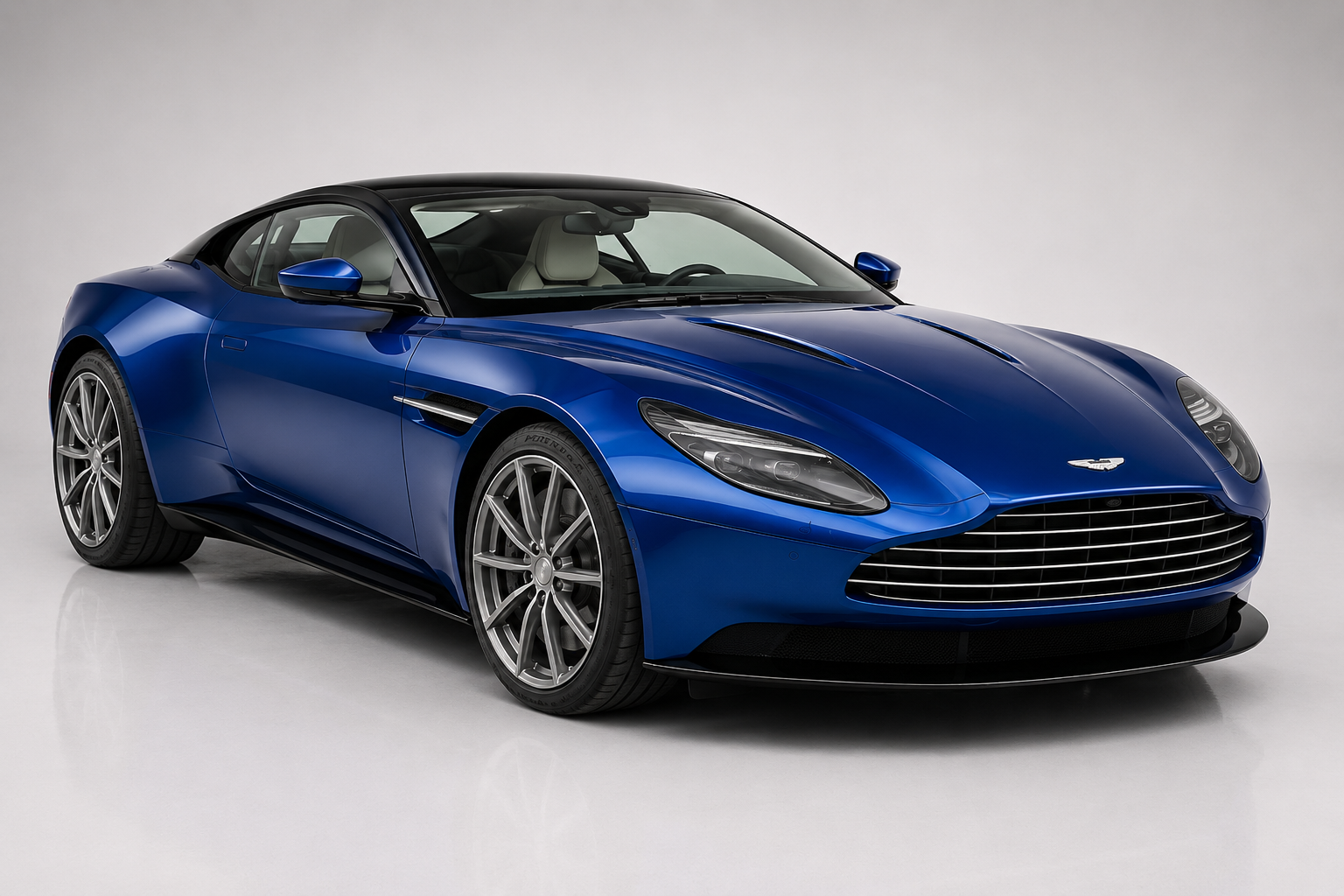
The DB11 debuted at the Geneva Motor Show in March 2016, with manufacturing beginning at Gaydon in September 2016. Designed by Marek Reichman, it was the first car of Aston Martin's 'second-century plan' and replaced the DB9. The DB10 was never a production car. The DB11 is a 2+2 grand tourer with swan-hinged doors on a bonded-aluminium structure.
The car launched with an in-house-designed 5.2-litre twin-turbocharged V12 — the first turbocharged series-production engine ever fitted to an Aston Martin. From summer 2017 a 4.0-litre twin-turbocharged Mercedes-AMG M177 V8 was added, materially lighter than the V12 and with a different weight distribution. In May 2018 an AMR version replaced the standard V12 after only about eighteen months in production. Volante production, V8 only, followed in 2018. The 5.2 twin-turbo V12 introduced with the DB11 would go on to serve in the DBS Superleggera, V12 Vantage, V12 Speedster and Valour.
The DB11 is the opening statement of Aston Martin's second-century plan, the introduction point for the marque's first turbocharged series-production engine, and the last mainstream Aston to offer a V12. It sits at a pivot between the VH-platform DB9/DBS era and the DB11-derived bonded-aluminium platform that carries through to the current DB12 and Vantage.
Variants
Range and production
Variant
Years
Production
Notes
DB11 V12
2016–2018
Not separately recorded
The launch specification. 5.2-litre in-house twin-turbocharged V12 producing 600 bhp / 608 PS and 516 lb-ft / 700 Nm — Aston Martin's first turbocharged series-production engine. Includes cylinder deactivation (marketed as 'Intelligent Bank Activation') and stop-start. 0–62 mph 3.9 seconds, 200 mph top speed. Replaced by the AMR from May 2018 after around eighteen months in production.
DB11 V8
2017–2023
Not separately recorded
Added from summer 2017. 4.0-litre Mercedes-AMG M177 twin-turbocharged V8 producing 503 bhp / 510 PS and 498 lb-ft. 115 kg lighter than the V12, with a 49/51 front/rear weight distribution against the V12's 51/49. DB11 range replaced by the DB12 in 2023.
DB11 AMR
2018–2023
Not separately recorded
Revealed at Aston's AMR Performance Centre near the Nürburgring in May 2018 and replaced the standard V12, which had been in production only about eighteen months. 630 bhp / 639 PS, an increase of 30 bhp over the standard V12. 0–62 mph in 3.7 seconds (manufacturer figure), 208 mph top speed. The AMR Signature Edition was Stirling Green with Lime Green accents at £201,995 against £174,995 for the standard AMR; deliveries from summer 2018.
DB11 Volante
2018–2023
Not separately recorded
Convertible body, V8 only — Aston stated no V12 Volante was planned, on the basis that the Volante already weighs 110 kg more than the V8 coupé. 513 lb-ft, more torque than the V8 coupé. 0–62 mph 4.1 seconds, 187 mph top speed; 47/53 front/rear weight distribution.
Buyer's Guide
What to look for
Provenance — factory paperwork and service history
Current-era Aston Martins live and die on continuous factory service history and dealer-network paperwork. For the DB11 specifically, the choice between the V12, the V8 and the AMR is the primary specification decision — each has a distinct weight distribution, character and future collector position. Confirm the exact engine and any AMR / AMR Signature Edition paperwork against the delivery documents. Confirm chassis number, delivery specification, options and full service book against the authorised dealer portal before pricing.
Drivetrain — V12 or AMG twin-turbo V8
The hand-built 5.2 twin-turbo V12 and the Mercedes-AMG M177 4.0 twin-turbo V8 are both robust when correctly maintained but must be serviced at an authorised dealer for warranty and value continuity. Cold-start behaviour, boost signature and any recall or campaign history are the primary purchase-time diagnostics.
Chassis and body — bonded aluminium and carbon-ceramic brakes
Bonded-aluminium chassis require authorised body-shop repair; non-factory bonded-aluminium work is priced against that history. Carbon-ceramic brake systems are a factory-only replacement item — verify pad and disc condition alongside the service book.
Options, specification and condition
Specification drives value in the modern-Aston market. Carbon-ceramic brakes, lightweight packages, popular colour and trim combinations, and factory-fitted rare options are the material spec-side signals; confirm every claim against the original delivery documents.
Ownership
Living with it
Typical mileage
2,000–6,000 miles typical
Service interval
12 months by time or 10,000 miles, whichever first
Annual running cost
$6,000 – $16,000 depending on use and specification
Fuel economy
16–22 mpg
Insurance
Agreed-value modern GT policy with limited mileage and secure storage. Current-era Aston Martins sit in the specialist modern-Aston underwriting tier.
Factory / authorised-dealer servicing
Modern Aston Martin drivetrains — the hand-built V12 and the Mercedes-AMG M177 twin-turbo V8 — should be serviced through the authorised dealer network. Continuous factory service history is a material value driver.
Carbon-ceramic brakes and electronics
Carbon-ceramic brake systems on current Astons are a factory-only replacement item. Verify infotainment revisions, software updates and any recall or campaign history at the dealer service portal before purchase.
Auctions
Recent results
Date
Auction
Car
Mileage
Result
2026-06-25
Barrett-Jackson
Columbus, Columbus, USA
2019 DB11 Volante
Lot 768.
—
US$93,500
Sold
2026-01-17
Barrett-Jackson
Scottsdale, Scottsdale, USA
2021 DB11 AMR
Lot 1301.
—
US$286,000
Sold
2025-10-12
Bonhams
The Zoute Sale, Knokke-Heist, Belgium
2017 DB11
Lot 173.
—
€126,500
Sold
2025-03-07
Broad Arrow Auctions
The Amelia Auction, Amelia Island, USA
2023 DB11
Lot 236.
—
US$196,000
Sold
2024-10-06
Bonhams
The Zoute Sale, Knokke-Heist, Belgium
2017 DB11
Lot 168.
—
€115,000
Sold
2023-09-20
Mecum
Dallas, Dallas, USA
2017 DB11
Lot S118.
—
US$110,000
Sold
Investment
Long-term outlook
EmergingHorizon: 5–10 years
The DB11 opened Aston Martin's second-century plan and introduced the company's first turbocharged series-production engine. It is the last mainstream Aston Martin to offer a V12. The V12 cars, and the AMR in particular, are the natural collector focus; the V8 is lighter and more agile but shares its engine with a broad range of Mercedes-AMG models.
Our view, not advice. This section is Car Collector International's editorial judgement on where this model sits in the collector market, based on the production, specification and market data set out in this guide. It is not a recommendation to buy or sell and it is not investment advice. Values can fall as well as rise.