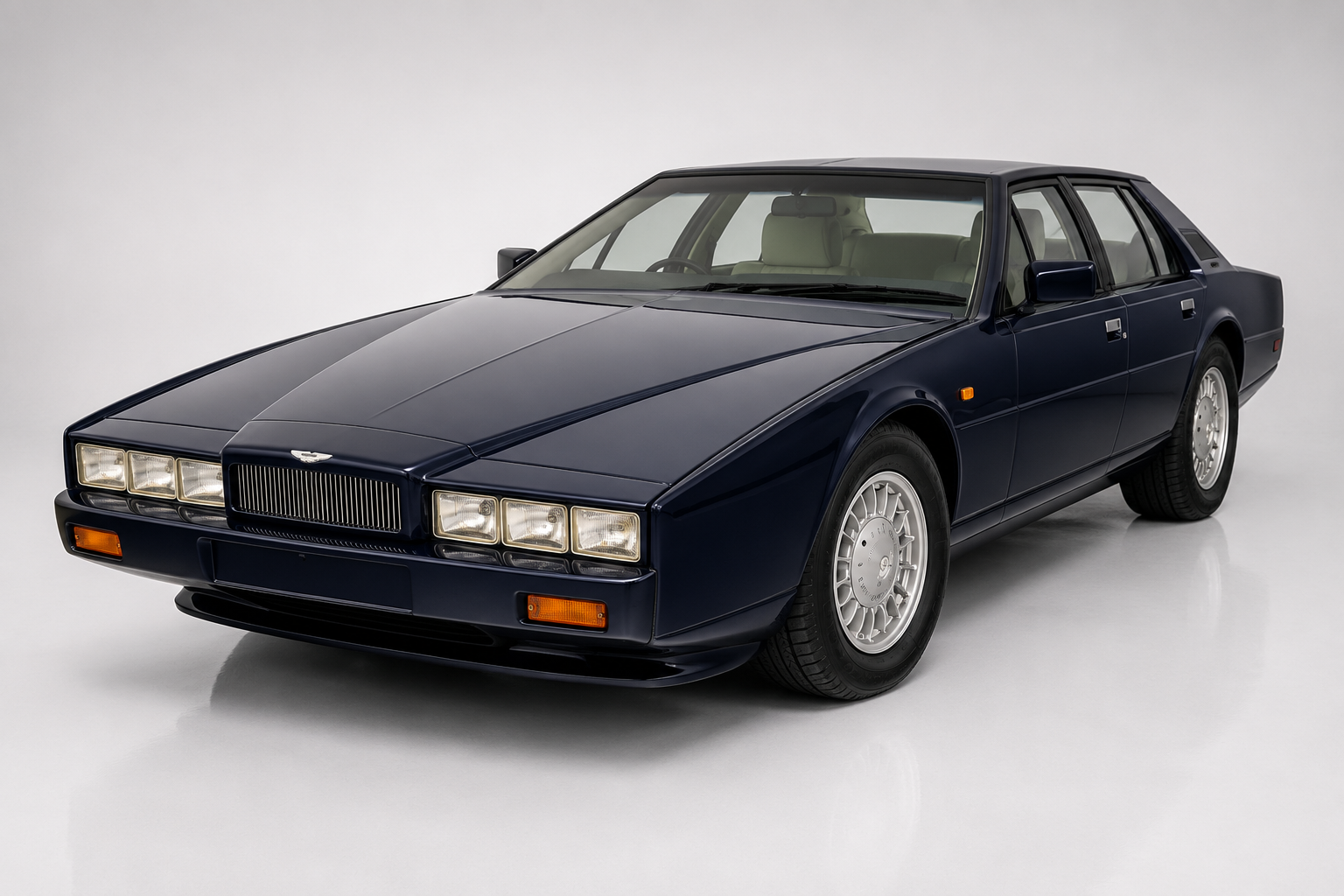
William Towns' folded-paper wedge saloon — the first production car with computer management and a digital instrument panel, and one of the most expensive saloons in the world.
The Aston Martin Lagonda is properly two distinct cars sold under one name. The Series 1 of 1974 was a long-wheelbase four-door Aston Martin V8, designed by William Towns and based on the DBS, and was the first car to wear the Lagonda name since the 1961 Rapide — only seven were sold; a period power figure of 280 bhp is quoted, and a 320 hp figure marked 'estimated' also circulates (Verify). The Series 2 of 1976 was an entirely redesigned wedge saloon by Towns — a specifically extreme interpretation of the 1970s 'folded paper' design idiom, sharing little with the Series 1 apart from the engine and the long-wheelbase V8 chassis. Series 3 added fuel injection and cathode-ray-tube instrumentation that proved even less reliable than the original LED display. The Series 4, unveiled at Geneva in March 1987, was a Towns facelift that rounded the edges, deleted the pop-up headlights in favour of six smaller lights, removed the side swage line and moved to 16-inch wheels.
Underneath sat the 5.3-litre DOHC V8 with four twin-choke Weber 42DCNF carburettors — 280 bhp at 5,000 rpm, 320 lb/ft, Chrysler Torqueflite three-speed automatic — good for 145 mph and 0–60 mph in 7.9 sec; a top speed of 149 mph is also published (Verify). Production totals reflect the SCOPE difference between two commonly-quoted numbers, not a conflict: 645 total across the full 1974–1990 run including the 7 Series 1 cars, or 638 for the wedge cars alone (645 − 7). The Series 4 count itself is disputed at 105 or 98 (Verify), and one auction house publishes 638 'including 98 Series 4 models'. The end date is likewise disputed — the factory says 1989; other sources give January and May 1990 (Verify).
The car was launched at the 1976 London Motor Show (Earls Court) and was the sensation of it — but it was not production-ready: the prototype L/13001/R was a complete non-runner, and BBC footage showing it moving is the car coasting downhill under gravity. Production did not begin until 1978, and only 16 cars were completed in the first two years. Commercially, the reveal drew hundreds of deposits and saved Aston Martin's cash position; strong demand from the Middle East led to an Arabic-language brochure. £32,620 in 1977 and around £50,000 by 1980, the Lagonda was among the most expensive saloons in the world, approached only by the Rolls-Royce Silver Spirit / Silver Spur and the Bentley Mulsanne.
The wedge Lagonda was the first production car in the world to use computer management and a digital instrument panel — a genuinely first-mover technical exercise whose electronics development cost is variously reported at three or four times that of the entire rest of the car (Verify multiple), and which exceeded the car's own development budget several times over. The result was profoundly unreliable in period, but the ambition and the resulting shape — William Towns' folded-paper saloon — are both marque-defining. The car was named on Bloomberg Businessweek's '50 ugliest cars' and Time's '50 worst cars' lists in later retrospectives; period reception is now itself part of the model's story. Note that 'Aston Martin' was quietly dropped from the description during the 1980s; Lagonda is a marque Aston Martin purchased in 1947, and the company itself is Aston Martin Lagonda Limited.

Variants
Range and production
Variant
Years
Production
Notes
Lagonda Series 1 (DBS-based saloon)
1974
7
William Towns-designed long-wheelbase four-door Aston Martin V8, based on the DBS. First car to wear the Lagonda name since the 1961 Rapide. Only 7 sold. Power disputed — 280 bhp quoted as period figure; 320 hp also published and marked 'estimated' (Verify). Not to be conflated with the wedge cars introduced from 1976.
Lagonda Series 2 (William Towns wedge, launch)
1976–1985
—
Entirely redesigned wedge saloon by William Towns — the extreme interpretation of 1970s 'folded paper' design. Shares little with Series 1 apart from the engine and long-wheelbase V8 chassis. Pop-up headlights. First production car with LED digital instrumentation. Launched at the 1976 London Motor Show (Earls Court) as the sensation of the show; production did not begin until 1978 with only 16 cars completed in the first two years.
Lagonda Series 3
1985–1987
—
Fuel injection added; cathode-ray-tube (CRT) instrument replacement for the LED display — proved even less reliable than the LED system it replaced.
Lagonda Series 4
1987–1990
—
Unveiled at Geneva, March 1987. William Towns facelift — rounded edges, pop-up headlights deleted in favour of six smaller lights in two banks, side swage line removed, 16-inch wheels. Series 4 unit count disputed: 105 or 98 (Verify); one auction house publishes 638 wedge cars 'including 98 Series 4 models'. End date disputed — factory says 1989; other sources say January 1990 and May 1990 (Verify).
Tickford Lagonda (1983)
1983
5
Tickford performance and luxury conversion; 5 cars.
Tickford Lagonda limousine (1984)
1984
4
4 long-wheelbase cars at £110,000 each in period.
Buyer's Guide
What to look for
Provenance — Aston Martin Works records and Series identification
The wedge Lagonda passed through Series 2, 3 and 4 and each has visibly and mechanically distinct hardware, trim and electronics. For the Lagonda specifically, the electronics package is the standing risk and the primary spend line — every Series has its own hardware, none has aged well, and specialist repair is a costed reserve. Cross-check chassis number and delivery specification against Aston Martin Works records and confirm the Series identity of every fitting before pricing.
Electronics — the standing risk
Lagondas ran a succession of unreliable electronic instrument packages — LED (Series 2), cathode-ray tube (Series 3), later revisions — with development costs variously reported at three or four times that of the rest of the car. Assume the system is at least partly broken; specialist repair is a costed line item.
V8 drivetrain — a known quantity
The 5.3-litre DOHC V8 with four twin-choke Weber 42DCNF carburettors and Chrysler Torqueflite three-speed automatic is well-supported by Aston V8 specialists. Verify carburettor sync, oil pressure at temperature, gearbox behaviour and cooling condition.
Coachwork and interior
William Towns' folded-paper bodywork is unforgiving of poor accident repair; interior leather, veneer and carpet are model-specific and expensive to source. Series 4 (1987) rounded edges and deleted pop-up headlights are the visible identifier — verify hardware matches the Series presented.
Pricing
What to pay
Driver, running, electronics functional
USD$35,000 – $55,000
GBP£27,000 – £42,000
EUR€30,000 – €48,000
Running driver-condition wedge Lagondas with functional electronics. Regional figures reflect independent local markets rather than an FX conversion; non-observed bands are approximate equivalents.
Excellent, documented, electronics fully working
USD$55,000 – $85,000
GBP£42,000 – £62,000
EUR€48,000 – €72,000
Excellent, documented cars with the instrument package fully working. The upper half of this band is untested — cars offered at that level have repeatedly failed to find buyers.
Series 1 (7 built)
A single public result exists and that car carried a non-original 7.0-litre conversion, so it is not a Series 1 benchmark — Verify. Priced individually against provenance and originality of the DBS-based long-wheelbase saloon.
Regional ranges authored independently — each reflects its local market, not an FX conversion
Ownership
Living with it
Typical mileage
1,000–3,000 miles typical
Service interval
12 months by time or 3,000 miles, whichever first
Annual running cost
$10,000 – $30,000+ depending on condition and electronics state
Fuel economy
10–13 mpg
Insurance
Agreed-value classic policy with limited mileage and secure storage. The wedge Lagonda is a specialist-only underwriting risk given the electronics package.
Electronics — the standing risk
The wedge Lagonda was the first production car to use computer management and a digital instrument panel; the LED, cathode-ray-tube and later systems are famously unreliable. Any car should be inspected with a Lagonda-literate specialist and priced against the state and completeness of its electronics.
V8 drivetrain support
The 5.3-litre V8 and Chrysler Torqueflite are robust and well-supported by Aston V8 specialists; the surrounding car — trim, glass, electronics and interior — is not, and is the expensive-to-restore side of ownership.
Common Problems
Known issues by system
Electronics
LED / CRT / later digital instrument package failure
Critical$15,000 – $60,000+ depending on hardware sourcing
Symptoms — Mismatched or damaged trim, non-Series-correct hardware, worn veneer.
Inspection — Interior review against Series 2 / 3 / 4 factory specification.
Valuation
Current value bands by region
Each region quoted in its local currency — independent market readings, not FX conversions
Completed sales cluster tightly: £35,464 and $49,000 in September 2025, €32,735 in October 2025. Cars offered materially above that level have repeatedly failed to sell — a 1990 car at £48,000–£56,000, a 1984 at $75,000–$85,000 and a 1982 at €70,000–€110,000 all went unsold in mid-2025. Treat asking prices above the mid-£40,000s as untested rather than established. Electronics condition is the dominant variable in placement.
Auctions
Recent results
Date
Auction
Car
Mileage
Result
2025-09-20
Historics
Ascot Racecourse 2025, Lot 163
1979 Lagonda
Verified sold result.
—
£35,464
Sold
2025-10-11
Aguttes
Autoworld Brussels 2025, Lot 41
1984 Lagonda
Verified sold result.
—
€32,735
Sold
2025-09-10
Bring a Trailer
2025 online sale
Lagonda
Verified sold result — online auction, no house catalogue lot number.
—
$49,000
Sold
Investment
Long-term outlook
Strong HoldHorizon: 10+ years
Small overall production, first-mover technical status as the first production car with computer management and digital instrumentation, and William Towns' unmistakable wedge shape together position the Lagonda as a defensible long-term hold. Series 1 and the Tickford derivatives are separate collector propositions.
Our view, not advice. This section is Car Collector International's editorial judgement on where this model sits in the collector market, based on the production, specification and market data set out in this guide. It is not a recommendation to buy or sell and it is not investment advice. Values can fall as well as rise.