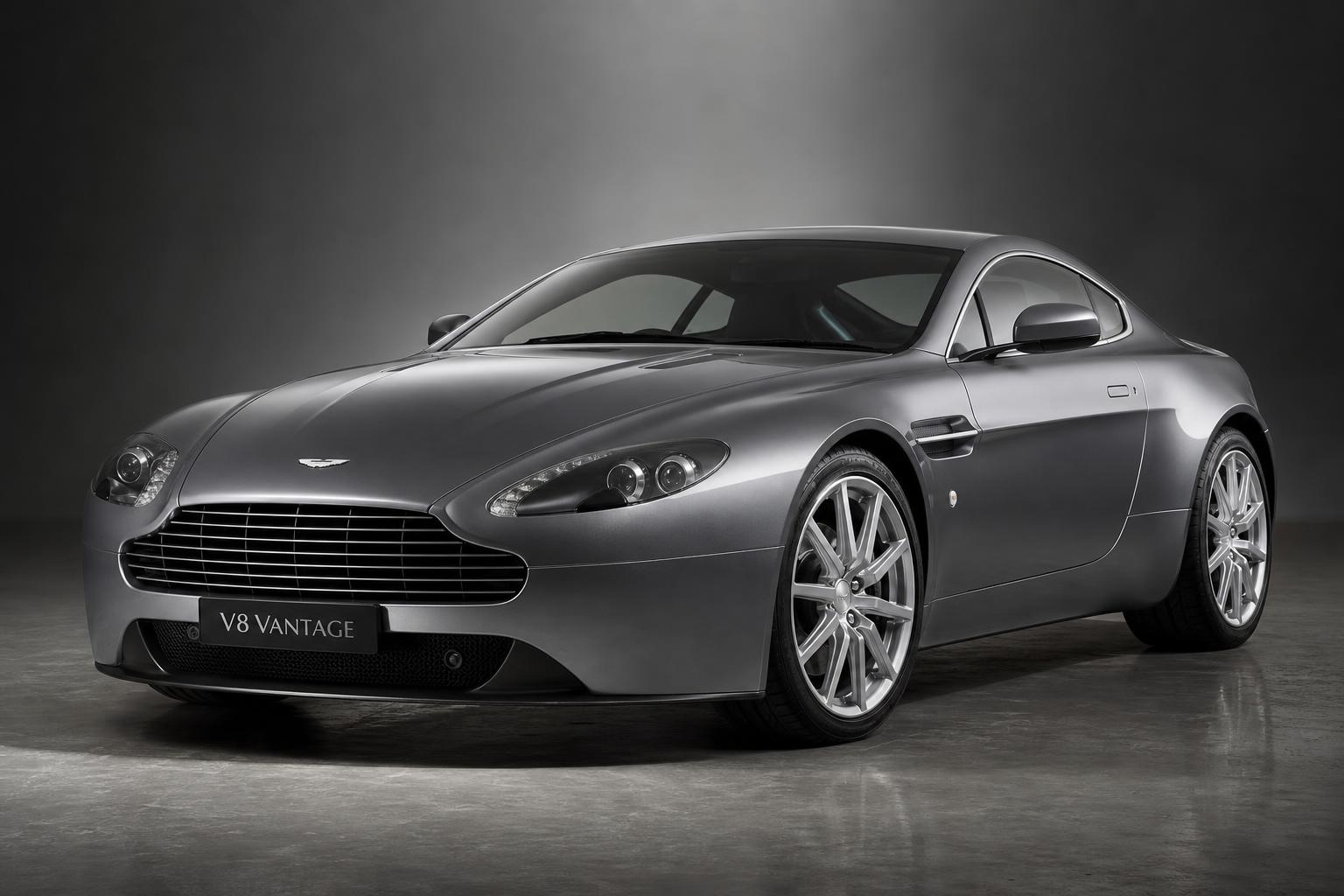
Launched at the 2005 Geneva Motor Show and produced until 2017, the VH-platform V8 Vantage was Aston Martin's most compact and driver-focused car of its generation. It was developed under Dr Ulrich Bez at Gaydon, shared its bonded-aluminium VH architecture with the DB9, and was the first Aston designed from the outset as a true Porsche 911 rival. Power came initially from a 4.3-litre AM02 V8 producing 380 hp, mated to a six-speed manual or single-clutch Sportshift automated gearbox driving the rear wheels through a rear-mounted transaxle.
From 2008 the engine grew to 4.7 litres and 420 hp, with revised gearing, electronics and chassis settings. A succession of more focused variants followed — the V8 Vantage S in 2011, the limited-production V12 Vantage in 2009, the V12 Vantage S in 2013, and a small run of manual-gearbox V12 Vantage S cars in 2016 — culminating in the AMR special editions that closed the line in 2017–2018. The car remained in production largely unchanged in concept for twelve years, a remarkable run by modern standards.
The VH-platform Vantage is now widely regarded as one of the last true hand-built, front-mid-engined Aston Martins, and the most analogue Vantage of the modern era. Its bonded-aluminium chassis was assembled at Gaydon, its V8 engines hand-built at the dedicated facility in Cologne, and its 50:50 weight distribution and rear transaxle gave it dynamics closer to a Porsche than a traditional grand tourer. For collectors, the manual-gearbox 4.7-litre coupes and the V12 variants — particularly the manual V12 Vantage and V12 Vantage S — are the cars that anchor the long-term narrative.