
Car Collector International
Classic · 1980–1991

Audi Quattro Turbo

The car that rewrote rallying — Audi's first quattro all-wheel-drive turbo coupe, in production for 11 years.

Car Collector International Editorial
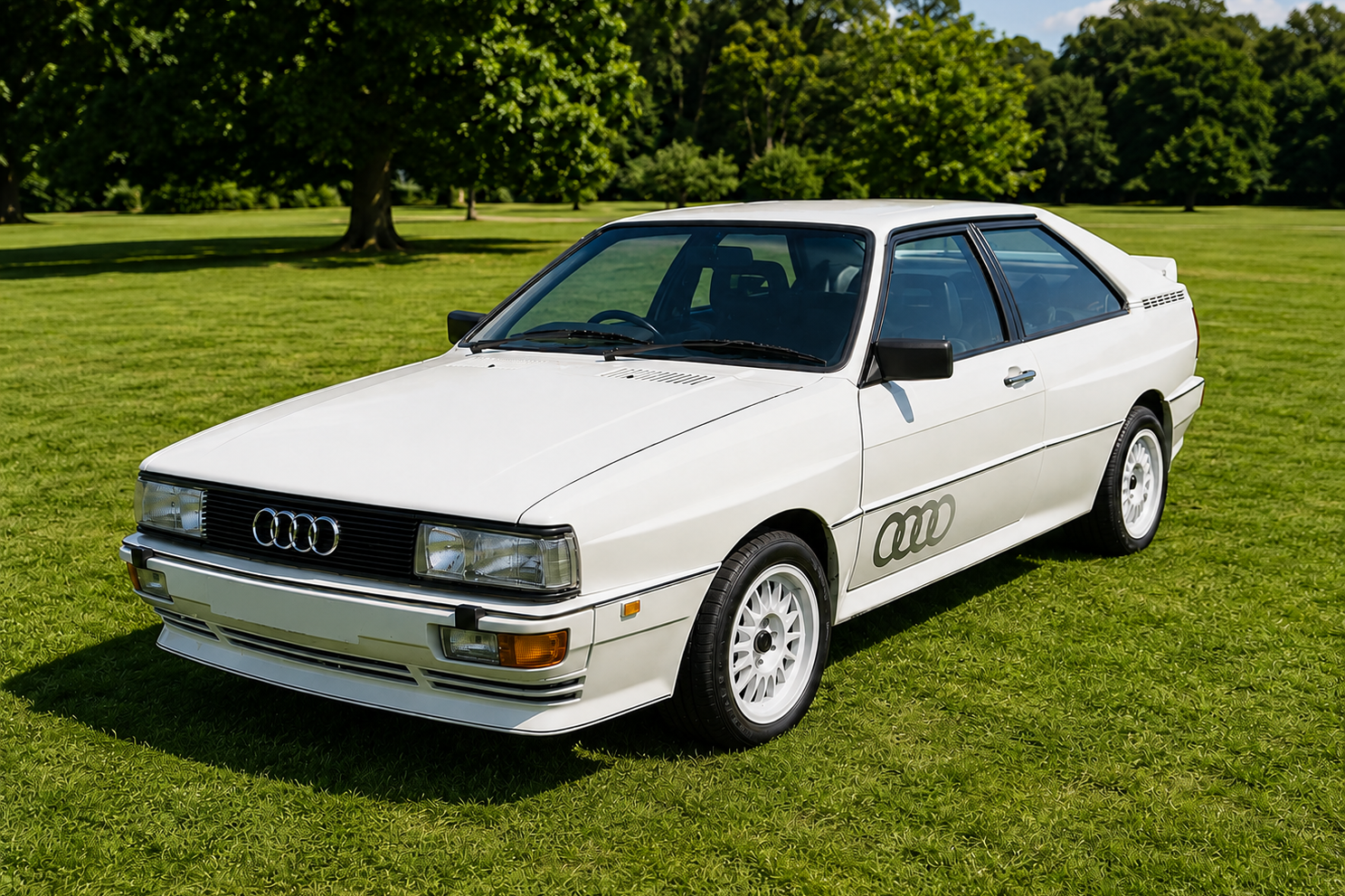
White Audi Ur-Quattro Turbo coupe on a manicured lawn, front three-quarter view showing the four-ring grille, twin rectangular headlamps, front spoiler, white lattice alloy wheels and side 'Audi rings' decal.
Overview

Why this car matters

Launched in 1980, the Ur-Quattro ('original Quattro') was the first car to combine permanent four-wheel-drive with a turbocharged engine in a road-going coupe. It transformed rallying and gave Audi two World Rally Championships (1982, 1984), with the homologation Quattro Sport S1 derivatives running until 1986.

The production Coupe ran from 1980 to 1991 in WR (10v 2.1), MB (10v 2.2) and RR (20v 2.2) engine specifications. The 20v RR — final-evolution, 220 PS, built in the smallest numbers — is the most collectable production Ur-Quattro; the Sport Quattro and S1 are separate ultra-blue-chip cars.

The Ur-Quattro changed the technical direction of the entire performance-car industry; values are driven by sub-variant (10v vs 20v), originality and continuous documented history.

Variants

Range and production

VariantYearsProductionNotes
Ur-Quattro WR (10v 2.1)1980–1987Not separately recordedOriginal 2.1-litre 10-valve five-cylinder; the longest-produced specification.
Ur-Quattro MB (10v 2.2)1987–1989Not separately recorded2.2-litre 10-valve; smaller production.
Ur-Quattro RR (20v 2.2)1989–1991932Final-evolution 20-valve 220 hp specification; the production apex.
Sport Quattro1984–1985224Short-wheelbase homologation derivative; separate ultra-blue-chip tier.
Sport Quattro S1 / S1 E21985–1986Not separately recordedGroup B rally specification; effectively unique race cars.
Collector Variants

Limited & special editions

The models below represent the most significant limited and special edition variants — factory-produced cars that command meaningful premiums over standard examples and warrant specific attention from serious collectors.

Sport Quattro · 1984–1985

224 (of which 214 road cars + 10 prototypes/race)
Distinguishing features
Short-wheelbase (320 mm shorter) homologation special, 306 PS / 302 bhp 2.1 20V turbo (vs 200 PS Ur-Quattro), Kevlar/composite body panels, flared arches and revised suspension.
Value premium
5–10× a standard Ur-Quattro in equivalent condition; routinely £400k–£600k+.
Inspection points
Verify short wheelbase, 20-valve engine number, Kevlar body panels and the Audi Tradition documentation.
Authentication
Ur-Quattros have been converted to Sport-look. Only the 214 road cars on the Audi Tradition register are genuine; chassis numbers are public knowledge.

Audi Sport Quattro S1 / S1 E2 (Group B) · 1985–1986

20 (S1 E2 evolution; small additional run of S1 spec)
Distinguishing features
Group B competition Sport Quattro with extensive aero (large front splitter, biplane rear wing on E2), 500+ PS 2.1 20V turbo. Not road-registered as delivered; some have been road-converted by specialists.
Value premium
Multi-million dollar; treated individually by chassis history.
Inspection points
Verify FIA papers, Audi Sport build records and continuous race history.
Buyer's Guide

What to look for

Provenance and originality

Start with identity, paperwork and originality. For the Audi Quattro Turbo, the strongest cars have a continuous ownership file, matching numbers where applicable, original manuals, invoices and evidence of work by recognised marque specialists. Originality, low mileage, original colour combination, continuous service history and Audi Tradition / Quattro Club documentation are decisive.

Mechanical inspection priorities

The turbocharged five-cylinder is robust when correctly maintained; turbo health, head-gasket integrity, cooling and electronic engine management are core items. A proper pre-purchase inspection includes cold-start behaviour, leak-down or compression testing where appropriate, underbody photography, suspension and chassis-point inspection, brake condition and a road test long enough to expose heat-related faults. Deferred maintenance is almost always more expensive than buying a better-sorted car.

Body, paint and accident history

Use a paint-depth gauge, lift access and a specialist familiar with the model's factory seams and panel gaps. Collector value is dramatically affected by structural repairs, poor paintwork, corrosion, incorrect panels and missing factory trim. Documented cosmetic restoration is acceptable; concealed accident repair must be priced severely.

Specification strategy

20v RR cars are the production apex; Sport Quattro short-wheelbase derivatives sit in their own ultra-blue-chip market; 10v WR/MB cars are the usable entry. Specification, colour, transmission and limited-build variants move values significantly. Buy the best-documented example in the most desirable specification you can justify rather than a tired example of a rarer derivative that will need years of corrective work.

Ownership

Living with it

Typical mileage
1,500–4,000 miles typical for collector use
Service interval
12 months; mileage interval varies by model and use
Annual running cost
$4,000 – $12,000
Fuel economy
15–24 mpg depending on use
Insurance
Use an agreed-value collector policy with limited mileage, secure storage, documented photography and an annual value review. Premiums vary sharply by age, storage location and declared value.

Maintenance planning

Budget annually even if the car is used sparingly. Fluids age, tyres date out, fuel systems suffer from ethanol, batteries fail and stored cars need exercise. A documented maintenance rhythm protects both reliability and resale value.

Parts and specialist access

Audi-experienced specialists are essential; the five-cylinder engines, four-wheel-drive transmission and brake systems are not generally serviced correctly by general European-car shops. Before purchase, confirm parts availability for model-specific trim, suspension, fuel system, electronics and engine components. A cheap car waiting on unobtainable parts is rarely cheap in collector ownership.
Common Problems

Known issues by system

Body

Corrosion in sills, arches, sunroof and rear screen surrounds

Critical$10,000 – $30,000+ for correct body restoration
Symptoms — Filler, bubbling, sunroof and rear-screen leaks.
Inspection — Lift inspection by a specialist; magnet survey throughout.
Engine

Head-gasket and turbo wear

Major$5,000 – $15,000
Symptoms — Head-gasket weeping, smoke on start-up, fault codes from the original system.
Inspection — Compression and leak-down test, recent service paperwork.
Drivetrain

Differential and centre-diff wear

Moderate$3,000 – $10,000
Symptoms — Noise from drivetrain, vibrations under load, oil leaks.
Inspection — Cold and hot road test; oil inspection of all differentials.
Auctions

Recent results

DateAuctionCarMileageResult
2025-05-24
Broad Arrow
The Villa d'Este Auction, Lot 225
1990 Quattro 20V RR
€92,000
Sold
2025-01-24
RM Sotheby's
Arizona, Lot 141
1984 Sport Quattro
$758,500
Sold
2024-05-10
RM Sotheby's
Monaco, Lot 115
1985 Sport Quattro S1 E2
€635,000
Sold
Investment

Long-term outlook

Strong HoldHorizon: 5–10 years

20v RR cars should continue to appreciate at the originality-led end. Sport Quattro and S1 derivatives are blue-chip and should remain durable; standard 10v cars depend more sharply on condition and documentation.

Our view, not advice. This section is Car Collector International's editorial judgement on where this model sits in the collector market, based on the production, specification and market data set out in this guide. It is not a recommendation to buy or sell and it is not investment advice. Values can fall as well as rise.

Recommended

The trusted network

Specialists

  • Audi marque specialist
    View →
    UK / Europe
    Audi Quattro Turbo inspections, servicing and originality reviews.
  • Model-focused independent
    View →
    United States
    Pre-purchase inspections, major service planning and market-correct preparation for the Quattro Turbo.
  • Concours preparation studio
    View →
    International
    Paint correction, detailing, preservation and sale preparation for premium collector cars.

Storage

  • Windrush Car Storage
    View →
    London & Cotswolds, UK
    Climate-controlled storage and collection management for high-value collector cars.
  • AutoVault
    View →
    Essex, UK
    Dehumidified storage at 55% RH in purpose-built sealed buildings, with maintenance programmes and individual motor-trade insurance cover.
  • Classic Car Club Manhattan
    View →
    New York, NY
    Secure urban storage for collector and modern-classic performance cars.

Transport

  • CARS UK
    View →
    UK & Europe
    Enclosed event, concours and collection transport across Europe.
  • Reliable Carriers
    View →
    USA (national)
    Enclosed coast-to-coast transport for premium and collector cars.
  • FERRLOG
    View →
    Italy / Europe
    Air-ride enclosed transport for Italian and European collector cars.

Enjoyed this guide?

Get new buyer's guides and collector market intelligence delivered to your inbox. No spam. We respect your inbox.

The valuation figures in this guide are for research purposes only and do not constitute financial or investment advice. See our full disclaimer.