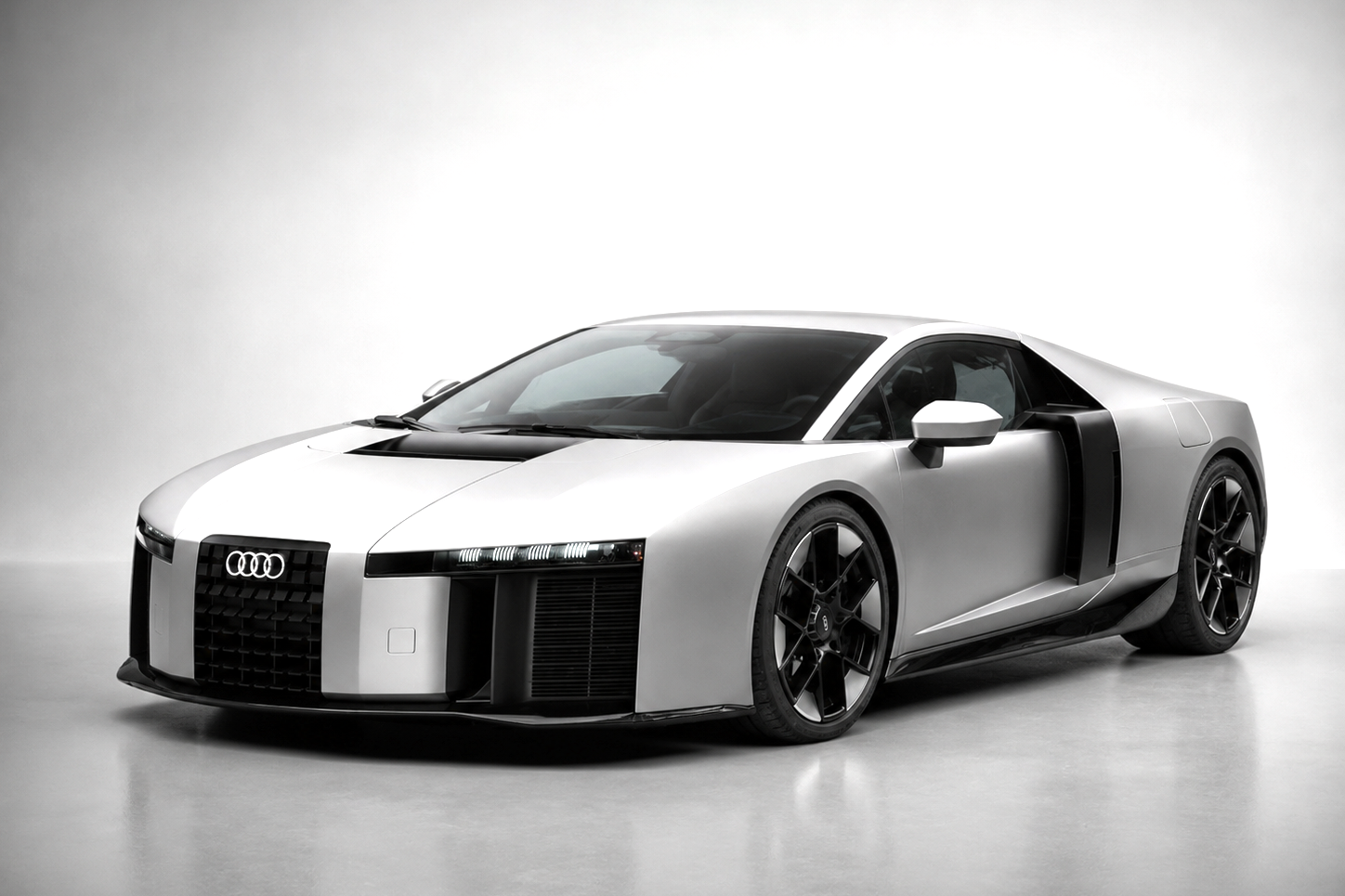
The first Audi supercar built as a plug-in hybrid — a 987 bhp / 1,001 PS carbon-bodied, mid-V8, front-axle-electrified, left-hand-drive-only successor to the R8, limited to 499 units and set to reach owners in the first half of 2027.
The Audi Nuvolari is the first supercar Audi has built with a plug-in-hybrid powertrain and the first production Audi to wear the marque's new design language. It was unveiled on 4 June 2026 at a hotel in Antibes, just outside Monaco, on the eve of the Monaco Grand Prix, after a 14-month development programme kept entirely secret; it is limited to 499 left-hand-drive examples worldwide, with customer deliveries scheduled to begin in the first half of 2027. Named for Tazio Nuvolari, the pre-war Auto Union driver whom Ferdinand Porsche called 'the greatest driver of the past, the present and the future', the name also recalls Audi's 2003 Geneva concept, the V10 Nuvolari quattro. It is positioned as the follow-on to the R8 and as Audi's technical bridge between its Formula 1 programme and its road-car range. Power comes from a mid-mounted 4.0-litre twin-turbo V8 rated at 789 bhp / 800 PS with a 10,000 rpm redline, coupled to three axial-flux electric motors — two at the front axle for torque vectoring and one between the V8 and the eight-speed dual-clutch transaxle — for a total system output of 987 bhp / 1,001 PS from a 7.3 kWh lithium-ion battery. Audi claims 0–100 km/h in 2.6 seconds, 0–200 km/h in 6.8 seconds and a top speed above 350 km/h. Structure is an Audi Space Frame with a carbon fibre reinforced polymer exterior produced by prepreg autoclave technology; the brakes are the new Audi Ceramic Pro brake-by-wire system with long-fibre carbon discs derived directly from the F1 programme; and the aerodynamic package pairs a vented S-duct front with a three-position adaptive rear wing carrying an F1-style DRS steering-wheel activation.
The Nuvolari matters because it is a genuine change of tempo for Audi at the top of the range. Three points anchor it. First, it is the first plug-in-hybrid supercar Audi has ever built, and the first model to follow the new design philosophy previewed by the Concept C — not a facelift, not a spin-off, but a clean start after the R8. Second, the engineering package is coherent with that positioning: a 10,000-rpm 4.0-litre twin-turbo V8 that shares its architecture with the Lamborghini Temerario — same V8 displacement and layout, same three-motor hybrid configuration, same 730 Nm from the combustion engine — with the Nuvolari producing 987 bhp / 1,001 PS to the Temerario's 920 PS, and with Audi's own distinctions of a carbon-fibre body (the Temerario uses aluminium), a larger 7.3 kWh battery (against 3.8 kWh), higher system output and a more advanced quattro predictive ride system. Third, the production terms make it the smallest-volume Audi road car in a generation: 499 left-hand-drive units globally, sold at roughly €600,000 in Germany and around $700,000 in the United States, delivered from the first half of 2027. That combination — a numbered 499-car run, an all-new powertrain layout, a left-hand-drive-only allocation and a design language that will define the next Audi range — is the collector context in which the Nuvolari should be read.
Variants
Range and production
Variant
Years
Production
Notes
Nuvolari (2026 reveal / 2027 delivery, 499 units)
2026–2027
Not separately recorded
Sole announced variant. Mid-mounted 4.0-litre twin-turbo V8, 588 kW / 800 PS (≈789 bhp) at up to 10,000 rpm, 730 Nm / 538 lb-ft; three 110 kW axial-flux electric motors (two on the front axle delivering up to 2,150 Nm of axle torque, one between V8 and transaxle); 7.3 kWh gross lithium-ion battery; total system output 736 kW / 1,001 PS (≈987 bhp). Eight-speed dual-clutch transaxle; quattro predictive ride all-wheel drive with front-axle torque vectoring. Audi Space Frame with CFRP prepreg-autoclave carbon exterior; forged centre-lock wheels; Audi Ceramic Pro brake-by-wire braking with F1-derived long-fibre carbon discs (front 420 × 40 mm ten-piston, rear 410 × 32 mm four-piston). Titanium launch signature colour. Announced pricing ~€600,000 in Germany at introduction; ~$700,000 US indicative. Global run capped at 499 left-hand-drive units; deliveries begin in the first half of 2027. Powertrain architecture is shared with the Lamborghini Temerario — same 4.0-litre V8, same three-motor hybrid layout, same 730 Nm from the combustion engine — with the Nuvolari's higher output, carbon-fibre body, larger 7.3 kWh battery and more advanced quattro predictive ride as Audi-specific distinctions. No numbered sub-editions confirmed by Audi.
Buyer's Guide
What to look for
Allocation, deposit and delivery position
The Nuvolari is a 499-unit, left-hand-drive-only global run scheduled to begin customer deliveries in the first half of 2027, and every car will be spoken for through an Audi factory allocation channel long before then. Any offer of a Nuvolari before that window is by definition an allocation trade, and the first item on any purchase is documentary evidence of that allocation — the signed factory order, the confirmed build slot, the deposit and payment record, and the transferability terms Audi has applied. Cars offered without that paperwork are not the reference position and should be treated on the strength of the paperwork produced, not the specification quoted.
V8, axial-flux motors and 7.3 kWh drive battery
The mid-mounted 4.0-litre twin-turbo V8 revs to 10,000 rpm, produces 789 bhp / 800 PS at the crank and 730 Nm / 538 lb-ft, and drives through an eight-speed dual-clutch transaxle. It shares its architecture with the Lamborghini Temerario — same V8 displacement and layout, same three-motor hybrid configuration, same 730 Nm from the combustion engine — with the Nuvolari's higher output, carbon-fibre body, larger 7.3 kWh battery and more advanced quattro predictive ride as Audi-specific distinctions. Two axial-flux electric motors sit on the front axle and a third between the V8 and the transmission; together they lift system output to 987 bhp / 1,001 PS and give the front axle up to 2,150 Nm of axle torque with active torque vectoring. The drive battery is 7.3 kWh gross. Ownership implications are that early-car servicing will be a Volkswagen Group Audi-network commission — main dealer or Audi Sport-authorised specialist — and that the plug-in-hybrid architecture adds high-voltage handling, battery-conditioning and software-update discipline to the pre-chamber-style modern-supercar service programme. Any car offered without a complete Audi-network service and software history should be treated on the basis of the documentation produced.
quattro predictive ride, brake-by-wire and F1-derived carbon discs
quattro predictive ride reads steering angle, yaw rate, acceleration and grip and pre-empts loss of traction by managing torque distribution, targeted braking and downforce as an integrated system; front-axle torque vectoring through the axial-flux motors is a core element of that. The braking system is Audi Ceramic Pro brake-by-wire, with the pedal functionally decoupled from wheel braking force and with front and rear carbon discs (420 × 40 mm ten-piston front, 410 × 32 mm four-piston rear) derived from the F1 programme. Under lighter loads, deceleration up to 0.3 g is provided by electric recuperation before the hydraulics engage. This is a live-software system and any car acquired without a documented current software build and closed-off recall and service-action record is not the reference position; verify software state, ECU fault-code history for the brake-by-wire and torque-vectoring systems, and calibration of the driving-mode rotary controls at PPI.
Carbon exterior, Audi Space Frame and Titanium finish
Almost every exterior panel is CFRP produced by prepreg autoclave technology, and the underlying Audi Space Frame is a structural composite-and-aluminium assembly. Any car with a damage or repair history must produce full body-shop documentation, including composite repair records and structural inspection of the space frame. The Titanium launch signature colour, shared with the Concept C and the Audi F1 car, is finish-critical — any repaint or re-finish on a Titanium car should be documented against Audi's own paint standard rather than accepted at face value. Kerb-strike damage to the front splitter, delamination at exposed carbon edges, and integrity of the deployable rear wing and its S-duct routing are the standing inspection points.
Active aerodynamics — S-duct, deployable rear wing and DRS
The active aero package pairs a vented S-duct front with a deployable three-position rear wing (Closed, Low Downforce, High Downforce) that generates over 400 kg of downforce in HD, plus an F1-style DRS button on the steering wheel that lowers the wing on straights for top-speed runs. In Dynamic, Dynamic+ and Track modes the wing operates automatically; in E-Hybrid mode it is disabled. Verify the wing's full range of travel from cold under all three settings, the DRS activation and reset behaviour, and the physical integrity of the wing mounts and the S-duct outlet. Any car whose wing does not cycle cleanly through all three positions is a documented rectification item.
Forged centre-lock wheels, tyres and carbon-disc life
Forged centre-lock wheels are a first for Audi production and require correct torque-and-torque-check protocol at every removal; insist on the Audi-network wheel-change record. Tyre date codes and wheel condition (kerb-strike, refurb history) should be verified against age and mileage. On the long-fibre carbon discs, pad and disc life is measurable at PPI and any car within a service interval of replacement should be priced accordingly — a full carbon-disc refresh on the Nuvolari's ten-piston / four-piston system is a materially larger operation than on a conventional carbon-ceramic supercar.
Battery health, charging record and long-idle behaviour
The 7.3 kWh gross lithium-ion battery is a service item as well as a performance item. Insist on the full charging record, thermal-management diagnostics, cell-balance history and any battery-related recall and service actions from the Audi network. On low-mileage cars stood between events, verify the state-of-charge management protocol used during storage and the current battery health readout at PPI. Aged tyres past date code, unbalanced cell packs and undocumented long unheated storage are all live risks on early-owner cars used on a light collector pattern.
Electronics, HMI, ADAS and over-the-air software
The Nuvolari uses a modern connected-car architecture and will run a live over-the-air software cycle through its ownership life. Verify current software build, all recall and service actions closed off, and that the driver-centric HMI, ADAS suite and driving-mode selectors respond to specification cold and hot. On any early car, extended infotainment and cluster testing at length is a specific PPI item; a screen or cluster that requires re-boot in normal use is a rectification item rather than a character trait.
Pre-purchase inspection — Audi Sport-authorised specialist
PPI on any Nuvolari should be conducted by an Audi main dealer or an Audi Sport-authorised specialist with direct experience of the 10,000-rpm V8, the axial-flux motor package, the brake-by-wire system and the CFRP body structure. A generalist modern-supercar workshop is not the reference for these systems in the first years of ownership. The PPI should extend to the factory allocation and build-file documentation, the software and charging record, and the physical integrity of the aerodynamic, brake and battery packages.
Ownership
Living with it
Typical mileage
1,000–4,000 miles / 1,600–6,400 km typical on a numbered limited-production modern hybrid supercar; higher on cars used as intended on road and occasional track.
Service interval
Annual service through an Audi main dealer or Audi Sport-authorised specialist covering fluid service, hybrid battery and high-voltage system diagnostics, brake-by-wire calibration, software update and ADAS calibration where required.
Annual running cost
USD $8,000 – $18,000 typical for an Audi main-dealer annual service programme on a road-use plug-in hybrid supercar; materially higher on cars requiring long-fibre carbon disc service, battery pack diagnostics or aero-panel rectification.
Fuel economy
Not a material ownership consideration on a 1,001 PS plug-in hybrid supercar; short electric-only urban range is available in E-Hybrid mode, combustion-mode consumption in the 14–20 mpg (US) / 12–17 L/100 km range is representative.
Insurance
Agreed-value high-net-worth cover is the reference; underwriters price the Nuvolari alongside contemporary Ferrari SF90 XX Stradale and McLaren W1 in the plug-in-hybrid supercar band, with the 499-unit cap scheduled at chassis-specific agreed values.
Audi Sport-authorised specialist network
Audi main dealers and Audi Sport-authorised specialists are the standing reference for service, warranty and software support. Independent workshops with genuine capability on the 10,000-rpm V8, the axial-flux motor package, the brake-by-wire system and the CFRP body structure will be thin for the first years of the model's life; a serviceable in-region authorised specialist should be a prerequisite before purchase, not a subsequent problem to solve.
As with any modern plug-in hybrid supercar on light-use ownership, dry climate-controlled storage with a properly-configured battery conditioner and documented state-of-charge management protocol is the reference. Long unheated idle is a specific risk for the lithium-ion pack and for the brake-by-wire hydraulics and should be avoided.
Track use — designed for it, but ownership consequences apply
The Nuvolari is a track-capable car by design — Track Mode, DRS activation, F1-derived carbon disc braking system, downforce over 400 kg — but sustained lapping accelerates pad and disc life, tyre life and cooling-system stress; any car offered with a claimed track history should be reconciled against the Audi-network service file and brake and tyre records.
Common Problems
Known issues by system
4.0-litre twin-turbo V8 — early production, 10,000 rpm redline
The Nuvolari's mid-mounted 4.0-litre twin-turbo V8 is a new-generation modern supercar V8 with a 10,000 rpm redline; long-term durability data will only accumulate through the first ownership cycles from 2027 onwards.
MajorUSD $6,000 – $30,000+ depending on scope, higher on any turbocharger or top-end rectification.
Symptoms — Rough cold start; boost-pressure inconsistency; ignition or misfire fault codes in the ECU; oil consumption above the expected range under high-rpm use.
Inspection — Cold-start behaviour verification; ECU fault-code and boost-history readout; oil analysis on any car with unclear service history; independent inspection of turbochargers and cooling system at an Audi Sport-authorised specialist.
Axial-flux electric motors and 7.3 kWh drive battery
The three axial-flux motors and the 7.3 kWh lithium-ion battery are new to Audi's production portfolio at this level; battery cell balance, thermal management and motor cooling are live inspection items on any early-owner car.
MajorUSD $4,000 – $25,000+ depending on scope, materially higher on any battery pack or motor replacement.
Inspection — Battery health and cell-balance readout; charging-record review; motor cooling-system inspection; software build verification against Audi service literature.
Audi Ceramic Pro brake-by-wire and long-fibre carbon discs
The brake-by-wire system decouples the pedal from wheel braking; the long-fibre carbon discs are F1-derived and specific to Audi's Ceramic Pro package. Software state, hydraulic-actuator integrity and disc-and-pad life are the standing items.
MajorUSD $10,000 – $28,000+ for a full long-fibre carbon disc and pad refresh, higher on any brake-by-wire hardware rectification.
Symptoms — Inconsistent pedal feel; brake-by-wire fault codes; recuperation-to-hydraulic hand-off inconsistency; elevated pad wear or disc surface degradation approaching service limit.
Inspection — Software build verification; hydraulic actuator diagnostic; pad and disc life measurement; hot-and-cold pedal-feel test across the full driving-mode range.
CFRP body, Audi Space Frame and Titanium finish
Almost all exterior panels are CFRP; the space frame is a structural composite-and-aluminium assembly; the Titanium launch colour is finish-critical. Any repair history must be fully documented.
MajorUSD $8,000 – $70,000+ depending on scope, higher on documented space-frame repair.
Symptoms — Undocumented composite repair; delamination at exposed carbon edges; kerb-strike damage to the splitter; Titanium re-finish inconsistent with Audi's paint standard.
Inspection — Full body and space-frame inspection at an Audi-authorised composite shop; documented paint-thickness survey; verification against factory delivery photographs from the build file.
Active aerodynamics — deployable rear wing, S-duct and DRS
The three-position deployable rear wing with DRS activation is a specific mechatronic assembly; the S-duct routing is exposed to airflow debris and stone-chip damage.
ModerateUSD $2,500 – $12,000 depending on scope.
Symptoms — Wing failing to cycle through Closed / LD / HD; DRS activation not resetting cleanly; S-duct blockage or airflow-edge damage; wing-mount play under load.
Inspection — Full wing-cycle test cold and hot in Dynamic, Dynamic+ and Track modes; DRS activation and reset test; visual inspection of S-duct outlet and wing mounts.
Forged centre-lock wheels, tyres and long-idle behaviour
Forged centre-lock wheels are new to Audi production and require correct torque and inspection protocol; tyre date codes and long-idle service items accumulate on light-use collector patterns regardless of odometer reading.
ModerateUSD $3,000 – $10,000 for a comprehensive pre-purchase long-idle service and wheel-and-tyre refresh.
Symptoms — Aged tyres past date code; battery replacement history in service file; documented long unheated storage; centre-lock wheel torque record incomplete or absent.
Inspection — Battery health test; tyre date-code verification; Audi-network wheel-change record review; full underside inspection for storage-related deterioration.
Auctions
Recent results
No verified public auction results are currently available for this model. We publish sale figures only from examples we have confirmed against auction house records, and will update this guide as results appear.
Investment
Long-term outlook
SpeculativeHorizon: 5–10 years
The Nuvolari investment case sits on three axes and is speculative by construction until public secondary data exists. First, the 499-unit global cap — all left-hand drive — is small: comparable to the tightest end of the modern hybrid-supercar range and materially smaller than the R8 or the wider Audi Sport range, and creates a genuine first-cycle scarcity story. Second, the Nuvolari is the first production Audi to follow the new design language and the first Audi supercar built as a plug-in hybrid; it is a definitional model for the marque's next decade rather than a facelift of an existing car, and the Titanium launch signature colour, shared with the Concept C and the Audi F1 car, is the reference specification. Third, the F1-derived engineering package — long-fibre carbon discs, brake-by-wire with electric-first deceleration, active aero with DRS activation, quattro predictive ride with front-axle torque vectoring — is a coherent motorsport-to-road transfer and reads cleanly for collectors who value the technical narrative rather than a badge. Best holds over the horizon: first-year 2027 delivery cars in Titanium with full factory allocation and delivery documentation, complete Audi-network service and software history, and unbroken original ownership. Watch items: Audi's long-term parts and software support commitment on a 499-unit run; the durability profile of the axial-flux motor package and the 7.3 kWh battery through the first ownership cycles; and whether any numbered sub-editions or motorsport-tribute commissions follow the initial allocation.
Our view, not advice. This section is Car Collector International's editorial judgement on where this model sits in the collector market, based on the production, specification and market data set out in this guide. It is not a recommendation to buy or sell and it is not investment advice. Values can fall as well as rise.
Audi Sport factory service, warranty and delivery channel; standing reference for the 10,000-rpm V8, axial-flux motor package, brake-by-wire system and CFRP body structure on the 499-unit Nuvolari run.
Audi main dealers and Audi Sport-authorised specialists
V8 and hybrid-system service, brake-by-wire calibration, high-voltage battery diagnostics, software update and warranty rectification through the authorised network.
Climate-controlled UK storage appropriate to a low-volume modern hybrid supercar on light-use collector patterns, with battery-conditioning discipline.