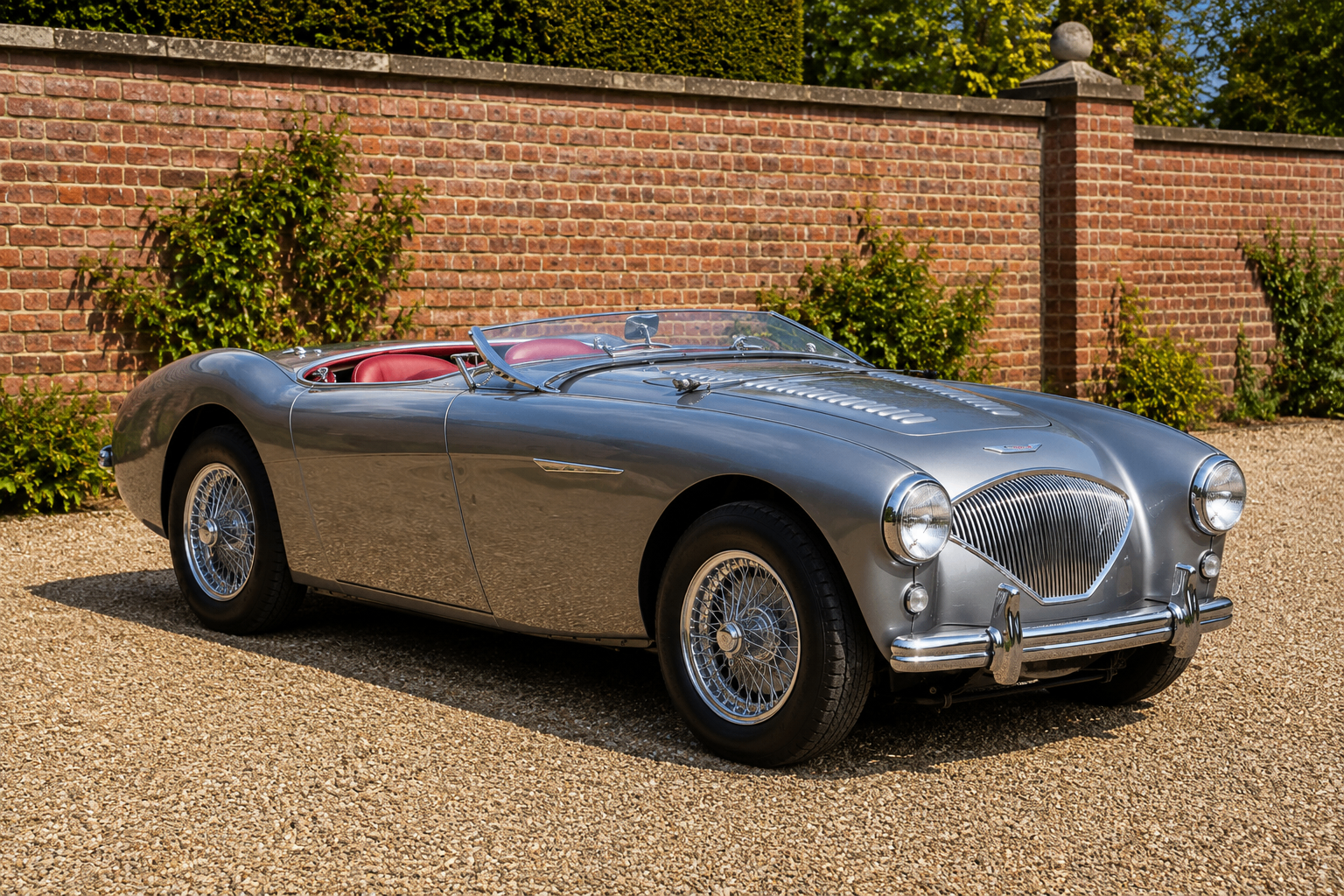
The car that started the 'big Healey' story — the 2.66-litre four-cylinder Donald Healey / Austin collaboration built by Jensen from 1953 to 1956, culminating in the 100M and the aluminium-bodied 100S racer.
The Austin-Healey 100 is the first car of the Donald Healey / Austin partnership and the founding member of the 'big Healey' family. Its origin story is unusually specific: Donald Healey commissioned Tickford to build a single 'Healey Hundred' prototype for the 1952 London Motor Show; the design so impressed Leonard Lord, managing director of Austin, that he offered on the show stand to build it in volume using Austin A90 Atlantic mechanicals, in exchange for the car being renamed the Austin-Healey 100 (source: Wikipedia 'Austin-Healey 100', en.wikipedia.org/wiki/Austin-Healey_100, drawing on Culshaw & Horrobin, Complete Catalogue of British Cars, Macmillan 1974, ISBN 0-333-16689-2). Body styling was by Gerry Coker; chassis engineering by Barry Bilbie, with the front bulkhead innovatively welded to the frame for torsional stiffness and the rear axle underslung to keep the cowl and driving position low.
Production split into two main series:
• BN1 (May 1953 – August 1955) — 10,030 cars built (source: Wikipedia, citing Clausager, Original Austin-Healey 100, 100-Six and 3000, MotorBooks/MBI Publishing, 2002, p. 48, ISBN 978-0-7603-1225-4). 2,660 cc undersquare BMC four-cylinder, 90 bhp, three-speed manual with overdrive on 2nd and top (the A90 gearbox was modified to lock out first gear and effectively provide 4 usable ratios with overdrive). Girling 11-inch drum brakes all round. The Motor tested a BN1 in September 1953: 106 mph, 0–60 mph in 11.2 s, £1,063 including taxes (The Motor, 16 September 1953).
• BN2 (August 1955 – July 1956) — 4,604 cars built including the 100M (source: Wikipedia, citing Clausager 2002). Genuine four-speed manual (still with overdrive on top two gears), slightly larger front wheel arches, revised rear axle, and the first 100 available with two-tone paint (Carmine Red / Reno Red / Spruce Green / Healey Blue / Florida Green / Old English White / Black; roughly 50 cars in the rare Gunmetal Grey — per Clausager as cited on Wikipedia). By January 1956 production was running at 200 cars a month, 150 of them destined for California each month (Wikipedia, citing period source).
BN1 + BN2 total: 14,634 cars (Wikipedia, citing Robson, A-Z of British Cars 1945–1980, Herridge Books 2006, ISBN 0-9541063-9-3). Flag: this figure is universally cited for 'the 100' and does not include the 50 aluminium-bodied 100S race cars or the five 'SPL' works development cars, which were hand-built separately at the Donald Healey Motor Company in Warwick and carry AHS / SPL chassis prefixes rather than BN. Including 100S the widely accepted total is 14,634 + 50 + 5 SPL works = 14,689 — Verify against Clausager 2002 (the primary printed register) if a specific-car provenance depends on it. Bodies were built by Jensen Motors at West Bromwich; final assembly (except the first 20 pre-production cars) took place at Austin's Longbridge plant alongside the A90 (Wikipedia lead section).
The 100 is where 'the big Healey' begins — the direct progenitor of the 100-6 (1956–1959) and the 3000 (1959–1967), and the archetype for the entire six-cylinder era that followed. Three overlapping identities keep the 100 in continuous collector demand: (1) it is the founding four-cylinder 'big Healey' — a materially different driving character to the smoother six-cylinder cars that followed, with a much more purposeful, low-cowled look thanks to the flat-two-piece fold-flat windscreen unique to the 100; (2) the factory-built 100M 'Le Mans' at 640 cars occupies a documented, well-authenticated rarity slot in the collector hierarchy (with a strict per-car authentication protocol via the Registry of Austin-Healey 100M Le Mans); and (3) the aluminium-bodied 100S at 50 production cars plus five SPL works cars is one of the great British sports-racers of the period — the first production car in the world with disc brakes both front and rear (Dunlop, per Wikipedia citing period source), and a car whose top-tier hammer prints have reached £843,000 at Bonhams (Cornbury Park sale, 1 December 2011 — flagged below as a period reference, not verified from a fetched Bonhams page in the current review window). The 100 has firmed rather than re-rated through the 2020–2026 cycle; the material dispersion is between honest standard BN1/BN2 driver cars in the low-USD-30,000s, well-restored BN2 cars in the USD-50,000s to USD-60,000s, factory 100Ms in the mid-USD-70,000s to USD-125,000s at BaT hammer, and the effectively separate 100S market.

Variants
Range and production
Variant
Years
Production
Notes
BN1 — 3-speed with overdrive
May 1953 – August 1955
10,030
10,030 cars built at Longbridge on Jensen-supplied body/chassis units (source: Wikipedia 'Austin-Healey 100', citing Clausager, Original Austin-Healey 100, 100-Six and 3000, MotorBooks/MBI Publishing 2002, ISBN 978-0-7603-1225-4). The BN1 gearbox is famously eccentric: the A90 unit had first gear locked out and overdrive fitted on 2nd and top, giving four usable ratios (1-2-2od-3-3od). The BN1 has smaller front wheel arches and the pre-BN2 chassis and is the more visually 'transitional' 100. The first 20 cars were hand-finished by the Donald Healey Motor Company in Warwick before the Longbridge line came on stream — those pre-production cars are effectively separate from the mainstream BN1 population.
BN2 — genuine 4-speed with overdrive
August 1955 – July 1956
4,604
4,604 cars total, including the 640 factory 100Ms (source: Wikipedia, citing Clausager 2002). Real four-speed manual with overdrive on 3rd and 4th, slightly larger front wheel arches, revised rear axle, and the first 100 available with two-tone paint. Roughly 50 BN2s were built in the rare Gunmetal Grey (per Clausager as cited on Wikipedia). The BN2 is the running-production 100 in demand today: usable gearbox, factory two-tone availability, and the platform on which the 100M is built.
100M — factory 'Le Mans' spec
1955–1956
640
640 factory-built 100Ms — a documented, definable spec, not a paint code (source: Wikipedia 'Austin-Healey 100', citing Clausager 2002, pp. 39, 41–43). The 100M spec bundled the Le Mans Engine Modification Kit (larger 1¾-inch SU carburettors, cold-air box, high-lift camshaft, 8.1:1 compression pistons, 110 bhp at 4,500 rpm), stiffened front suspension, a louvered bonnet with a leather bonnet belt, and — on approximately 70% of 100Ms — a two-tone paint scheme. The Le Mans kit was also sold separately as a BMC accessory for owner-installation on BN1 or BN2 cars, giving roughly 100 bhp; three categories of 'M'-look car therefore exist in the market: (a) BN1/BN2 cars retrofitted in period with the kit; (b) the 640 factory 100Ms; and (c) cars converted to Le Mans specification in later decades (per Wikipedia). Only the factory-registered chassis identification distinguishes the genuine article. The Registry of Austin-Healey 100M Le Mans (100m-registry.org) is the standing per-car authentication reference; every credible 100M sold today should carry a Registry certification alongside the BMIHT Heritage Certificate. Two BaT prints in this review window explicitly cite '1 of 640' status in the catalogue.
100S — factory aluminium-bodied racer
February–November 1955
50
50 production 100S cars hand-built at the Donald Healey Motor Company in Warwick between February and November 1955, carrying AHS chassis prefixes and separate from the Longbridge BN1/BN2 production line (source: Wikipedia, citing Clausager 2002, pp. 41–43). Aluminium body panels; Weslake aluminium cylinder head; 132 bhp at 4,700 rpm; no overdrive; Dunlop disc brakes front and rear (the world's first production car with four-wheel discs per Wikipedia); no bumpers or convertible top; reduced-size grille; plastic windscreen; approximately 200 lb / 91 kg lighter than a standard 100. A separate population of five 'SPL' works development / special test cars carrying the SPL prefix was built in 1953–54, one of which won its class at the 1954 12 Hours of Sebring and prompted the 'S' designation. Two Bonhams-cited period prints for 100S cars are noted in the market commentary below and flagged as un-fetched-in-this-review references, not verified in the current review window.
Buyer's Guide
What to look for
The 100 within the big-Healey story and the four different specification tracks
The 100 is the founding big Healey and is materially different in feel and layout from the six-cylinder 100-6, 3000 and later cars: it has the fold-flat two-piece windscreen (drops flat onto the scuttle for a proper period 'raced-hot' look), a lower cowl, a shorter cabin, no rear seat, and the four-cylinder A90-derived engine rather than the C-series six. Within the 100 range there are four cleanly distinct specification tracks that trade at very different prices: standard BN1 (three-speed with overdrive), standard BN2 (four-speed with overdrive), factory 100M BN2 with the Le Mans kit installed at the factory (640 cars) and certified by the Registry of Austin-Healey 100M Le Mans, and the aluminium-bodied 100S (50 production cars plus five SPL works cars) with disc brakes, no overdrive and Warwick assembly. A 'Le Mans conversion' or 'Le Mans-spec' car in period trim is a fourth-tier category — legitimate and collectible, but not a factory 100M and priced accordingly (BaT April 2026 sold a 1955 BN1 'Le Mans conversion' for US$48,500 — cited in the auctions section below).
Provenance and documentation — BMIHT Heritage Certificate plus Registry certification for 100M
Every serious purchase of a 100 must be supported by a British Motor Industry Heritage Trust (BMIHT) Heritage Certificate for the specific chassis. The Heritage Certificate is the factory-record document confirming original build date, engine number, body colour, trim colour, transmission spec (three-speed on BN1 / four-speed on BN2), and destination. For any car represented as a factory 100M, add a further essential document: certification from the Registry of Austin-Healey 100M Le Mans (100m-registry.org), which maintains the per-car register and verifies factory Le Mans-kit installation against Longbridge records. Without both documents on a 100M, the car should be priced as a Le Mans-conversion BN2, not as one of the 640. For a car represented as an SPL / 100S, further primary-source Donald Healey Motor Company records and AHS-prefix chassis matching are essential — and any credible 100S trades case-by-case with FIA papers and period photography.
Mechanical inspection priorities — 2.66-litre four, overdrive, and the BN1 gearbox quirk
The 2,660 cc BMC four-cylinder is shared with the Austin A90 and is a well-understood pushrod engine — parts are cheap, specialist knowledge is broad, and a healthy engine runs to 80,000+ miles between rebuilds. Priorities at PPI, in order: cylinder head condition (a leak-down test is essential — the head is prone to cracking on overheated cars); front and rear main oil seals (rope seals, universal weepage — a converted lip seal is a plus); SU HD4 (BN1) or HD6 (BN2 / 100M) carburettor condition and correct-number/type match against the Heritage Certificate; Laycock de Normanville overdrive operation on the applicable gears (BN1: 2nd and top; BN2: 3rd and 4th) — an inoperative overdrive is common and rebuildable through the wider British-classic trade; the BN1 A90 gearbox specifically has a known lock-out on first gear (functionally three-speed) — a synchro-rebuilt BN1 gearbox often has that lock-out defeated for driveability, but reversing that to factory spec is required for a concours-grade car. The BaT market file for this review window includes multiple V8-swapped or five-speed-manual-converted 100s (Ford 302, Ford 289, Toyota five-speed) — a legitimate driver-side market, but a completely separate valuation universe from a matching-numbers BN1/BN2.
Body, chassis and the Jensen ladder frame
The 100 is a body-on-chassis car built by Jensen — the ladder-frame chassis runs the length of the car with the rear axle passing under the frame rails (unusually for the period) to keep the cowl low. Corrosion priorities: the chassis rails themselves, particularly at the outriggers under the doors and the rear spring hangers; the footwells behind the pedal box; the rocker panels and lower rear quarters; the boot floor; the lower cowl at the base of the windscreen; and the front and rear inner wings behind the wheels. The 100's low cowl and rocker panels sit closer to the ground than the six-cylinder cars — scrape damage on the exhaust and chassis rails from driveways and speed humps is a well-known service item. On any car with restoration history, verify the reproduction panel supplier — panel fit varies materially between the major UK / US suppliers and door-shut alignment is the fastest tell.
Interior, hood and the fold-flat windscreen
Interior trim priorities: the fold-flat two-piece windscreen is the 100's signature feature and must operate cleanly — verify the pivoting mechanism, the seals, and the fit against the scuttle when folded. Sliding perspex sidescreens are period-correct; a brittle or non-original set is a red flag and expensive to reproduce. The hood frame folds cleanly on a good car; a jammed frame or non-original hood material is a common defect. Original Smiths gauges (speedometer in mph or km/h per market, tachometer, ancillaries) should be checked against the Heritage Certificate. BN2 leather trim, the correct 100M louvered bonnet with bonnet belt, and any factory two-tone paint scheme are all specific value contributors — verify against the Heritage Certificate and (for 100M) Registry certification.
Specification hierarchy and market strategy
The standing collector-market hierarchy on the 100 range is: 100S (works or hand-built Warwick — completely separate tier) > factory 100M with Registry certification, Heritage Certificate, matching-numbers, original two-tone paint > 100M with paperwork gaps > well-restored BN2 in original colour > well-restored BN1 > standard BN2 driver > standard BN1 driver > BN1/BN2 with V8 swap, five-speed conversion or heavy modification. LHD dominates the US trading pool (which is by far the largest); RHD is materially rarer in the trading market outside the UK because most production went to North America in period. Two-tone paint schemes originally offered on BN2 (Reno Red/Black, Healey Blue/White, Black/Reno Red, Florida Green/White, White/Black — per Clausager as cited on Wikipedia) are the collector-market defaults; single-colour BN2s are less commonly restored back to original.
Pricing
What to pay
Standard BN1 or BN2 driver — soft paperwork, honest use, no Heritage Certificate
USD$28,000 – $42,000
GBP£22,000 – £34,000
EUR€28,000 – €42,000
Basis: Bring a Trailer Lot for '24-Years-Owned 1956 Austin-Healey 100 BN2 Roadster' — chassis BN2L228717, Earls Court display car, US-market since dispatch, sold US$31,000 on 8 June 2026 (bringatrailer.com/listing/1956-austin-healey-100-roadster-10/); Bring a Trailer Lot '1955 Austin-Healey 100 BN1 Roadster' (2.7L inline-four, retrofitted 4-speed manual with overdrive, white over black vinyl), sold US$31,000 on 6 January 2026 (bringatrailer.com/listing/1955-austin-healey-100-bn1/); Bring a Trailer Lot '25-Years-Owned 1956 Austin-Healey 100 BN2 Roadster' — 1999 refurbishment, sold US$41,000 on 4 December 2025 (bringatrailer.com/listing/1956-austin-healey-100-bn2-roadster-37-2/). US band anchored directly on these three fetched hammer prints clustering in the low-USD-30,000s to low-USD-40,000s. UK band reflects the UK-market discount to the US market on standard-spec BN1/BN2 drivers (the UK sees larger local supply and does not price RHD as a premium against RHD supply). EU band aligned to the US band given active US↔EU shipping traffic on driver-tier 100s. Regional bands authored independently — NOT FX-converted.
Well-restored BN2 in original two-tone paint, matching numbers, Heritage Certificate
USD$50,000 – $75,000
GBP£40,000 – £62,000
EUR€52,000 – €78,000
Basis: Bring a Trailer Lot '1956 Austin-Healey 100 BN2 Roadster' — early-2000s refurbishment, red and black over red leather with white piping, sold US$51,500 on 24 February 2026 (bringatrailer.com/listing/1956-austin-healey-100-bn2-roadster-41-2/); Bring a Trailer Lot '1956 Austin-Healey 100 BN2 Roadster' — Düsseldorf US Army delivery, Canepa Design refurbishment circa 2011, sold US$59,956 on 30 January 2026 (bringatrailer.com/listing/1956-austin-healey-100-roadster-8/); Bring a Trailer Lot '1955 Austin-Healey 100 BN1 Roadster' — AFIVA-Paris delivery, chassis BN1-L/227211, bid to US$54,500 (unsold, close to hammer level) on 29 April 2026 (bringatrailer.com/listing/1955-austin-healey-100-roadster-16/). US band anchored directly on the two sold prints plus the near-miss BN1 bid; UK and EU bands authored independently against the same specification bar. Regional bands NOT FX-converted.
Factory 100M (BN2) with Registry certification, Heritage Certificate and complete two-tone livery
USD$85,000 – $135,000
GBP£70,000 – £105,000
EUR€90,000 – €140,000
Basis: Bring a Trailer Lot '1956 Austin-Healey 100M BN2 Roadster' — one of 640, chassis BN2L230890, Auto Land Inc. Buffalo NY delivery, sold US$125,000 on 12 April 2026 (bringatrailer.com/listing/1956-austin-healey-100m-roadster-9/); Bring a Trailer Lot '28-Years-Owned 1956 Austin-Healey 100M BN2 Roadster' — one of 640, built 14 March 1956, US delivery, frame-replaced during 2000s refurbishment, sold US$99,100 on 3 December 2025 (bringatrailer.com/listing/1956-austin-healey-100m-roadster-7/); Bring a Trailer Lot '1955 Austin-Healey 100M BN2 Roadster' — one of 640, built 30 November 1955, Virginia delivery, restored by Preserving the Classics, sold US$85,000 on 25 November 2025 (bringatrailer.com/listing/1955-austin-healey-100m-roadster/); Bring a Trailer Lot '1956 Austin-Healey 100M BN2 Roadster' — Fourintune-restored, sold US$77,550 on 6 February 2026 (bringatrailer.com/listing/1956-austin-healey-100m-roadster-8/). US band anchored on this four-print cluster running from mid-USD-70,000s to USD-125,000s at hammer, with the top of the band reflecting factory documentation plus original two-tone paint plus Registry certification. Regional bands NOT FX-converted.
100S (production or SPL works) — separate market
USD$800,000+
GBP£650,000+
EUR€750,000+
Basis: no fetched primary-source auction hammer for a 100S was located within the current review window — the 50-production-car (plus five SPL) 100S trades sparingly and case-by-case. Wikipedia summarises two period prints as reference: an unrestored works SPL Special Test Car sold £843,000 at Bonhams on 1 December 2011, and driver David Shale's '100S' known as 'EVV' sold £673,500 at Bonhams Goodwood Festival of Speed on 27 June 2014. Both prints are cited here as period reference, NOT verified from a Bonhams URL in this review window; the tier is therefore floor-set on the £650k-plus level published by Wikipedia and would require a fresh direct-source fetch and specialist inspection to substantiate on any specific car. Flag: this tier is not a fetched hammer print. Regional bands NOT FX-converted.
Regional ranges authored independently — each reflects its local market, not an FX conversion
Ownership
Living with it
Typical mileage
1,000–3,500 miles typical for collector use; the 100 is genuinely usable as a spirited tourer and Austin-Healey Club events (touring, hillclimbs, vintage racing) actively encourage regular road use.
Service interval
12 months / 3,000 miles at a recognised BMC B-series-derived or big-Healey specialist; annual oil and filter, twice-yearly SU carburettor balance, annual overdrive oil and solenoid check.
Annual running cost
$2,000 – $4,500
Fuel economy
~20–26 mpg imperial combined; touring at motorway speed with overdrive returns the upper end of the band.
Insurance
Agreed-value cover with limited mileage and secure storage is the norm. US premiums typically US$600–US$1,300/yr on a $55k agreed value; UK premiums via Footman James or Hagerty commonly £300–£600/yr on a £45k agreed value with 3,000-mile limit; factory 100Ms sit meaningfully above these bands to reflect the reinstatement cost premium.
Maintenance planning
The 2,660 cc BMC four-cylinder is a well-understood engine with broad specialist support. Priorities to plan for: an SU carburettor rebuild every 15–20 years (HD4 on BN1, HD6 on BN2, larger HD6s on the 100M kit); a Laycock de Normanville overdrive service every 30–40k miles; the rope crank seals (universal weepage — most 100s eventually convert to modern lip seals at engine rebuild); and a chassis inspection every three to five years with the exhaust off. Body and chassis are the cost driver — a full body-off restoration in the UK today runs £60,000–£110,000+ at a top-tier specialist (JME Healeys, Denis Welch Motorsport, Bill Rawles Classic Cars) which puts a firm floor under the value of a documented recent restoration. Factory 100Ms priced at the top of the market carry a reinstatement cost premium via the 100M-specific Le Mans engine kit components and the correct louvered bonnet with bonnet belt.
Parts and specialist access
Mechanical parts availability is excellent. Complete engine, gearbox, brake, suspension, ignition, cooling and trim components are all reproduced or remanufactured by a mature UK / US specialist trade — Moss Motors, A. H. Spares, Cape International, Denis Welch Motorsport, JME Healeys and Bill Rawles Classic Cars are the standing references. Body panels (front wings, rear shrouds, doors, boot lids) are reproduced but panel fit varies materially by supplier; pre-fitting at a specialist bodyshop is standard practice. Trim (leather, carpet sets, hood, sidescreens, tonneau covers) is reproduced correctly by the same trade. 100M-specific components (the Le Mans engine kit, louvered bonnet, bonnet belt, correct instruments) are reproduced but should be sourced through Registry-recognised specialists. The Austin-Healey Club (UK and US) is the standing owner-community reference and hosts the definitive Concours judging standards.
Common Problems
Known issues by system
Chassis — Jensen ladder-frame corrosion
Outriggers, rear spring hangers, floors, boot floor and lower cowl — the single biggest structural risk on a 100
Critical$7,000 – $28,000 (targeted chassis repair through to a full body-off chassis rebuild at a specialist)
Symptoms — Bubbling at the outriggers under the doors, corrosion around the rear spring hangers, rust in the footwells behind the pedal box, weakness at the body-to-chassis mount points.
Inspection — Full underside inspection on a lift with the exhaust removed for visibility; scraper and awl in the outrigger seams, rear spring hangers, boot floor, battery box and lower cowl at the windscreen base. Any car with active outrigger or rear-hanger corrosion needs a body-off strip to inspect properly.
Engine — cylinder-head cracking and rear crank seal
The 2.66-litre BMC four-cylinder head is prone to cracking on overheated cars; the rope rear-crank seal weeps
Major$2,500 – $6,000 (cylinder-head refurbishment or replacement); $1,200 – $2,500 (rope-to-lip crank seal at engine rebuild)
Symptoms — Coolant loss with no visible external leak, oil-water emulsion in the rocker cover or expansion tank, misfires, persistent oil drip below the bellhousing.
Inspection — Full cooling-system pressure test cold and hot; head-off inspection where any cooling anomaly is present; leak-down test on all four cylinders. A weeping rope seal is universal and not a purchase-killer, but a documented conversion to a modern lip seal at last engine rebuild is a plus.
Transmission — BN1 3-speed gearbox, BN2 4-speed and overdrive
BN1 A90 gearbox first-gear lock-out and synchro wear; BN2 synchros; Laycock de Normanville overdrive faults
Moderate$1,000 – $2,500 (solenoid replacement and overdrive service); $3,000 – $6,000 (full gearbox or overdrive rebuild)
Symptoms — Difficulty engaging first gear on a BN1 (or first gear defeated on modified cars), synchro crunch on cold 2nd gear, overdrive fails to engage on the applicable gears (BN1: 2nd and top; BN2: 3rd and 4th), no click from the overdrive solenoid.
Inspection — Full road-test of every gear cold and warm; specific overdrive engagement/disengagement test on the applicable gears; solenoid operation check with a multimeter. Confirm any period lock-out modification (or removal) against Heritage Certificate specification. Rebuildable through the wider British-classic trade at moderate cost.
Body — panel-fit on restored cars and reproduction panel supplier variation
Rear wheel arches, lower rear quarters, sills, boot floor; reproduction panel fit varies by supplier
Major$4,000 – $18,000 (targeted panel replacement and paint refresh at a specialist)
Symptoms — Bubbling at the rear arches, rust ahead of the rear wheels, poor door-shut alignment, uneven panel gaps on cars with recent panel replacement.
Inspection — Full paint-depth gauge over every panel; specific attention to rear arches, lower rear quarters, sills and boot floor. On restored cars, check door-shut alignment and panel gap — a car that fails to shut cleanly typically has poorly-fitted reproduction panels.
Fold-flat windscreen and sidescreens
Signature 100 windscreen mechanism and perspex sidescreens are common defect items
Moderate$1,500 – $4,500 (windscreen seal set, sidescreen refurbishment or replacement)
Symptoms — Windscreen fails to fold flat cleanly, seals brittle or leaking, sidescreens cracked or non-original, sidescreen slides jammed.
Inspection — Physical operation of the fold-flat windscreen at PPI; visual inspection of sidescreens and slides; confirm original-spec fitment. Correctly reproduced sidescreens are expensive; poor reproductions are a common cost-cutting fault.
100M authentication — factory vs. Le Mans-kit conversion vs. later 'Le Mans-spec' build
A material valuation risk — the market pays roughly 2–3× for a certified factory 100M versus a period Le Mans-kit conversion
MajorValuation delta $30,000 – $65,000 (the pricing gap between a certified factory 100M and a Le Mans-kit conversion or Le Mans-spec BN2)
Symptoms — A car represented as '100M' with no Registry of Austin-Healey 100M Le Mans certification and no matching Heritage Certificate; a car whose 100M spec items look period-correct but sit on a non-100M BN2 chassis; a modern Le Mans-spec build.
Inspection — Insist on Registry of Austin-Healey 100M Le Mans certification (100m-registry.org) plus BMIHT Heritage Certificate for any car represented as a factory 100M. Absence of either is not a purchase-killer but must be priced against the standard BN2 tier, not the factory-100M tier.
Electrical — original Lucas wiring loom and Smiths gauges
Symptoms — Intermittent gauge readings, dim or flickering headlamps, blown fuses, tachometer swing, non-functional overdrive despite mechanical health.
Inspection — Full switched-circuit test at PPI; check every gauge, warning lamp and switched item; verify any period-correct rewiring or full loom replacement in the file.
Valuation
Current value bands by region
Concours
USD
$120,000
GBP
£95,000
EUR
€125,000
▬ +2% 12-mo
Excellent
USD
$72,000
GBP
£58,000
EUR
€75,000
▲ +4% 12-mo
Good
USD
$45,000
GBP
£36,000
EUR
€46,000
▲ +3% 12-mo
Fair
USD
$28,000
GBP
£22,000
EUR
€28,000
▬ 0% 12-mo
Project
USD
$12,000
GBP
£10,000
EUR
€12,000
▬ 0% 12-mo
Each region quoted in its local currency — independent market readings, not FX conversions
The 100 market has been strikingly stable through the 2024–2026 review window, with clear and repeatable differentials between the four specification tiers. Fetched primary-source public prints from Bring a Trailer through November 2025 to July 2026 anchor the range. Standard BN1/BN2 drivers cluster in the USD-30,000s: 1956 BN2 sold US$31,000 (Lot #10/2026, 8 June 2026); 1955 BN1 sold US$31,000 (Lot BN1/2026, 6 January 2026); 25-Years-Owned 1956 BN2 sold US$41,000 (4 December 2025). Well-restored BN2 cars in original colour with quality paperwork sit above that at USD-51,500 (Lot #41-2/2026, 24 February 2026) and USD-59,956 (Lot #8/2026, 30 January 2026 — Canepa Design refurbishment). The factory 100M market clears at USD-77,550 (Lot #8/2026, 6 February 2026), USD-85,000 (25 November 2025), USD-99,100 (3 December 2025) and — at the top — USD-125,000 for the well-documented 1956 100M BN2 chassis BN2L230890 (Lot #9/2026, 12 April 2026). The 100S occupies a completely separate tier and did not appear in the fetched review window — Wikipedia-cited period Bonhams prints (£843,000 in December 2011 for an SPL works car; £673,500 in June 2014 for 'EVV') are quoted for reference but were not independently fetched in this review window and are flagged accordingly. V8-swapped and five-speed-converted 100s are legitimate driver-market cars but trade in a completely separate valuation universe from a matching-numbers BN1/BN2 (BaT April 2026 hammered a 289-powered, five-speed 1955 BN1 custom to US$81,500 — not part of the collector valuation tiers above).
Auctions
Recent results
Date
Auction
Car
Mileage
Result
2026-04-12
Bring a Trailer
Online auction
1956 Austin-Healey 100M BN2 Roadster (one of 640 factory 100Ms; chassis BN2L230890; delivered new to Auto Land Inc., Buffalo NY; raced 1956–58 by original owners)
Primary-source verified. Page bringatrailer.com/listing/1956-austin-healey-100m-roadster-9/ fetched directly (5 July 2026) via the Austin-Healey 100 listing index at bringatrailer.com/austin-healey/100/: '1956 Austin-Healey 100M BN2 Roadster … Sold for USD $125,000 on 04/12/2026'. Catalogue: 'one of 640 factory-built 100M "Le Mans" examples produced over a 10-month span in 1955 and 1956'. Top of the fetched-review-window factory 100M market and the current-market anchor for the well-documented factory 100M tier.
—
US$125,000
Sold
2025-12-03
Bring a Trailer
Online auction
1956 28-Years-Owned Austin-Healey 100M BN2 Roadster (one of 640 factory 100Ms; built 14 March 1956, US delivery; 2000s refurbishment with frame replacement)
Primary-source verified. Page bringatrailer.com/listing/1956-austin-healey-100m-roadster-7/ fetched directly (5 July 2026) via the BaT Austin-Healey 100 listing index: '28-Years-Owned 1956 Austin-Healey 100M BN2 Roadster … Sold for USD $99,100 on 12/03/2025'. Secondary anchor for the factory 100M tier — long-term single-family ownership with documented refurbishment.
—
US$99,100
Sold
2026-02-06
Bring a Trailer
Online auction
1956 Austin-Healey 100M BN2 Roadster (one of 640; two-tone red and black over black leather; Fourintune Garage restoration in the 1990s; mechanical refresh 2011 and 2024)
Primary-source verified. Page bringatrailer.com/listing/1956-austin-healey-100m-roadster-8/ fetched directly (5 July 2026) via the BaT Austin-Healey 100 listing index: '1956 Austin-Healey 100M BN2 Roadster … Sold for USD $77,550 on 02/06/2026'. Lower-end factory 100M print reflecting older restoration timing.
—
US$77,550
Sold
2026-01-30
Bring a Trailer
Online auction
1956 Austin-Healey 100 BN2 Roadster (ordered new by US Army officer stationed near Düsseldorf; 1999 US refurbishment; Canepa Design refurbishment circa 2011)
Primary-source verified. Page bringatrailer.com/listing/1956-austin-healey-100-roadster-8/ fetched directly (5 July 2026) via the BaT Austin-Healey 100 listing index: '1956 Austin-Healey 100 BN2 Roadster … Sold for USD $59,956 on 01/30/2026'. Anchor for the well-restored non-100M BN2 tier.
—
US$59,956
Sold
2026-06-08
Bring a Trailer
Online auction
1956 24-Years-Owned Austin-Healey 100 BN2 Roadster (chassis BN2L228717, built October 1955 and assigned for display at the Earls Court Motor Show; US-market since dispatch)
Primary-source verified. Page bringatrailer.com/listing/1956-austin-healey-100-roadster-10/ fetched directly (5 July 2026) via the BaT Austin-Healey 100 listing index: '24-Years-Owned 1956 Austin-Healey 100 BN2 Roadster … Sold for USD $31,000 on 06/08/2026'. Standard-BN2-driver-tier anchor.
—
US$31,000
Sold
All five results above were fetched directly from Bring a Trailer's own Austin-Healey 100 listing index (bringatrailer.com/austin-healey/100/) on 5 July 2026 and each individual listing URL is cited in the note against the specific hammer print. No Bonhams / RM Sotheby's / Gooding / Broad Arrow / Bonhams|Cars Online 100 hammer was independently fetched for this review — the well-known 100S period prints (Bonhams £843,000, 1 December 2011 for an SPL works car; Bonhams Goodwood Festival of Speed £673,500, 27 June 2014 for 'EVV') are cited in the market commentary and 100S valuation tier as period reference only and are NOT verified from a fetched Bonhams URL in this review window. UK-market pricing in the valuation and 'what to pay' tables therefore draws on the UK specialist-trade context (JME Healeys, Denis Welch Motorsport, Bill Rawles Classic Cars — the standing UK big-Healey specialist reference points) rather than a fetched UK auction hammer. Every reference to a factory 100M above ('one of 640') originates in the BaT catalogue text and should be substantiated on any specific car via a Registry of Austin-Healey 100M Le Mans certification (100m-registry.org) plus BMIHT Heritage Certificate — the Registry maintains the per-car authentication register that separates the 640 factory 100Ms from period Le Mans-kit conversions and later Le Mans-spec builds.
Investment
Long-term outlook
StableHorizon: 5–10 years
The 100 sits in a mature, well-supported segment of the British sports-car market and has firmed rather than re-rated through 2020–2026. Three tailwinds keep the case constructive over a 5–10-year horizon: (1) deep US and UK specialist-trade infrastructure (JME Healeys, Denis Welch Motorsport, Bill Rawles Classic Cars, Cape International, Moss Motors, A. H. Spares) — no parts or knowledge risk; (2) the enduring cultural position of the 100 as the founding big Healey, with the unique fold-flat windscreen visual identity that separates it from the six-cylinder cars that followed; (3) a well-defined and well-authenticated 100M tier (640 cars, Registry-certified) that commands a firm 2–3× premium over standard BN2 drivers and appears to be structurally sticky through market cycles. Best buys are factory 100M BN2 cars with full Registry certification, BMIHT Heritage Certificate, matching-numbers engine, original two-tone paint and the correct louvered bonnet with bonnet belt — cars in that spec at the current USD-95,000–USD-125,000 band are the clearest hold in the 100 range. For the collector willing to accept driver-tier ownership, a well-restored non-100M BN2 in original colour at USD-55,000–USD-65,000 is the next-best value. The 100S sits in a completely separate, thinner and more volatile market and is not part of this general-production thesis.
Long-established UK marque specialist — full body-off restoration, mechanical rebuild, concours preparation and Austin-Healey Club show-standard work for the 100 / 100-6 / 3000.
US-market big-Healey restoration specialist — noted on BaT Lot #8/2026 as the restorer of a factory 100M BN2 that sold for US$77,550 on 6 February 2026.