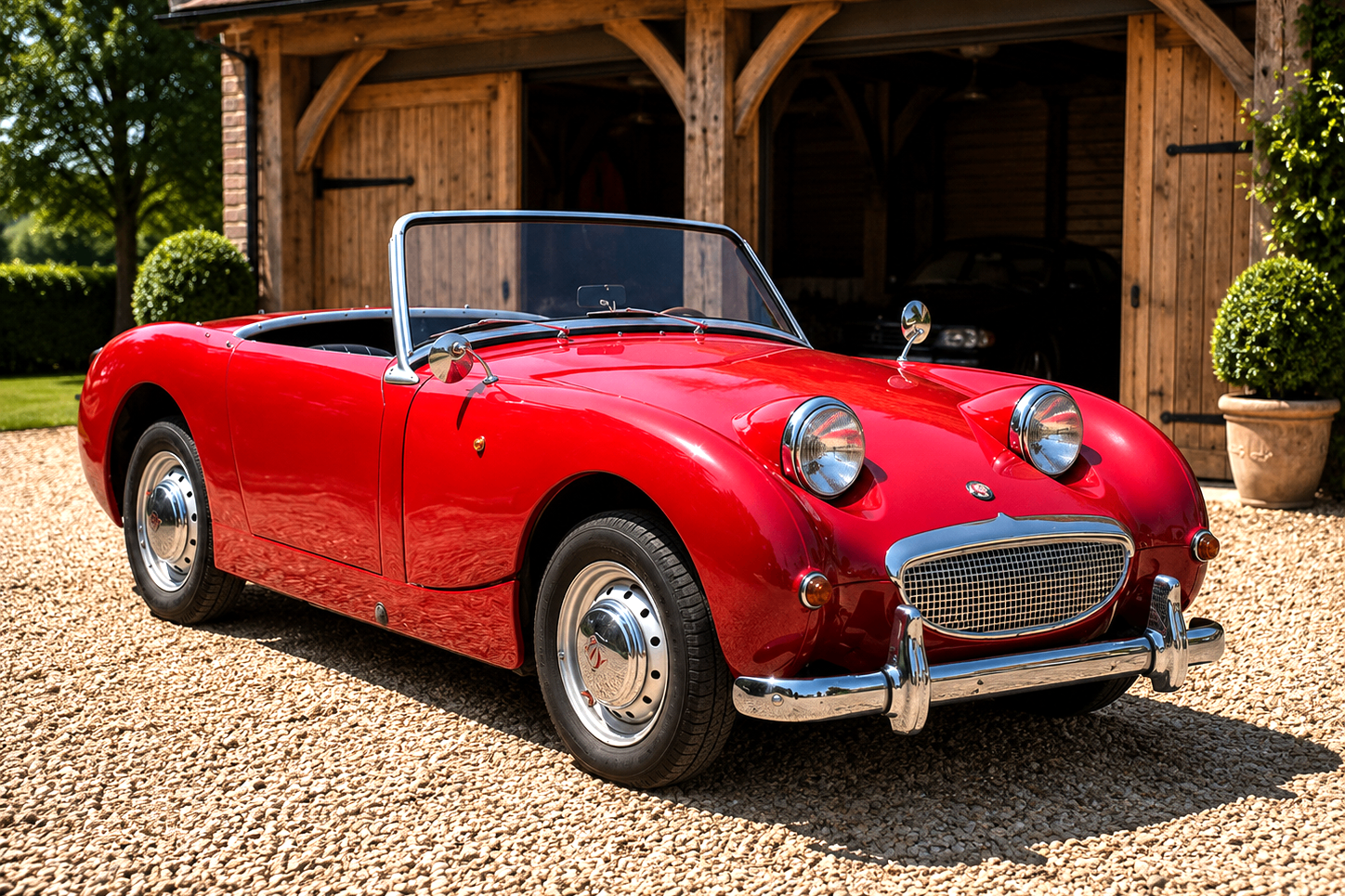
The 948cc BMC 'chap could keep in his bike shed' sports car — the world's first volume-production sports car built on unitary construction, and the founding member of the Spridget family.
The Austin-Healey Sprite Mark I — universally the 'Frogeye' in the UK and 'Bugeye' in the US — is the small-Healey origin story. Announced to the press by the British Motor Corporation in Monte Carlo on 20 May 1958 (two days after the Monaco Grand Prix), it was designed by the Donald Healey Motor Company to Leonard Lord's brief for an affordable sports car 'a chap could keep in his bike shed' and built at the MG factory at Abingdon. It sold new at £669, powered by a tuned 948 cc BMC A-series inline-four with twin 1⅛-inch SU carburettors (43 bhp at 5,200 rpm), and shared components liberally with the Austin A35 (front suspension) and Morris Minor 1000 (rack-and-pinion steering) to keep costs down (per Culshaw & Horrobin (Complete Catalogue of British Cars, Macmillan, 1974) and Robson (A-Z of British Cars 1945–1980, Herridge, 2006)).
The Frogeye's engineering importance is often forgotten behind the face: Barry Bilbie's chassis, adapted from Jaguar D-type thinking, made the Sprite the world's first volume-production sports car to use unitary construction — the sheet-metal body panels (apart from the front clam) take the structural loads (per period sources). The front clam — bonnet, wings and grille surround, hinged at the scuttle and lifting as a single piece — was originally designed to house retracting headlamps that would face skyward when not in use (a solution used decades later on the Porsche 928); BMC deleted the mechanism for cost and fixed the headlamps in the upright bug-eyed position that made the car famous (per published references). There are no exterior door handles, no boot lid, and access to the spare wheel is via the seat backs and under the rear deck — 'likened to potholing' as period owners described it (per published references).
Production ran from 1958 to 1961 with a single powertrain (948 cc, 9CC engine code, 43 bhp), a total of 48,987 Frogeye Sprites built (per Robson (A-Z of British Cars 1945–1980, Herridge, 2006)). A period test by The Motor in 1958 recorded 82.9 mph, 0–60 mph in 20.5 s, 43 mpg imperial and a test price of £678 including £223 of taxes (per The Motor, 1958). The Frogeye was replaced in May 1961 by the square-bodied Mk II Sprite (headlamps in conventional wing positions, opening boot lid, badge-engineered as the MG Midget) — everything from Mk II onwards is a 'Spridget', not a Frogeye. The Frogeye is a single, unrepeated three-year run and the only Sprite that carries the original design's clam-front and quarter-elliptic rear suspension architecture.
The Frogeye is a cornerstone entry-level British sports car and one of the most affectionately regarded shapes in the entire post-war British motor industry. Three overlapping identities keep it in permanent collector demand: (1) design — the one-piece hinged front clam and the fixed upright headlamps are one of the two or three most instantly recognisable British sports-car faces of the 1950s, and the Frogeye is the only Sprite that looks like this (from May 1961 onwards it's a Spridget, styled to look like a mini MGB); (2) engineering — the world's first volume-production unitary-construction sports car, a genuinely important footnote in car engineering history that trades at prices below what its historical importance would suggest; (3) competition heritage — active BMC Competitions Department entries (class win on the 1958 Alpine Rally with John Sprinzel/Willy Cave; class win at Sebring in 1959) plus the entire independent Sebring-Sprite / Speedwell / WSM privateer culture that grew around the platform. The Frogeye is not the pointy end of the collector-car market — a strong driver is a five-figure car — and that is part of the appeal: it is one of the very few genuinely historic 1950s British sports cars that a working enthusiast can still credibly buy, run and show.
Variants
Range and production
Variant
Years
Production
Notes
Sprite Mk I 'Frogeye' — 948 cc
May 1958 – May 1961
48,987
48,987 cars built at the MG factory at Abingdon (per Robson (A-Z of British Cars 1945–1980, Herridge, 2006)). Single powertrain across the run: 948 cc BMC A-series inline-four (engine code 9CC) with twin 1⅛-inch SU carburettors, 43 bhp at 5,200 rpm, 52 lb·ft at 3,300 rpm; four-speed manual with synchromesh on the upper three ratios; 13-inch pressed-steel disc wheels; drum brakes all round; quarter-elliptic leaf-sprung live rear axle located by top links. No exterior door handles, no boot lid, one-piece front clam. Dominant export market was North America (the UK-market car quickly became known as the 'Frogeye', the US-market car as the 'Bugeye'). A small Australian assembly ran at Enfield, New South Wales alongside the UK Abingdon line (per published references).
Buyer's Guide
What to look for
Frogeye vs. Spridget — why the Mk I is a different car
Everything from the May 1961 Mk II onwards is a 'square-bodied' Sprite (or its MG Midget twin) — headlamps repositioned into the front wings, full-width grille, opening boot lid, and — from Mk III (March 1964) — semi-elliptic rear springs and exterior door handles. The Frogeye is the only Sprite that carries the one-piece hinged front clam, the fixed upright headlamps, the quarter-elliptic rear suspension architecture, the no-boot-lid rear deck and the no-exterior-door-handle body. It looks like nothing else and is bought for that reason. In collector-market terms, the Mk I stands cleanly apart from the Spridget population; a Mk II or later 'Sprite' is not a substitute for a Frogeye at the buying level and does not trade like one.
Provenance and documentation — Heritage Certificate first, then history file
Every serious Frogeye purchase should be supported by a British Motor Industry Heritage Trust (BMIHT) Heritage Certificate confirming the chassis number, engine number (9CC prefix), original body colour, trim colour, transmission spec, dispatch date and destination market. Frogeyes were dispatched heavily to the United States, and a US-market Bugeye returning to the UK today is a legitimate car but should be priced against its documented history — repatriation is common on this platform and does not itself carry a premium. The market values a matching-numbers Frogeye with an intact 948 cc drivetrain materially above the (numerous) cars that have received retrofitted 1,098 cc or 1,275 cc A-series engines and rib-case gearboxes for driveability — those upgrades are a legitimate long-standing club practice, but they are a driver-market feature, not a matching-numbers feature.
Mechanical inspection priorities — 948 cc A-series and the drivetrain
The 948 cc A-series is one of the best-supported engines in the entire British classic trade and there is essentially no parts or knowledge risk. PPI priorities, in order: engine number confirmed against Heritage Certificate (9CC prefix on Frogeye — a car represented as matching-numbers with a later 10CG / 12CC / 12CG block is not what the Heritage Certificate describes); cylinder-head condition and compression / leak-down test on all four cylinders; SU HS2 carburettor condition and correct-spec match; front and rear main-bearing oil leaks (the Frogeye is an early A-series and pre-dates the later engines' improved rear main sealing — some seepage is universal); clutch and gearbox operation (the small-A-series ribcase gearbox is durable but tired synchromesh on 2nd gear is a classic tell); rear-axle whine; and — specifically for the Frogeye — the quarter-elliptic rear-suspension top locating links and their body-mount points, which carry structural loads that later Sprites route through semi-elliptic springs.
Body, chassis and the unitary-construction risk
Because the Frogeye is a unitary-construction car with structural loads travelling through the sheet-metal body panels (per published references — the world's first volume-production sports car so built), corrosion is not cosmetic — it is structural. Priorities: the front chassis rails projecting forward from the scuttle (which support the front suspension and locate the hinged clam); the sills, particularly the inner sill and closing-panel; the floors and footwells; the rear inner wings and boot floor; and — critically — the rear body attachment points and quarter-elliptic top-link mounts. The one-piece front clam itself is prone to stress cracks around the scuttle hinge and headlamp pods on cars that have been dropped hard on the hinges; verify smooth operation and correct gap all around the scuttle joint. Reproduction panels and complete steel body shells are available through the UK / US small-Healey trade (Cape International, Frontline Developments, BugEyeGuys — noted on multiple BaT catalogues in this guide window — Moss Motors, A. H. Spares), but panel fit varies materially by supplier and pre-fitting at a specialist bodyshop is standard practice.
Originality vs. modification and specification hierarchy
The Frogeye trading pool contains four broad specification categories at very different valuations: (1) matching-numbers 948 cc, standard-spec, original-drivetrain cars with Heritage Certificate — the top of the collector market; (2) originally standard cars sympathetically upgraded with a rib-case gearbox, a later 1,098 cc or 1,275 cc A-series engine, front disc brakes (Mk II onwards spec) and negative-earth electrics — a legitimate driver market that trades right through the middle band; (3) period competition Sprites (Sebring Sprites, Speedwell, WSM, John Sprinzel-associated cars) — trade case-by-case with FIA papers and period photography and are outside the general Frogeye valuation ladder; and (4) coachbuilt or heavily modified cars (Ashley GT coupes, WSM coupes, drag-race and hillclimb specials) — a specialist market unto themselves. Buy the specification you actually want to own; do not pay matching-numbers money for an upgraded driver, and do not pay driver money for a documented matching-numbers Heritage Certificate car.
Ownership
Living with it
Typical mileage
1,500–4,000 miles typical — the Frogeye is one of the most usable small British sports cars of the period and Austin-Healey Club members regularly use theirs on touring events, hillclimbs and vintage racing.
Service interval
12 months / 3,000 miles at a recognised BMC A-series specialist; annual oil and filter, twice-yearly SU carburettor balance, annual grease of front suspension and steering.
Annual running cost
$900 – $2,200
Fuel economy
~40–45 mpg imperial combined (34–38 mpg US) — the 948 cc A-series is genuinely economical
Insurance
Agreed-value cover with limited mileage and secure storage is the norm. US premiums typically US$300–US$650/yr on a US$18k agreed value; UK premiums via Footman James or Hagerty commonly £150–£300/yr on a £15k agreed value with 3,000-mile limit — the Frogeye is one of the cheapest 1950s British sports cars to insure.
Maintenance planning
The 948 cc A-series is a sixty-year-old, extremely simple pushrod four-cylinder with the deepest parts and knowledge base of any British classic engine. Priorities to plan for: an SU HS2 carburettor rebuild every 15–20 years; a distributor points-and-condenser service annually (or electronic-ignition conversion, near-universal today and welcomed by the market); a gearbox rebuild at 60,000–80,000 miles (the small ribcase is durable but 2nd-gear synchromesh is the usual weak point); and a body / chassis inspection every three to five years. A full body-off restoration in the UK today runs £30,000–£55,000 at a top-tier small-Healey specialist (Cape International, Frontline Developments, Bill Rawles Classic Cars) — which places a firm floor under the value of a documented recent restoration and explains why quality driver cars trade above what the parts-cost arithmetic alone would suggest.
Parts and specialist access
Parts availability is exceptional. Complete engine, gearbox, brake, suspension, ignition, cooling, electrical and trim components are all reproduced or remanufactured — Moss Motors (US), A. H. Spares (UK), Cape International (UK), Frontline Developments (UK), Bill Rawles Classic Cars (UK) and BugEyeGuys (US — the standing US-market Frogeye service specialist) are the standing references. Body panels — front clam sections, sills, floors, rear inner wings — are reproduced but panel fit varies materially by supplier and pre-fitting at a specialist bodyshop is standard practice. Trim (vinyl, carpet sets, hood, sidescreens, tonneau covers) is reproduced correctly by the same trade. The Austin-Healey Club (UK and US) plus the Bugeye Sprite Club (US) are the standing owner-community references.
Common Problems
Known issues by system
Body / chassis — unitary-construction corrosion
Sills, floors, front chassis rails, rear inner wings and — specifically Frogeye — quarter-elliptic top-link mounting points
Critical$4,000 – $18,000 (targeted body / chassis repair through to a full body-off shell rebuild at a specialist)
Symptoms — Bubbling at the sills and lower rear quarters, rust in the footwells and boot floor, movement or corrosion at the quarter-elliptic top-link body-mount points, poor door-shut alignment and uneven panel gaps.
Inspection — Full underside inspection on a lift with the exhaust removed; scraper and awl in the sills, floors, rear inner wings, boot floor and — specifically — the quarter-elliptic top-link body-mount points that carry rear-suspension loads directly into the shell. Any car with active corrosion at those top-link points needs a proper shell-off strip to inspect and repair correctly.
Front clam and scuttle hinge
One-piece hinged front clam — signature Frogeye feature and a specific defect item
Moderate$1,500 – $6,000 (targeted repair through to full clam replacement and repaint)
Symptoms — Cracks around the scuttle hinge, damage at the headlamp pods on cars dropped hard on the hinges, poor gap around the scuttle joint, difficulty aligning the clam when reinstalled after service.
Inspection — Physical operation of the clam at PPI — lift, hold, verify smooth hinge action and clean seating on closure; visual inspection of the scuttle-hinge area for stress cracks; check headlamp-pod alignment for accident-repair history.
Engine — 948 cc A-series originality vs. later-A-series retrofit
Matching-numbers 9CC engines vs. common retrofit of 1,098 cc / 1,275 cc later A-series units
MajorValuation delta $8,000 – $18,000 (the pricing gap between a matching-numbers 948 cc Frogeye and a later-A-series-engined driver)
Symptoms — Engine number does not match the 9CC prefix documented on the Heritage Certificate; larger later-A-series block visible on inspection; rib-case gearbox in place of the original 'smooth-case' unit.
Inspection — Read engine number stamped on the block; cross-reference to the BMIHT Heritage Certificate for the specific chassis. A later A-series retrofit is a legitimate driver upgrade but places the car firmly in the driver tier — not the matching-numbers concours tier.
Transmission — small-A-series ribcase gearbox
2nd-gear synchromesh wear on the original small-case four-speed
Moderate$1,500 – $3,500 (original small-case rebuild); $2,500 – $5,000 (rib-case retrofit including sourcing the correct gearbox)
Symptoms — Crunch on cold 2nd-gear engagement, occasional jumping out of gear under overrun, whine that changes with road speed.
Inspection — Full road-test of every gear cold and warm; specific attention to 2nd-gear cold engagement; verify against any receipt for a gearbox rebuild or rib-case replacement (a rib-case retrofit is common and welcomed on driver cars, but again should be priced against the driver tier, not the matching-numbers tier).
Rear suspension — quarter-elliptic springs and top links
Frogeye-specific rear-suspension architecture; loads travel through the shell
Major$1,500 – $4,000 (quarter-elliptic spring pack replacement and top-link overhaul)
Symptoms — Sagging ride height at the rear, cracking or corrosion at the quarter-elliptic mount points, movement in the top locating links, uneven rear tyre wear.
Inspection — Physical inspection of the quarter-elliptic springs, top-link mount points and shackle bushes; ride-height measurement each side; check for corrosion at every body-mount point. From Mk III onwards the Sprite reverted to semi-elliptic springs — do not accept semi-elliptic conversions as a substitute for correctly restored quarter-elliptic architecture on a car represented as concours.
Electrical — original Lucas positive-earth wiring and instruments
Aged Lucas loom, positive-earth original electrics, brittle insulation
Symptoms — Intermittent gauge readings, dim or flickering headlamps, blown fuses, non-functional turn signals. A period-correct positive-earth car is desirable on a concours-tier example; a negative-earth conversion (near-universal on driver cars) is welcomed on that tier but noted against Heritage Certificate specification.
Inspection — Full switched-circuit test at PPI; check every gauge, warning lamp and switched item; verify any full loom replacement in the file; confirm earth polarity against seller representation and Heritage Certificate.
Brakes — four-wheel drum system
Original Frogeye is drums all round; front discs appear from Mk II Convertible-spec onwards
Moderate$400 – $1,500 (full drum-brake overhaul); $1,000 – $2,500 (front-disc conversion, if desired as a driver upgrade)
Symptoms — Long pedal, pulling under braking, wheel-cylinder leakage, glazed shoes. Front-disc conversions to Mk II / MG Midget spec are a common driver upgrade — legitimate but again a driver-tier feature not a matching-numbers one.
Inspection — Full brake road-test on the level and downhill; visual inspection of wheel cylinders for leakage; specific check of any front-disc conversion for correct fitment and consistent pedal feel.
1959 Austin-Healey Bugeye Sprite (white with red accents, 948cc, project-completed)
—
US$14,750
Sold
2026-04-22
Bring a Trailer
Online auction
1960 Austin-Healey Bugeye Sprite (Union Jack British Auto Restoration & Repair refurbishment 2009, San Jose delivery)
—
US$17,050
Sold
2026-04-13
Bring a Trailer
Online auction
1959 Austin-Healey Bugeye Sprite (right-hand-drive, UK-supplied, refurbished 2005 in Dubai, relocated to British Columbia)
—
US$31,000
Sold
2026-04-06
Bring a Trailer
Online auction
1960 Austin-Healey Bugeye Sprite (green over green vinyl, 948cc original-spec inline-four)
—
US$18,250
Sold
Investment
Long-term outlook
StableHorizon: 5–10 years
The Frogeye sits in a mature, well-supported segment of the British sports-car market and has been strikingly range-bound through the 2020–2026 cycle. Three factors keep the case constructive over a 5–10-year horizon: (1) the shape is one of the most recognisable British sports-car faces of the 1950s and the only three-year run of the original Mk I clam-front design — the Spridget is not a substitute and does not trade like one; (2) parts, specialist and community infrastructure is exceptional (Cape International, Frontline Developments, Bill Rawles Classic Cars, Moss Motors, A. H. Spares, BugEyeGuys) — no meaningful parts or knowledge risk; (3) entry-price economics — a running Frogeye is a five-figure car and continues to serve as one of the very few genuinely historic 1950s British sports cars that a working enthusiast can credibly buy, run and show. The cleanest long-term case is a matching-numbers 948 cc car with BMIHT Heritage Certificate at the concours-preparation tier; the best value is a well-sorted, sympathetically-upgraded driver in the high-USD-teens. Period-competition Sebring / WSM / Speedwell cars sit in a separate, thinner and more volatile specialist market and are not part of this general-production thesis.
Our view, not advice. This section is Car Collector International's editorial judgement on where this model sits in the collector market, based on the production, specification and market data set out in this guide. It is not a recommendation to buy or sell and it is not investment advice. Values can fall as well as rise.
Austin-Healey parts, restoration and sales specialist; long-standing supplier of correct-spec trim, chassis and mechanical components for the Sprite Mk I.