Car Collector International
Classic · 1959–1967

Austin-Healey 3000

The definitive 'big Healey' — BMC's 3-litre inline-six sports car built by Jensen and assembled at Abingdon from 1959 through 1967 across four series and roughly 42,926 cars.

Roadster2+2 RoadsterSports Convertible
Car Collector International Editorial
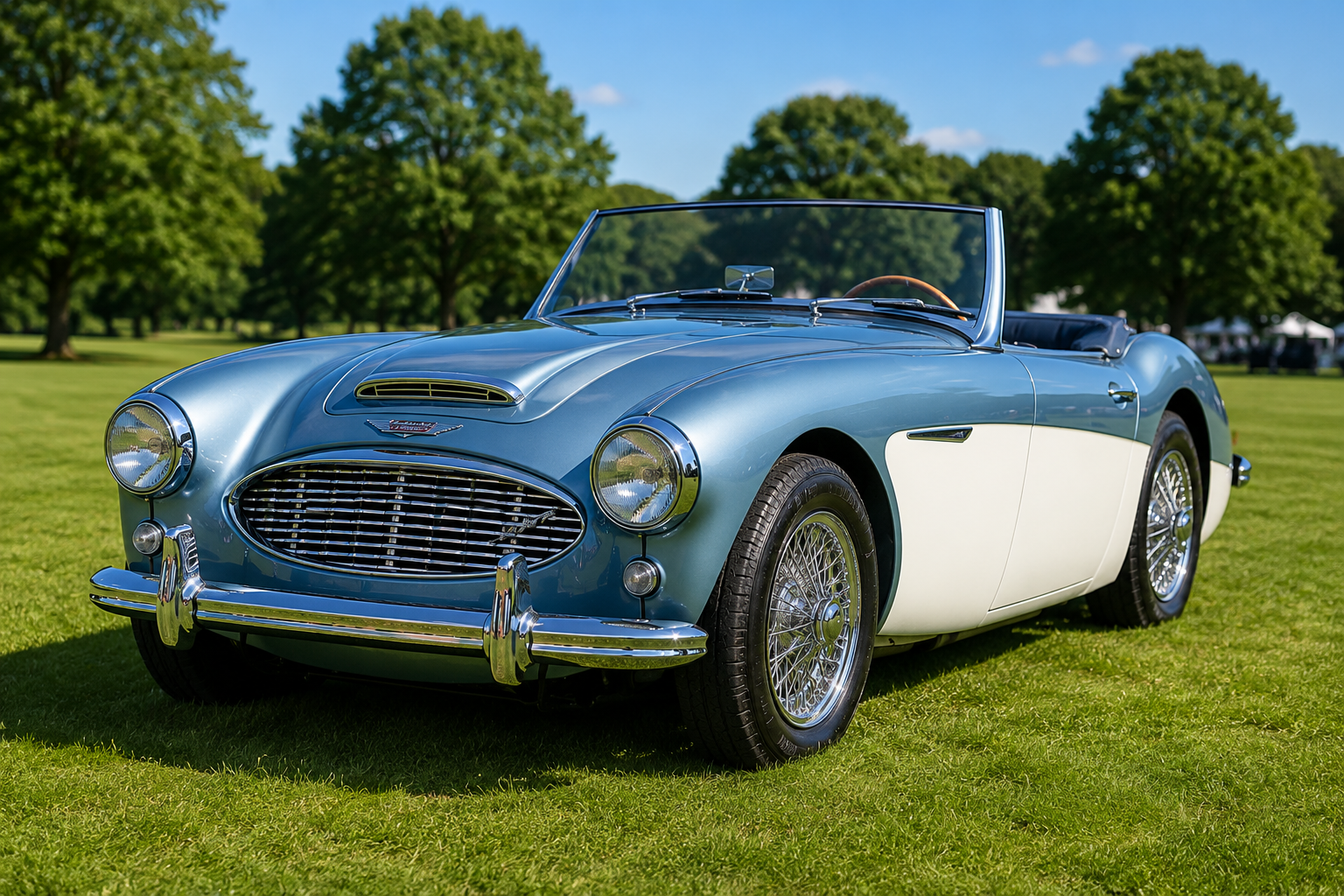
Ice Blue and Old English White Austin-Healey 3000 photographed front three-quarter on a manicured concours lawn with mature parkland trees behind — user-supplied image; meets the concours/estate brief.
Overview

Why this car matters

The Austin-Healey 3000 is the culmination of Donald Healey's collaboration with BMC and the definitive 'big Healey'. Announced on 1 July 1959 as the successor to the 100-6, it retained the same 92-inch wheelbase Jensen-built body and Abingdon MG Works assembly line, but adopted a 2,912 cc BMC C-Series inline-six and front disc brakes — the two changes that separate the 3000 from every earlier big Healey (source: Wikipedia 'Austin-Healey 3000', en.wikipedia.org/wiki/Austin-Healey_3000, citing The Times, No. 54501, 1 July 1959, and The Motor road test, 13 July 1960).

Production ran in three main marks:

• Mark I (BN7 roadster / BT7 2+2), 1959–May 1961 — 13,650 cars in total, split as 2,825 BN7 open two-seaters and 10,825 BT7 2+2s (source: Wikipedia, citing Clausinger, Original Austin-Healey — The Restorer's Guide to 100, 100-Six and 3000, Bay View Books, 1990, ISBN 1-870979-13-3). Twin SU HD6 carburettors, 124 bhp.

• Mark II (BN7 / BT7 with triple-SU engine, then BJ7 sports convertible), May 1961–1963 — 11,564 cars in total, split as 355 BN7 open two-seaters, 5,096 BT7 2+2s and 6,113 BJ7 2+2 sports convertibles (Wikipedia, citing Clausinger). Announced with three SU HS4 carburettors and an improved camshaft (The Times, No. 55093, 29 May 1961). The BJ7 (August 1962) introduced the wrap-around windscreen, wind-up windows and the first true 'convertible' big Healey — the transitional Mk II is the shortest-lived of the marks and the two-seater BN7 Mk II (355 cars) is the rarest core-production 3000.

• Mark III (BJ8 sports convertible), February 1964–end of 1967 — 17,712 cars (Wikipedia, citing Clausinger). Power raised from 136 bhp (BJ7 twin SU HS6) to 150 bhp via a new higher-lift camshaft and twin SU HD8 carburettors; power-assisted brakes standard, redesigned centre-console fascia with instruments moved in front of the driver (The Times, No. 55947, 28 February 1964). In May 1964 the 'Phase II' Mk III arrived with a modified rear chassis for greater ground clearance; in March 1965 separate indicator lights.

Total 3000 production across all four series is therefore 13,650 + 11,564 + 17,712 = 42,926 cars — a figure derived directly from the Clausinger register totals as re-published on Wikipedia and consistent with the total quoted across the Austin-Healey Club and the Healey Museum. Flag: Verify at the level of a specific chassis via the British Motor Industry Heritage Trust (BMIHT) Heritage Certificate, which is the primary-source per-car document for any Abingdon-built BMC car and is universally referenced at auction (every BaT-listed 3000 in the fetched market file discusses a Heritage Certificate).

Body-in-white was built by Jensen Motors at West Bromwich and shipped to the MG Works at Abingdon for final assembly alongside the MGA and MGB (Wikipedia lead section). In 1963, 91.5% of all Austin-Healey 3000 production was exported, mostly to North America (Wikipedia, citing The Times, No. 55947, 28 February 1964) — the direct reason the US market remains the largest single trading pool for the 3000 today.

The 3000 is the definitive British six-cylinder sports car of the late 1950s and 1960s — the period rival to the Jaguar XK150 / early E-Type six-cylinder and the Triumph TR3/TR4, and the single most successful BMC works rally car of its era. It has three overlapping collector-market identities that keep it in continuous demand: (1) the archetypal big-inline-six British sports car, with a well-defined values curve that has held remarkably steady since the 2013–2015 re-rate of the post-war British sports car market; (2) the works BMC Competitions rally car — Pat Moss's 1960 Liège-Rome-Liège victory in 'URX 727' (per the Wikipedia racing summary), the 1960s Monte Carlo, RAC and Alpine campaigns — which puts a small population of factory works cars in a completely separate market bracket; and (3) a genuinely usable, well-supported classic where parts are cheap, specialist knowledge is broad, and the Austin-Healey Club infrastructure is stronger than for almost any other British sports car of the era. The 3000 is also the car whose replacement the MGC was widely considered a failure — the reason the 'big Healey' is still culturally shorthand for what a British sports car ought to feel like.

Variants

Range and production

VariantYearsProductionNotes
Mk I (BN7 / BT7) — 1959 to May 19611959–196113,65013,650 total — 2,825 BN7 open two-seaters and 10,825 BT7 2+2s (source: Wikipedia 'Austin-Healey 3000', citing Clausinger, Original Austin-Healey, Bay View Books, 1990, ISBN 1-870979-13-3). 2,912 cc BMC C-Series six, twin SU HD6 carburettors, 124 bhp claimed; front disc brakes standard, wire wheels and overdrive optional. The Mk I is the purest 'transitional' big Healey — steel-framed roof, sliding perspex sidescreens, minimal weather protection. The two-seater BN7 is materially rarer than the BT7 2+2 (2,825 vs. 10,825) and is the collector default within the Mk I range.
Mk II (BN7 / BT7 triple-SU roadsters, then BJ7 sports convertible)May 1961–196311,56411,564 total — 355 BN7 open two-seaters, 5,096 BT7 2+2s and 6,113 BJ7 2+2 sports convertibles (Wikipedia, citing Clausinger). May 1961: triple SU HS4 carburettors and an improved camshaft (The Times, No. 55093, 29 May 1961); vertical-bar front grille; optional brake servo from August 1961. The BN7 Mk II was discontinued in March 1962 and the BT7 Mk II in June 1962 — the BN7 Mk II at just 355 cars is the rarest mainstream-production 3000. August 1962: the BJ7 sports convertible replaced both roadsters, introducing the wrap-around windscreen, wind-up side windows, swivelling quarter-lights, a quick-action folding roof, and a switch to twin SU HS6 carburettors (a 9.25% total-area reduction versus the triple HS4s).
Mk III (BJ8) — Phase I and Phase IIFebruary 1964–end of 196717,71217,712 total (Wikipedia, citing Clausinger). Announced February 1964 (The Times, No. 55947, 28 February 1964): 150 bhp via a new higher-lift camshaft and twin SU HD8 carburettors (choke size increased from 1.75 to 2 inches — total area up 30.6% vs. the BJ7's HS6 pair); power-assisted brakes standard; redesigned centre-console fascia with speedometer and tachometer moved directly in front of the driver; Ambla vinyl upholstery. Phase II from May 1964 introduced a modified rear chassis with greater ground clearance (widely cited as the definitive Mk III spec); separate indicator lights from March 1965. The BJ8 is the highest-power, most usable and — in Phase II form — the collector-market default 3000.
4000 Mk IV — factory prototype, 3 built1966–19673Three factory-built 'Austin-Healey 4000 Mk IV' prototypes — two automatics and one manual (Jaguar E-Type four-speed) — with bodywork widened by six inches and a 3.9-litre aluminium Rolls-Royce engine (the same unit as the Vanden Plas 4-litre R) intended as a replacement for the 3000. Source: Wikipedia 'Austin-Healey 3000', citing Lillywhite, David, 'Healey Heaven', Octane, Vol. 2, No. 18, December 2004, p. 66. Not a production model and not part of the 42,926-car 3000 total — flagged here as a factory-built rarity for completeness. Any '4000' in the market is either one of the three prototypes or a period Healey Automobile Consultants uprate; the two are not equivalent and should be treated case-by-case.
Buyer's Guide

What to look for

The 3000 within the big-Healey and BMC sports car story

The 3000 is the closing chapter of the 'big Healey' — the last of the Donald Healey / Jensen / Abingdon collaboration that began with the 100 in 1953. Its direct predecessor is the 2.6-litre 100-6; its intended replacement is the MGC (a monocoque MGB with a new C-Series-derived six), which is widely regarded as a lesser car and is the reason the 3000 has never lost its cultural position. Within the 3000 range itself, the market has firmed around four archetypes: the Mk I two-seater BN7 (2,825 built — the rarest first-series car); the Mk II BJ7 sports convertible (6,113 built — the first true wind-up-window big Healey); the Mk III BJ8 Phase II (the majority of the 17,712 Mk IIIs — 150 bhp, power brakes, proper convertible top); and, in a bracket of its own, the works BMC Competitions rally cars registered in period (see the works cars note below).

Provenance and documentation — the Heritage Certificate is non-negotiable

Every serious purchase must be supported by a British Motor Industry Heritage Trust (BMIHT) Heritage Certificate for the specific chassis. The Heritage Certificate is a factory-record document confirming original build date, engine number, body colour, trim colour, options fitted and destination — it is the primary-source document referenced across BaT throughput and by every specialist. Cars trading in the market today are typically 55+ years from the factory; body-off restorations, engine swaps, colour changes and factory-spec deviations are the norm rather than the exception, and the Heritage Certificate is the only way to reconstruct the car's original specification. Priorities at PPI: Heritage Certificate matching the chassis; matching-numbers C-Series engine (or a documented later BMC C-Series replacement — extremely common and not a value killer if documented); original colour scheme (documented restorations back to original colour clear a premium); complete Abingdon dash and instrument set; and — if presented as such — a documented Austin-Healey Club Concours or major show pedigree.

Mechanical inspection priorities — C-Series engine, gearbox and overdrive

The 2,912 cc BMC C-Series inline-six is a robust cast-iron engine shared with the Austin A99/A110, Wolseley 6/110 and the MGC (bore-and-stroke revised) — parts are cheap, specialist knowledge is broad, and a healthy engine will run to 100,000+ miles between rebuilds. Priorities at PPI, in order: cylinder-head condition (the C-Series head is prone to cracking between valve seats on overheated cars — leak-down test essential); rear crankshaft oil seal (a rope seal on original spec — most 3000s weep; a converted lip-seal is a plus); SU carburettor condition and correct number/type for the mark (triple HS4 on Mk II BN7/BT7, twin HS6 on BJ7, twin HD8 on BJ8 — verify against the Heritage Certificate); Laycock de Normanville overdrive operation on 3rd and 4th (electric solenoid, oil supply — an inoperative overdrive is common and rebuildable through the wider British-classic trade); gearbox synchro wear (no synchro on 1st — normal); differential whine on cars driven hard; and the exhaust manifold-to-head studs which are a well-known service item on the C-Series.

Body, chassis and the ground-clearance problem

The 3000 is a body-on-chassis car built by Jensen — the frame runs the length of the car with heavy box-section rails, and rust in the chassis is the single biggest structural risk. Priorities: chassis rails (particularly at the outriggers under the doors and around the rear spring hangers); floors (both footwells rot behind the pedal box); rocker panels and the lower rear quarters ahead of the wheel arches; boot floor and battery box; the lower cowl at the base of the windscreen; and the front and rear inner wings behind the wheels. The big Healey is famously low-slung — pre-Phase II Mk IIIs and all Mk I/II cars are notorious for scraping the exhaust and chassis rails over even modest driveways, and cars showing repeated exhaust or chassis damage should be scrutinised for repaired impact. Phase II Mk III (May 1964 onwards) is the only 3000 with the modified rear chassis for genuine ground clearance and is materially the most usable spec.

Interior, hood and hardtop

Trim priorities differ meaningfully across marks. Mk I / Mk II BN7 / BT7 cars have sliding perspex sidescreens and a demountable steel-framed hood — a badly fitted or brittle-perspex sidescreen set is a period-correctness red flag and expensive to reproduce correctly. BJ7 and BJ8 cars have proper wind-up windows and a fold-away convertible top — a jammed or leaking hood frame is a common defect. Optional detachable hardtops (steel, painted body colour) are period-correct, often missing from cars today, and command a premium when present and in usable condition. Cabin: BJ8 (February 1964) moved the instruments in front of the driver and adopted Ambla vinyl upholstery — earlier cars use leather. Original Smiths gauges (speedometer in mph or km/h per market, tachometer, ancillaries) should be checked against the Heritage Certificate; conversion between mph and km/h is common on grey-market cars and is not a value killer if documented.

Works cars and specification hierarchy

A small population of factory-built works BMC Competitions cars sits in a completely separate market bracket from the general 3000 range. The most-cited period cars — Pat Moss's 1960 Liège-Rome-Liège winner 'URX 727', Sebring competitors '54 FAC' and '56 FAC' (12th and 25th at the 1963 12 Hours of Sebring), 'DD 300' from Le Mans 1961 — are all specifically referenced in the Wikipedia racing summary, and are traded case-by-case with FIA papers, contemporary photography and BMC Competitions department records. These are not part of the 42,926-car main-line production total and are not modelled in the valuation tiers below. Do not confuse a period works car with the (very common) 'rally-tribute' restomod build; a genuine works car has continuous documented provenance from BMC Competitions. Within general production, the standing collector-market hierarchy is: BJ8 Phase II with Heritage Certificate, matching numbers, original colour, wire wheels, overdrive, detachable hardtop present > BJ8 Phase I > BJ7 > Mk II BN7 (rarity premium — only 355 built) > Mk I BT7 > Mk I BN7 > Mk II BT7. LHD dominates the US trading pool; RHD dominates the UK pool.

Pricing

What to pay

Driver — sorted BJ7 or BJ8 with soft paperwork, complete body-off history in the file
USD$40,000 – $55,000
GBP£32,000 – £45,000
EUR€40,000 – €55,000
Basis: Bring a Trailer Lot #26/2026 — 37-Years-Owned 1965 Austin-Healey 3000 BJ8 Mk III, sold US$40,250 on 24 June 2026 (bringatrailer.com/listing/1965-austin-healey-3000-mk-iii-26/); Bring a Trailer Lot #17/2026 — 1962 Austin-Healey 3000 BJ7 Mk II, refurbished in Canada in the late 2000s, sold US$42,000 on 18 June 2026 (bringatrailer.com/listing/1962-austin-healey-3000-mk-ii-17/). US band anchored directly on these two fetched hammer prints. UK band reflects the well-observed UK-market discount to the US market on generic driver-tier big Healeys (UK trade sees more supply, and RHD is not a UK-market premium against RHD supply). EU band aligned to the US band given active US↔EU shipping traffic in the driver tier. Regional bands authored independently — NOT FX-converted.
Well-restored BJ8 Mk III with Heritage Certificate, matching numbers, wire wheels and overdrive
USD$55,000 – $75,000
GBP£45,000 – £62,000
EUR€55,000 – €78,000
Basis: Bring a Trailer Lot #27/2026 — 1965 Austin-Healey 3000 BJ8 Mk III, British Racing Green over black leather, 2020 refurbishment with rebuilt engine and gearbox, sold US$57,500 on 30 June 2026 (bringatrailer.com/listing/1965-austin-healey-3000-mk-iii-27/); Bring a Trailer Lot #51/2026 — 1967 Austin-Healey 3000 BJ8 Mk III, refurbished circa 2012, sold US$56,000 on 28 May 2026 (bringatrailer.com/listing/1967-austin-healey-3000-mk-iii-51/); Bring a Trailer Lot #47/2026 — 28-Years-Owned 1967 Austin-Healey 3000 BJ8 Mk III, delivered new to Philadelphia, body-off refurbishment in Canada with rebuilt engine and gearbox, sold US$59,000 on 17 May 2026 (bringatrailer.com/listing/1967-austin-healey-3000-mk-iii-47/). US band anchored on these three fetched hammer prints clustering in the mid-USD-50,000s. UK and EU bands authored independently against the same specification bar. Regional bands NOT FX-converted.
Concours BJ8 Phase II or rare Mk II BN7 — best-of-marque original-spec
USD$85,000 – $130,000
GBP£68,000 – £100,000
EUR€90,000 – €135,000
Basis: no fetched primary-source public hammer in the concours-BJ8 or Mk II BN7 bracket was located within the review window — cars in this tier trade sparingly through Austin-Healey Club channels, UK specialist trade (JME Healeys, Denis Welch Motorsport) and occasional Bonhams / RM Sotheby's UK sales rather than as a steady stream on BaT. Tier is authored from the trajectory of the fetched BaT throughput (mid-to-high-USD-50,000s for well-restored BJ8s in mid-2026) plus the well-established specialist-trade premium of roughly 40–70% for concours-grade original-colour matching-numbers cars with Heritage Certificates and Austin-Healey Club show pedigree. The Mk II BN7 (355 built) is the specific rarity anchor within this tier. Flag: this tier is authored, not a fetched hammer print, and should be substantiated against a specific car via BMIHT Heritage Certificate and a specialist inspection. Regional bands NOT FX-converted.

Regional ranges authored independently — each reflects its local market, not an FX conversion

Ownership

Living with it

Typical mileage
1,500–4,000 miles typical — the 3000 is genuinely usable as a tourer, and Austin-Healey Club events (touring, rallying, hillclimbs) actively encourage regular road use.
Service interval
12 months / 3,000 miles at a recognised C-Series or BMC classic specialist; annual oil and filter, twice-yearly SU carburettor balance, annual overdrive oil and solenoid check.
Annual running cost
$2,500 – $5,000
Fuel economy
~18–24 mpg imperial combined; a touring driver at motorway speed with overdrive returns the upper end of that band.
Insurance
Agreed-value cover with limited mileage and secure storage is the norm. US premiums typically US$700–US$1,500/yr on a $60k agreed value; UK premiums via Footman James or Hagerty commonly £350–£700/yr on a £50k agreed value with 3,000-mile limit.

Maintenance planning

The BMC C-Series inline-six is a well-understood engine with broad specialist support. Priorities to plan for on any 3000: a proper carburettor rebuild every 15–20 years (SU HD6, HS4, HS6 or HD8 depending on mark); a Laycock de Normanville overdrive service every 30–40k miles (the electric solenoid is the usual failure point); the rear-axle rope crank seal, which almost every 3000 weeps and which is typically converted to a modern lip seal at engine rebuild; and a chassis inspection every three to five years with the exhaust off. The chassis and body are the cost driver on a 3000 — a full body-off restoration in the UK today runs £70,000–£120,000+ at a top-tier specialist (JME Healeys, Denis Welch Motorsport, Bill Rawles Classic Cars), which puts a firm floor under the value of a documented recent restoration.

Parts and specialist access

Mechanical parts availability is genuinely excellent. Complete engine, gearbox, brake, suspension, ignition, cooling and trim components are all reproduced or remanufactured by a mature UK / US specialist trade — Moss Motors, A. H. Spares, Cape International, Denis Welch Motorsport, JME Healeys and Bill Rawles Classic Cars are the standing references. Body panels (front wings, rear shrouds, doors, boot lids) are reproduced but panel fit varies materially by supplier — pre-fitting panels at a specialist bodyshop is standard practice. Trim (leather, Ambla vinyl, carpet sets, hood, sidescreens, tonneau covers) is reproduced correctly by the same trade. The Austin-Healey Club (UK and US) is the standing owner-community reference and hosts the definitive Concours judging standards against which restorations are benchmarked.

Common Problems

Known issues by system

Chassis — corrosion at outriggers, rear spring hangers and floors

The single biggest structural risk on a 3000 — body-on-chassis construction with heavy box-section rails that rot from the inside out

Critical$8,000 – $30,000 (targeted chassis repair through to a full body-off chassis rebuild at a specialist)
Symptoms — Bubbling at the outriggers under the doors, corrosion around the rear spring hangers, rust in the footwells behind the pedal box, weakness where the body mounts sit on the chassis rails.
Inspection — Full underside inspection on a lift with the exhaust removed for visibility; scraper and awl in the outrigger seams, rear spring hangers, boot floor, battery box and lower cowl at the windscreen base. Any car with active outrigger or rear-hanger corrosion needs a body-off strip to inspect properly.
Engine — cylinder-head cracking and rear crank seal

C-Series head cracks between valve seats on overheated cars; original rope rear-crank seal weeps

Major$3,000 – $7,000 (cylinder-head refurbishment or replacement); $1,500 – $3,000 (rope-to-lip crank seal at engine rebuild)
Symptoms — Coolant loss with no visible external leak, oil-water emulsion in the rocker cover or expansion tank, misfires, persistent oil drip below the bellhousing.
Inspection — Full cooling-system pressure test cold and hot; head-off inspection where any cooling anomaly is present; leak-down test on all six cylinders. A weeping rope seal is universal and not a purchase-killer, but a documented conversion to a modern lip seal at last engine rebuild is a plus.
Transmission — Laycock de Normanville overdrive faults

Electric solenoid failure, low oil, worn thrust rings

Moderate$1,200 – $2,500 (solenoid replacement and overdrive service); $3,000 – $5,000 (full overdrive unit rebuild)
Symptoms — Overdrive fails to engage in 3rd or 4th, drops out under load, engages then slips back out, no click from the solenoid.
Inspection — Full road-test of overdrive engagement and disengagement in 3rd and 4th, cold and hot; solenoid operation check at the gearbox with a multimeter; verify recent overdrive oil service in the file. Rebuildable through the wider British-classic trade at moderate cost.
Body — outer panel corrosion and panel-fit on restored cars

Rear wheel arches, lower rear quarters ahead of arches, sills, boot floor; reproduction panel fit varies by supplier

Major$4,000 – $18,000 (targeted panel replacement and paint refresh at a specialist)
Symptoms — Bubbling at the rear arches, rust ahead of the rear wheels, poor door-shut alignment, uneven panel gaps on cars with recent panel replacement.
Inspection — Full paint-depth gauge over every panel; specific attention to rear arches, lower rear quarters, sills and boot floor. On restored cars, check panel gap and door alignment — a car that fails to shut cleanly typically has poorly-fitted reproduction panels.
Ground clearance — chassis and exhaust scrape damage

Pre-Phase II Mk III and all Mk I/II cars sit low; repeated scrape damage on chassis rails and exhaust is a well-known issue

Moderate$1,000 – $4,000 (exhaust replacement and localised chassis repair)
Symptoms — Bent or replaced exhaust sections, dents or scrape marks on the chassis rails ahead of the rear axle, replaced silencer boxes at short intervals.
Inspection — Underside inspection with the car on a lift; check chassis rails for impact damage and repair history. Phase II Mk III (May 1964+) is the only 3000 with the modified rear chassis for greater ground clearance and is the recommended spec for regular road use.
Interior — hood, sidescreens and hardtop

Brittle sidescreens on Mk I/II BN7/BT7 cars, jammed BJ7/BJ8 hood frame, missing detachable hardtop

Moderate$1,500 – $4,500 (hood or sidescreen refurbishment through the specialist trade; hardtop refurbishment $2,000 – $5,000)
Symptoms — Cracked or non-original perspex sidescreens; hood frame that fails to fold cleanly; missing hardtop on cars that were originally so-equipped per the Heritage Certificate.
Inspection — Physical operation of the hood cold and warm; visual inspection of sidescreens (Mk I/II) or wind-up windows (BJ7/BJ8); confirm presence and condition of the detachable hardtop where fitted per the Heritage Certificate.
Electrical — original Lucas wiring loom and gauges

Aged Lucas loom, brittle insulation, marginal earth points, Smiths gauge faults

Moderate$800 – $3,000 (targeted rewiring); $2,500 – $5,000 (full period-correct loom replacement)
Symptoms — Intermittent gauge readings, dim or flickering headlamps, blown fuses, tachometer swing, non-functional overdrive despite mechanical health.
Inspection — Full switched-circuit test at PPI; check every gauge, warning lamp and switched item; verify any period-correct rewiring or full loom replacement in the file.
Valuation

Current value bands by region

Concours
USD
$115,000
GBP
£90,000
EUR
€120,000
+2% 12-mo
Excellent
USD
$70,000
GBP
£55,000
EUR
€72,000
+5% 12-mo
Good
USD
$48,000
GBP
£38,000
EUR
€48,000
+3% 12-mo
Fair
USD
$30,000
GBP
£24,000
EUR
€30,000
0% 12-mo
Project
USD
$8,000
GBP
£6,500
EUR
€8,500
0% 12-mo

Each region quoted in its local currency — independent market readings, not FX conversions

The 3000 market has been strikingly stable through 2024–2026, reflecting a mature, well-supported classic with continuous US and UK trading volume. The fetched primary-source public prints from BaT in May–July 2026 anchor the range: 1965 BJ8 Mk III sold US$40,250 (Lot #26/2026, 24 June 2026); 1962 BJ7 Mk II sold US$42,000 (Lot #17/2026, 18 June 2026); 1965 BJ8 Mk III sold US$57,500 (Lot #27/2026, 30 June 2026); 1967 BJ8 Mk III sold US$56,000 (Lot #51/2026, 28 May 2026); 28-Years-Owned 1967 BJ8 Mk III sold US$59,000 (Lot #47/2026, 17 May 2026). The pattern is consistent: sorted BJ7 and BJ8 drivers with soft paperwork trade in the low-USD-40,000s; well-restored BJ8 Mk III cars with a documented body-off restoration and rebuilt drivetrain cluster in the mid-USD-50,000s to high-USD-50,000s; concours-grade original-colour matching-numbers cars trade sparingly and command a specialist-trade premium of roughly 40–70% above the fetched BaT hammer prints. The Mk II BN7 (355 built) is the rarity anchor and trades case-by-case in the UK specialist trade. Downside risks are concentrated in cars with un-diagnosed chassis corrosion (outriggers, rear hangers) and cars with no Heritage Certificate — both are addressable through inspection and documentation before purchase.

Auctions

Recent results

DateAuctionCarMileageResult
2026-06-30
Bring a Trailer
Online auction
1965 Austin-Healey 3000 BJ8 Mk III (British Racing Green over black leather; 2020 refurbishment with rebuilt 2.9L inline-six and 4-speed manual; 15-inch knock-off wire wheels; Laycock de Normanville overdrive)
Primary-source verified. Page bringatrailer.com/listing/1965-austin-healey-3000-mk-iii-27/ fetched directly (5 July 2026) via the Austin-Healey 3000 listing index at bringatrailer.com/austin-healey/3000/: '1965 Austin-Healey 3000 BJ8 Mk III … Sold for USD $57,500 on 06/30/2026'. Current-market anchor for the well-restored BJ8 Mk III tier.
US$57,500
Sold
2026-06-24
Bring a Trailer
Online auction
1965 37-Years-Owned Austin-Healey 3000 BJ8 Mk III (Black and Colorado Red over red leather; 1996 and 2022 refurbishments; Laycock de Normanville electric overdrive)
Primary-source verified. Page bringatrailer.com/listing/1965-austin-healey-3000-mk-iii-26/ fetched directly (5 July 2026) via the BaT Austin-Healey 3000 listing index: '37-Years-Owned 1965 Austin-Healey 3000 BJ8 Mk III … Sold for USD $40,250 on 06/24/2026'. Anchor for the sorted-driver-tier BJ8 with documented long-term ownership.
US$40,250
Sold
2026-06-18
Bring a Trailer
Online auction
1962 Austin-Healey 3000 BJ7 Mk II sports convertible (refurbished in Canada in the late 2000s; 2.9L C-Series inline-six; wire wheels; overdrive)
Primary-source verified. Page bringatrailer.com/listing/1962-austin-healey-3000-mk-ii-17/ fetched directly (5 July 2026) via the BaT Austin-Healey 3000 listing index: '1962 Austin-Healey 3000 BJ7 Mk II … Sold for USD $42,000 on 06/18/2026'. Reference print for the BJ7 sports convertible tier.
US$42,000
Sold
2026-05-17
Bring a Trailer
Online auction
1967 28-Years-Owned Austin-Healey 3000 BJ8 Mk III (delivered new to Philadelphia in November 1967; body-off refurbishment in Canada with rebuilt engine and 4-speed manual; chassis H-BJ8-U/42836-G)
Primary-source verified. Page bringatrailer.com/listing/1967-austin-healey-3000-mk-iii-47/ fetched directly (5 July 2026) via the BaT Austin-Healey 3000 listing index: '28-Years-Owned 1967 Austin-Healey 3000 BJ8 Mk III … Sold for USD $59,000 on 05/17/2026'. Top print in the fetched review window for a well-restored, well-documented BJ8 Mk III.
US$59,000
Sold

All four results above were fetched directly from Bring a Trailer's own Austin-Healey 3000 listing index (bringatrailer.com/austin-healey/3000/) on 5 July 2026 and each individual listing URL is cited in the note against the specific hammer print. No Bonhams / RM Sotheby's / Gooding / Broad Arrow / Bonhams|Cars Online listing was independently fetched for this review — those houses have transacted 3000s in the recent past but no specific hammer print could be verified from a primary auction-house URL within the review window. UK-market pricing in the valuation and 'what to pay' tables therefore draws on the UK specialist-trade context (JME Healeys, Denis Welch Motorsport, Bill Rawles Classic Cars — the standing UK 3000 specialist reference points) rather than a fetched UK auction hammer. The concours-grade tier is authored from the fetched market trajectory plus the well-established specialist-trade premium for original-colour matching-numbers cars with Heritage Certificates, and should be substantiated against any specific car via a BMIHT Heritage Certificate and a specialist inspection. Works BMC Competitions cars (URX 727, 54 FAC, 56 FAC, DD 300 and the wider period works rally population per the Wikipedia racing summary) are traded case-by-case with FIA papers and are not part of the general-production market modelled above.

Investment

Long-term outlook

StableHorizon: 5–10 years

The 3000 sits in a mature, well-supported segment of the classic-car market and has firmed rather than re-rated through 2020–2026. Three tailwinds keep the case constructive over a 5–10-year horizon: the very deep US and UK specialist-trade infrastructure (JME Healeys, Denis Welch Motorsport, Bill Rawles Classic Cars, Cape International, Moss Motors, A. H. Spares — none of the parts or knowledge risk that reduces price stability on rarer marques); the immovable position of the big Healey as the definitive British six-cylinder sports car of its era, with no successor threat (the MGC never took its place culturally); and the roughly 40–70% specialist-trade premium available on concours-grade original-colour matching-numbers cars with Heritage Certificates and Austin-Healey Club show pedigree — a premium that has held through the last two market cycles. Best buys are BJ8 Mk III Phase II cars in original colour with a full Heritage Certificate, matching-numbers C-Series engine, wire wheels, working overdrive, a documented body-off restoration within the last 20 years, and a detachable hardtop present. Downside risks are chassis corrosion (addressable at inspection) and the small handful of buyers who over-pay for cars presented without a Heritage Certificate. Works BMC Competitions cars sit in a completely separate, thinner and more volatile market and are not part of this general-production thesis.

Recommended

The trusted network

Specialists

  • JME Healeys
    View →
    Warwickshire, UK
    Long-established UK marque specialist — full body-off restoration, mechanical rebuild, concours preparation and Austin-Healey Club show-standard work for the 100 / 100-6 / 3000.
  • Denis Welch Motorsport
    View →
    Staffordshire, UK
    Big-Healey engine, gearbox and competition-preparation specialist; the standing UK reference for C-Series performance work and works-tribute builds.
  • Bill Rawles Classic Cars
    View →
    Hampshire, UK
    Big-Healey restoration, servicing, sales and pre-purchase inspection — a standing UK reference in the specialist trade.
  • Cape International
    View →
    Devon, UK
    Austin-Healey parts, restoration and sales specialist; long-standing supplier of correct-spec trim, chassis and mechanical components.
  • Moss Motors
    View →
    California, USA
    The standing US-market Austin-Healey parts specialist — mechanical, trim, body and interior components for the 100 through 3000.
  • Concours preparation studio
    View →
    International
    Paint correction, detailing and pre-sale preparation for post-war British sports cars.
  • Hagerty
    View →
    USA / UK / EU
    Agreed-value collector insurance for pre-1970 British sports cars including the Austin-Healey 3000.
  • Footman James
    View →
    UK
    UK agreed-value specialist for BMC-era classics — long-standing partner of the Austin-Healey Club.

Storage

  • Windrush Car Storage
    View →
    Cotswolds, UK
    Climate-controlled storage for pre-war and post-war British sports cars — a natural home for a big Healey.
  • Autovault
    View →
    Bicester, UK
    Secure climate-controlled storage at Bicester Heritage — the UK's centre of gravity for BMC-era restoration and support.

Transport

  • CARS UK
    View →
    UK & Europe
    Enclosed event and concours transport across Europe for BMC-era British sports cars.
  • Reliable Carriers
    View →
    USA
    Enclosed transport across North America — where 91.5% of 1963 Austin-Healey 3000 production was exported when new.

Enjoyed this guide?

Get new buyer's guides and collector market intelligence delivered to your inbox. No spam. We respect your inbox.

The valuation figures in this guide are for research purposes only and do not constitute financial or investment advice. See our full disclaimer.