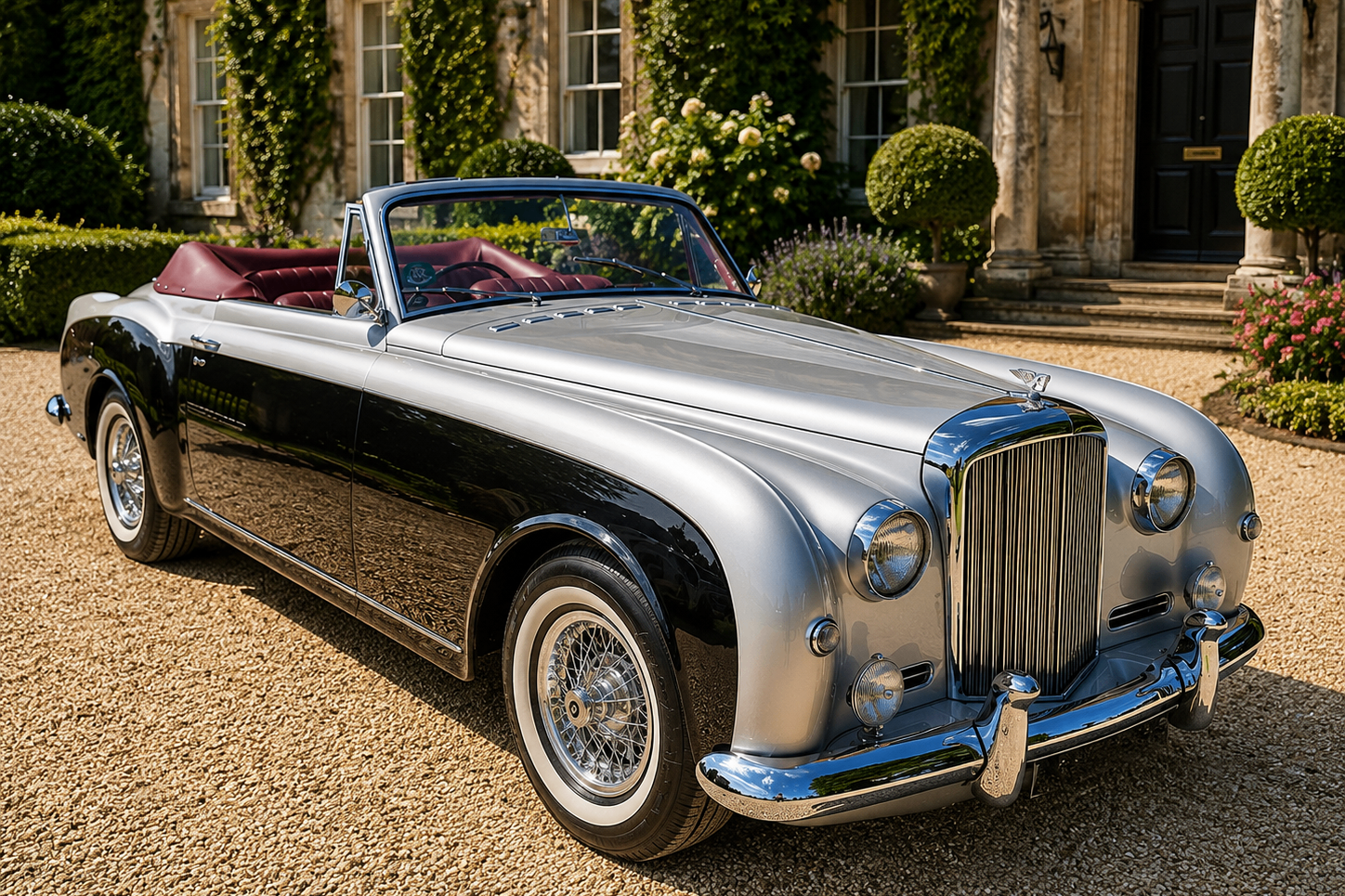
The last of the coachbuilt post-war Bentleys — the 4.9-litre inline-six 'C-series' Continental on the S-series chassis, bodied to individual order by H.J. Mulliner, Park Ward, James Young and (rarely) the great Continental European carrossiers.
The Bentley S1 Continental is the second-generation Continental (the first was the R Type Continental of 1952–1955) and the last of the four coachbuilt post-war Bentleys before the S3 Continental gave way to the unitary Silver Shadow / T-series in late 1965. Announced six months after the S1 saloon, in October 1955, the S Continental was a chassis-only proposition supplied by Crewe to a small number of approved coachbuilders — H.J. Mulliner & Co., Park Ward, James Young and Freestone & Webb domestically, with occasional Continental European bodies by Franay, Graber and Hooper (per period reporting in 'The Bentley S Series', The Motor, 10 July 1957, and 'New Rolls-Royce And Bentley Road Performance Improved', The Times, 27 April 1955, p. 9, issue 53205, col B).
Mechanically the S1 Continental shares Crewe's F-head 4,887 cc straight-six with the standard steel saloon and the Rolls-Royce Silver Cloud I: 95.25 mm × 114.3 mm bore and stroke, 6.6:1 compression, twin SU carburettors, and (through the S1 production run) the four-speed automatic gearbox derived from the pre-war GM Hydra-Matic architecture — the last vehicles to be powered by descendants of the engine originally used in the Rolls-Royce Twenty of 1922–1929 (per The Motor, 10 July 1957). Continental chassis carried higher compression and revised final drive on some cars, and the coachbuilders' bodies were aluminium-intensive (Mulliner's Design 7400 fastback and Design 7500 tailfin coupé were substantially all-aluminium), so a Continental is materially lighter and demonstrably faster than an equivalent steel-bodied S1 saloon. A standard-wheelbase S1 saloon tested by The Motor in 1957 recorded 103 mph and 0–60 mph in 13.1 seconds at a test price of £6,305 including £1,803 of taxes (The Motor, 10 July 1957); a Mulliner-bodied Continental in fastback form was materially quicker.
Production (S1 saloon totals per The Motor, 10 July 1957; S1 Continental total of 431 cars cross-referenced to the Bentley Drivers Club chassis register):
• S1 standard steel saloon: 3,072 built (of which 145 supplied as chassis for coachbuilt bodies).
• S1 long-wheelbase saloon (from 1957, 127-inch wheelbase): 35 built (of which 12 supplied as chassis for coachbuilt bodies).
• S1 Continental (separate 'B'-series chassis): 431 built — confirmed by multiple independent sources and accepted as the standing total.
Coachbuilder breakdown of the 431 Continentals (approximate; per-chassis confirmation via the Bentley Drivers Club register):
• Park Ward: 185 bodies total, of which 63 were left-hand drive.
• James Young: approximately 20 bodies.
• Hooper: approximately 6 bodies.
• H.J. Mulliner & Co. plus the low-volume Continental carrossiers (Franay, Graber, Freestone & Webb and one or two Pininfarina-influenced one-offs): the remaining balance, including the Design 7400 fastback, Design 7500 tailfin and Flying Spur sub-series.
The most numerous body on the Continental chassis is the H.J. Mulliner Design 7400 all-aluminium fastback ('Sports Saloon' — approximately 119 built). The most collectible sub-groups are the Park Ward Design 700 drophead coupé (31 built in left-hand drive), the H.J. Mulliner 'Flying Spur' four- and six-light Sports Saloons, and — the rarest — the Mulliner Design 7500 tailfin coupé, approximately nine of which were built at the very end of S1 production before the change-over to the S2 platform. Per-chassis confirmation against the Bentley Drivers Club register is essential for any car at this level.
The S1 Continental is one of the last chapters of the coachbuilt British motor car and the definitive post-war Bentley for collectors who value provenance, coachbuilder identity and matching-numbers rarity over sheer performance. Four overlapping identities keep it in permanent top-tier demand: (1) the last separate-chassis Continental (from the S3 Continental of 1962 onwards the Continental line is dominated by the Mulliner Park Ward standard drophead / coupé — a beautiful car, but a very different, unified proposition); (2) genuine per-car rarity — no coachbuilder-body sub-series on the S1 chassis exceeds ~120 cars, and several are in the single figures per drive configuration; (3) documented provenance culture — the Bentley Drivers Club chassis register and the Rolls-Royce Enthusiasts' Club records, plus the Crewe factory build cards that survive for essentially every S1 Continental, mean matching-numbers ownership can be substantiated to a depth that few pre-war or post-war cars can match; (4) celebrity and works history at the top end — Alfred Hitchcock's Flying Spur (US$295,000 at auction, September 2024) and recent verified drophead hammers — US$1,105,000 at Gooding Christie's Pebble Beach in August 2025 and US$951,000 at Broad Arrow's Amelia Island auction in March 2026 — demonstrate the height the top of the market can reach on the right car and story. Continental values sit materially above steel-bodied S1 saloons; a Continental in any body from any recognised coachbuilder trades in six figures at a minimum, and the top of the market for the rarest body configurations (Park Ward LHD drophead, Mulliner 7500 tailfin) is well into the seven figures on the right hammer.
Approximately 119 cars built with Mulliner's all-aluminium Design 7400 fastback body — the most numerous body on the S1 Continental chassis and the visual archetype of the S1 Continental in most enthusiasts' minds. Two doors, four seats, unbroken roof line dropping to a proper fastback tail; the majority right-hand drive but a meaningful minority left-hand drive for the US market via J.S. Inskip and comparable Rolls-Royce agents. The 7400 was the Continental you ordered if you wanted a two-door coachbuilt Bentley that would out-run any saloon on the S-series chassis.
H.J. Mulliner 'Flying Spur' — Four-Light and Six-Light Sports Saloon
1957–1959
~132
The four-door Flying Spur is the origin of the name Bentley later adopted for the modern Continental Flying Spur saloon; on the S1 chassis it is a rare four- and six-light aluminium Sports Saloon by H.J. Mulliner and one of the definitive post-war coachbuilt Bentleys. Sixteen left-hand-drive six-light cars are reported, alongside approximately 14 four-light cars with four-window alloy bodywork; total Flying Spur production across both configurations and both drive positions is materially larger. The exact build number for any specific car is documented per chassis in the Bentley Drivers Club register, and confirmation against that register is essential before purchase.
Approximately nine cars built with Mulliner's Design 7500 tailfin coupé body at the very end of S1 production before the change-over to the S2 platform — the rarest S1 Continental body. Distinguished by the rear tail-fin treatment that Mulliner introduced in response to late-1950s American styling trends; a completely separate design from the earlier Mulliner 7400 fastback. Per-car authentication depends on chassis-matched Crewe build card plus Mulliner body-number stamp, both cross-referenced to the BDC register.
Park Ward Design 700 — Drophead Coupé and Fixed-Head Coupé
1955–1959
~130
Park Ward-bodied cars are the second body family on the S1 Continental chassis, built in both fixed-head and drophead coupé forms. Thirty-one left-hand-drive dropheads with Design 700 coachwork are reported, alongside ten left-hand-drive coupés; right-hand-drive Park Ward bodies are more numerous. The left-hand-drive Park Ward drophead is the top-tier body configuration of the entire S1 Continental market. Total Park Ward output on the S1 chassis is documented per chassis in the Park Ward register held by the Bentley Drivers Club, and confirmation against those records is essential before purchase.
James Young, Franay, Graber, Freestone & Webb — one-off and low-volume bodies
1955–1959
~41
The balance of the 431 S1 Continentals carries bodywork by James Young (formal saloons and coupés), Franay of Paris (formal saloons, drophead cabriolets in the Continental French tradition), Graber of Wichtrach (Switzerland — a small number of coupés and cabriolets on the Continental chassis), Freestone & Webb (an early domestic body-builder listed on the Continental chassis in the published coachbuilder set) and one or two Pininfarina-influenced pre-production one-offs commissioned by the factory. These cars trade case-by-case against the specific coachbuilder body register and are outside the volume-body valuation ladder above; a Franay cabriolet with documented Paris-delivery history and a Graber coupé with documented Swiss delivery are the rare high points of this group and are transacted principally through the European classic auction houses (Bonhams, Artcurial, RM Sotheby's Paris) rather than online.
Collector Variants
Limited & special editions
The models below represent the most significant limited and special edition variants — factory-produced cars that command meaningful premiums over standard examples and warrant specific attention from serious collectors.
The rarest S1 Continental body — Mulliner's late-1959 tailfin coupé, built at the very end of S1 production before the change-over to the S2 platform. Distinguished by the rear tail-fin treatment introduced in response to late-1950s American styling trends; completely separate design from the earlier Mulliner Design 7400 fastback and materially different in silhouette. Two-door, four-seat aluminium bodywork on the S1 Continental chassis.
Value premium
Rarity premium of 1.5–3× the Mulliner Design 7400 fastback of comparable condition.
Inspection points
Chassis-matched Crewe build card confirming Mulliner Design 7500 body number; Mulliner body plate stamp cross-referenced to the BDC register; specific inspection of the tailfin rear-quarter aluminium panels and the interior compartment shape (materially different from the 7400 fastback); confirmation of matching-numbers engine and gearbox against the build card.
Authentication
Per-car authentication depends on chassis-matched Crewe build card plus Mulliner body-number stamp, both cross-referenced to the Bentley Drivers Club S1 chassis register. No car should be transacted at this tier without both documents.
Park Ward Design 700 Drophead Coupé (LHD) · 1955–1959
31 LHD
Distinguishing features
The top-tier body configuration of the entire S1 Continental market — Park Ward's Design 700 drophead coupé in left-hand-drive configuration. Two-door, four-seat convertible with the Park Ward pillarless side profile, aluminium body panels, and a folding hood mechanism specific to the design. Bodies were built at Park Ward's London works on chassis supplied from Crewe.
Value premium
3–5× the Mulliner Design 7400 fastback of comparable condition.
Inspection points
Chassis-matched Crewe build card confirming Park Ward Design 700 body number; specific inspection of the hood-frame mounting points, folding rear-quarter mechanism and hood-latch alignment; aluminium body panel corrosion inspection at the sill line, door bottoms and rear-quarter closing panels; confirmation of matching-numbers engine and gearbox.
Authentication
Park Ward body number stamp under the bonnet must be cross-referenced to the BDC register and to the Crewe build card. Converted-saloon 'Park Ward-style' cabriolets exist — documented conversions have appeared at auction well below the genuine Continental level — and must not be transacted at this tier.
The four-door aluminium 'Flying Spur' Sports Saloon by H.J. Mulliner — the direct ancestor of the modern Bentley Flying Spur nameplate. Four- or six-light window arrangement, all-aluminium body panels, Sports Saloon roofline distinct from the standard steel Bentley S1 saloon. The definitive four-door coachbuilt post-war Bentley for collectors who want a four-door Continental rather than a coupé or drophead.
Value premium
1.5–2.5× the Mulliner Design 7400 fastback of comparable condition — Alfred Hitchcock's six-light Flying Spur sold for US$295,000 at auction in September 2024, the current anchor for the tier.
Inspection points
Chassis-matched Crewe build card confirming Mulliner Flying Spur body number; specific inspection of the aluminium roof panel joints and the four- or six-light window frame integrity; door-shut alignment on all four doors; confirmation of matching-numbers engine and gearbox; interior verification against original Connolly hide, Waring & Gillow veneers and Wilton wool carpet.
Authentication
Mulliner body plate must confirm Flying Spur design number and specify four- or six-light configuration. Cross-reference to the BDC chassis register is required for any Flying Spur transacted at this tier.
Buyer's Guide
What to look for
The coachbuilder register comes first — everything else is second
The S1 Continental is not one car but four or five distinct cars sharing a chassis. In descending order of scarcity and value the standing groupings are: (1) the H.J. Mulliner Design 7500 tailfin coupé (approximately 9 cars, 1959 only); (2) LHD Park Ward Design 700 drophead coupé (31 LHD cars reported); (3) LHD H.J. Mulliner 'Flying Spur' Sports Saloon (16 LHD cars reported); (4) H.J. Mulliner four-light 'Flying Spur' (approximately 14 cars, 3 in LHD); (5) LHD Park Ward Continental coupé (10 LHD cars reported); (6) H.J. Mulliner Design 7400 fastback Sports Saloon (approximately 119 cars — the largest body group and the volume-market anchor); (7) James Young saloons and coupés and the European carrossier one-offs (Franay, Graber, Freestone & Webb). Buyers must engage the Bentley Drivers Club chassis register and the RREC's coachbuilder body records before any transaction. Two S1 Continentals presented as 'Mulliner Continentals' can differ in market value by 3–5× depending on which specific Mulliner body they carry.
Provenance and documentation — Crewe build card, BDC chassis register, coachbuilder body number
Every serious S1 Continental purchase should be supported by three primary-source documents: (1) the original Crewe build card for the chassis, showing engine number, gearbox number, delivery destination, original coachbuilder and body number, factory options and the specific delivering agent (surviving for essentially the entire S1 range and held today at the RREC / Bentley Motors heritage archive); (2) the Bentley Drivers Club chassis register entry for the specific 'BC'-prefix chassis, confirming coachbuilder body number, ownership history through the register and current spec against original build card; (3) the coachbuilder body number stamp on the body itself (Mulliner body plate, Park Ward body number stamp under the bonnet). A Continental represented as one specific Mulliner design that presents a body number outside that design's known run should be priced against the standard S1 saloon tier, not the coachbuilt Continental tier — 'style-transferred' body swaps do occur in period and later, and they are a material valuation risk.
Mechanical inspection priorities — 4.9-litre F-head six and the four-speed automatic
The 4,887 cc F-head six is a well-understood engine with an extensive UK specialist support network (P&A Wood, Frank Dale & Stepsons, Hilton & Moss, Fiennes Restoration, R.R. & B. Garages) and (in the US) Vantage Motorworks, RROC Certified Master Technicians and the BDC US Section reference specialists. PPI priorities, in order: engine number matched to the Crewe build card (a non-matching engine is not a purchase-killer but drops the car firmly to the driver tier); full cooling-system pressure test and inspection of the exhaust manifolds for the well-known cracking on cars run hard cold; twin SU carburettor condition and correct spec (larger units from 1957 — verify per build card); four-speed automatic-gearbox operation cold and warm, with specific attention to slow-to-engage kick-down (a Crewe-built Hydra-Matic derivative, rebuildable through the specialist trade but expensive); rear-axle whine; and — for cars with the optional power steering (near-universal on Continental chassis) — power-steering pump condition and hose integrity.
Body, chassis and coachbuilder-specific corrosion patterns
S1 Continental corrosion sits at the interface between the steel ladder chassis and the (mostly aluminium) coachbuilder body — the classic post-war British bimetallic-corrosion pattern. Priorities differ by coachbuilder: on Mulliner Design 7400 fastbacks and Flying Spurs, inspect the aluminium-to-steel interface at the sill line, the door bottoms (aluminium skins over steel frames — electrolytic corrosion at the joint is a known service item), the front and rear valance closing panels, and the boot floor. On Park Ward Design 700 dropheads, additional priorities are the hood-frame mounting points, the folding rear-quarter mechanism and the timber wood-framing behind the aluminium panels where that construction was used. On all Continental bodies the chassis outriggers, rear spring hangers and battery box are the standing steel-chassis inspection points. A full body-off restoration at a top-tier UK specialist (P&A Wood, Fiennes, Hilton & Moss) runs £250,000–£500,000+ depending on coachbuilder body and originality target — which is why documented recent restorations command a firm premium and lightly-used original-paint cars are prized above show-restored equivalents in the current market.
The Continental vs. the steel-bodied S1 saloon — a completely separate market
The steel-bodied S1 standard saloon is a genuinely usable, honest 1950s Bentley trading today at £30,000–£70,000 in the UK depending on condition — one of the most affordable ways into post-war coachbuilt Crewe. The S1 Continental is not the same market and never has been. Continentals trade in six figures at a minimum for a documented Mulliner fastback or Park Ward coupé with matching numbers and full Crewe build card, and the top of the market for the rarest configurations (Mulliner 7500 tailfin, Park Ward LHD drophead) is well into the seven figures on the right hammer with the right story. The most common valuation error on the S1 platform is to conflate saloon and Continental pricing; do not.
Ownership
Living with it
Typical mileage
500–2,500 miles typical — Continentals are grand-touring cars and can be used with confidence on continental European tours and RREC / BDC events; annual attendance at Salon Privé, Concours of Elegance, Pebble Beach and Amelia Island is routine for the top-tier examples.
Service interval
12 months / 3,000 miles at a recognised Crewe-era Bentley specialist; annual oil and filter, twice-yearly SU carburettor balance, annual gearbox fluid, annual chassis lubrication (period grease-point programme), annual mechanical-servo brake inspection.
Annual running cost
$8,000 – $22,000
Fuel economy
~14–17 mpg imperial combined (12–14 mpg US) — the 4.9-litre six with the four-speed automatic is not economical, and Continental compression / final-drive spec worsens this by a further 1–2 mpg imperial
Insurance
Agreed-value cover with mileage tolerance and secure storage is the norm. US premiums typically US$2,500–US$5,500/yr on a US$300k agreed value; UK premiums via Footman James or Hagerty commonly £1,200–£3,000/yr on a £220k agreed value with 3,000-mile limit; six-figure Park Ward LHD dropheads and Mulliner 7500 tailfin coupés at seven-figure agreed values sit meaningfully above these bands.
Maintenance planning
The S1 Continental is a maintenance-intensive coachbuilt post-war Bentley — this is not a car to buy on a hopeful budget. Priorities to plan for: an SU carburettor rebuild every 15–20 years; a four-speed automatic gearbox service every three to five years (a rebuild if needed runs £8,000–£18,000 through the specialist trade); the mechanical-servo brake system requires a specialist annual service and does not tolerate deferred maintenance; a full chassis lubrication programme (the period grease-point card should be followed) is expected annually; and the aluminium coachbuilder body panels require correct paint-system knowledge — a modern automotive paint applied without correct primer and filler chemistry will lift within 2–4 years on the aluminium. The specialist trade is deep and well-established — P&A Wood, Frank Dale & Stepsons, Hilton & Moss, Fiennes Restoration and R.R. & B. Garages in the UK; Vantage Motorworks (Miami), Steve Littin's Vintage Restorations and the RROC Certified Master Technician network in the US — and no S1 Continental should be serviced outside this network.
Parts and specialist access
Mechanical parts availability for the F-head 4.9-litre six, the four-speed automatic gearbox, the mechanical-servo brake system and the general chassis is excellent — the S-series shares the powertrain with the Silver Cloud I family and the specialist trade supports it with new-old-stock and correctly reproduced parts through Flying Spares (UK), P&A Wood, Introcar (UK) and the US RROC-affiliated parts network. Coachbuilder-specific body panels, trim and hardware are the constraint — reproduction Mulliner Design 7400 body panels are available on special order through the UK specialist trade at material cost, and Park Ward Design 700 hood frames, latches and rear-quarter mechanisms are reproduced by the same trade to Crewe specification. Interior trim (leather, wool, coach lace, headliner, veneer) is reproduced correctly through Autoveneers, Newton Commercial and the specialist trim shops. The Bentley Drivers Club (UK) and Rolls-Royce Enthusiasts' Club (UK) — the RROC (US) as its US counterpart — are the standing owner-community references and hold the definitive concours judging standards for the Continental range.
Common Problems
Known issues by system
Coachbuilder body — aluminium-to-steel bimetallic corrosion
Sill line, door bottoms, front and rear valance closing panels, aluminium body panels bolted or lead-loaded onto the steel chassis outriggers
Critical$40,000 – $150,000+ (targeted panel replacement and paint refresh at a Crewe-era specialist through to a full body-off strip and refurbishment)
Symptoms — Bubbling paint at the sill line and door bottoms, corrosion staining at the aluminium-to-steel interface, panel fit and gap deterioration on cars stored in damp UK / EU conditions.
Inspection — Full underside inspection on a lift with the exhaust removed; targeted paint-depth gauge along every aluminium-to-steel interface; specific attention to door bottoms and sill-line closing panels. Any car with active corrosion at those interfaces needs a proper body-off strip to inspect and repair correctly — a paint-only cosmetic refurbishment is a well-documented failure mode on this platform.
Engine — matching numbers and F-head cooling / exhaust manifold
Non-matching engines vs. Crewe build card; exhaust manifold cracking on cars run hard cold; head-gasket seepage
MajorValuation delta $60,000 – $150,000+ (non-matching engine drops the car firmly to the driver tier); mechanical repair $6,000 – $22,000 (manifold and head-gasket work)
Symptoms — Engine number does not match the Crewe build card; visible exhaust-manifold cracks; coolant loss with no visible external leak; oil-water emulsion in the rocker cover.
Inspection — Read engine number stamped on the block; cross-reference to the Crewe build card and BDC chassis register. Full cooling-system pressure test cold and hot; visual inspection of exhaust manifolds; leak-down test on all six cylinders.
Major$3,500 – $18,000 (targeted service through to full gearbox rebuild at a Crewe-era specialist)
Symptoms — Slow to engage kick-down, harsh 2-3 or 3-4 shift, fluid leakage at the front pump seal or the extension housing.
Inspection — Full road-test cold and warm, with specific attention to shift quality under load and kick-down engagement; visual inspection of the gearbox pan and extension housing for fluid loss.
Coachbuilder authentication — Mulliner design number and Park Ward body number
'Style-transferred' bodies, converted saloons presented as Continentals, body-number stamps altered or absent
MajorValuation delta $80,000 – $500,000+ (the pricing gap between a genuine coachbuilt Continental and a converted saloon or style-transferred car)
Symptoms — Chassis presented as one Mulliner design but with body-number stamp outside that design's known run; converted saloon bodies (Park Ward-style dropheads built from S1 saloon chassis in later decades) presented as genuine Continentals.
Inspection — Insist on the Mulliner body plate or Park Ward body number stamp under the bonnet; cross-reference to the design's known chassis / body-number run through the BDC register and RREC coachbuilder records. Refuse to price a Continental as its coachbuilder body tier without documented body-number verification.
Brakes — hydro-mechanical servo drum system
Crewe-specification mechanical-servo brake system requires specialist knowledge to overhaul correctly
Major$4,000 – $12,000 (full mechanical-servo brake system overhaul at a Crewe-era specialist)
Inspection — Full brake road-test on the level and downhill; visual inspection of every wheel cylinder for leakage; specific inspection of the mechanical servo linkage and its lubrication; verify any documented specialist brake rebuild in the file.
Electrical — Lucas positive-earth wiring and instruments
Aged Lucas loom, positive-earth original electrics, brittle insulation, marginal earth points
Symptoms — Intermittent gauge readings, dim or flickering headlamps, blown fuses, non-functional wipers, marginal starter engagement.
Inspection — Full switched-circuit test at PPI; verify any full loom replacement in the file; confirm earth polarity against seller representation and Crewe build card; check every gauge, warning lamp and switched item.
Interior — leather, veneer, coach lace and Wilton wool carpet
Original Connolly hide, Waring & Gillow veneers and Wilton carpets are original-spec — reproduction is possible but expensive
Moderate$12,000 – $45,000 (full period-correct interior refurbishment including leather, veneer, coach lace and Wilton carpet)
Symptoms — Cracked or lifted Connolly leather, veneer lifting or crazing, deteriorated coach lace, worn Wilton carpet.
Inspection — Full visual inspection of every interior surface; verify any documented interior refurbishment against the correct-spec suppliers (Autoveneers, Newton Commercial, the RREC-approved trim shops). Non-original-spec reproductions are common on driver cars and are a legitimate cost consideration for concours restoration.
Auctions
Recent results
Date
Auction
Car
Mileage
Result
2024-09-30
Bring a Trailer
Online auction
1958 Ex-Alfred Hitchcock Bentley S1 Continental Saloon by H.J. Mulliner — six-light 'Flying Spur' Sports Saloon (one of 16 LHD, chassis BC48LEL — provenance per the auction listing)
—
US$295,000
Sold
2023-12-08
Bring a Trailer
Online auction
1958 Bentley S1 Continental Coupe by Park Ward (LHD, one of 10 LHD S1 Park Ward-bodied coupés, delivered new to Rolls-Royce dealer Reyreca of Caracas, Venezuela)
—
US$345,000
Sold
Investment
Long-term outlook
Blue ChipHorizon: 10+ years
The S1 Continental is a blue-chip coachbuilt post-war Bentley whose collector standing is structurally underwritten by three factors that will not diminish over a 10-year horizon: (1) the coachbuilt era is finite and does not repeat — every year the pool of correctly documented, matching-numbers, coachbuilder-body Continentals thins through attrition, and no future car will restore the supply; (2) documentation depth is exceptional — Crewe build cards survive for essentially every car and the Bentley Drivers Club and RREC coachbuilder registers make ownership provenance verifiable to a depth few post-war platforms can match, which the top of the market rewards; (3) the top of the coachbuilder market (LHD Park Ward drophead, Mulliner 7500 tailfin, celebrity Flying Spur) has demonstrated ability to clear seven figures on the right hammer with the right story — a top-of-market ceiling that supports the entire coachbuilder pyramid below it. Best long-term holds in current buying: a documented H.J. Mulliner Design 7400 fastback with matching numbers and full Crewe build card in the US$200,000–US$250,000 range as the entry-level Continental value; an LHD Park Ward drophead or Mulliner Flying Spur with exceptional provenance in the mid- to high-six figures as the appreciation play; and a genuine Mulliner Design 7500 tailfin (nine cars) or Park Ward LHD drophead with celebrity or works history at seven figures as the trophy-cabinet position. Steel-bodied S1 saloons are not part of this thesis — they are a separate, cheaper, honest market of their own.
Our view, not advice. This section is Car Collector International's editorial judgement on where this model sits in the collector market, based on the production, specification and market data set out in this guide. It is not a recommendation to buy or sell and it is not investment advice. Values can fall as well as rise.
The standing UK reference for Crewe-era Rolls-Royce and Bentley — full body-off restoration, mechanical rebuild, coachbuilt-body refurbishment and concours preparation for the S-series Continental.
Long-established London Rolls-Royce and Bentley specialist — restoration, sales and standing-register expertise across the entire Crewe range including the S1 Continental.
UK Crewe-era Rolls-Royce and Bentley specialist — body-off restoration, mechanical rebuild, servicing and pre-purchase inspection for the coachbuilt S-series.
UK Rolls-Royce and Bentley mechanical specialist — engine, gearbox and complete drivetrain rebuilds; RREC-approved reference for the F-head 4.9-litre six.
International Rolls-Royce and Bentley parts specialist — comprehensive new-old-stock and correctly reproduced mechanical, electrical and trim parts for the entire S-series range.