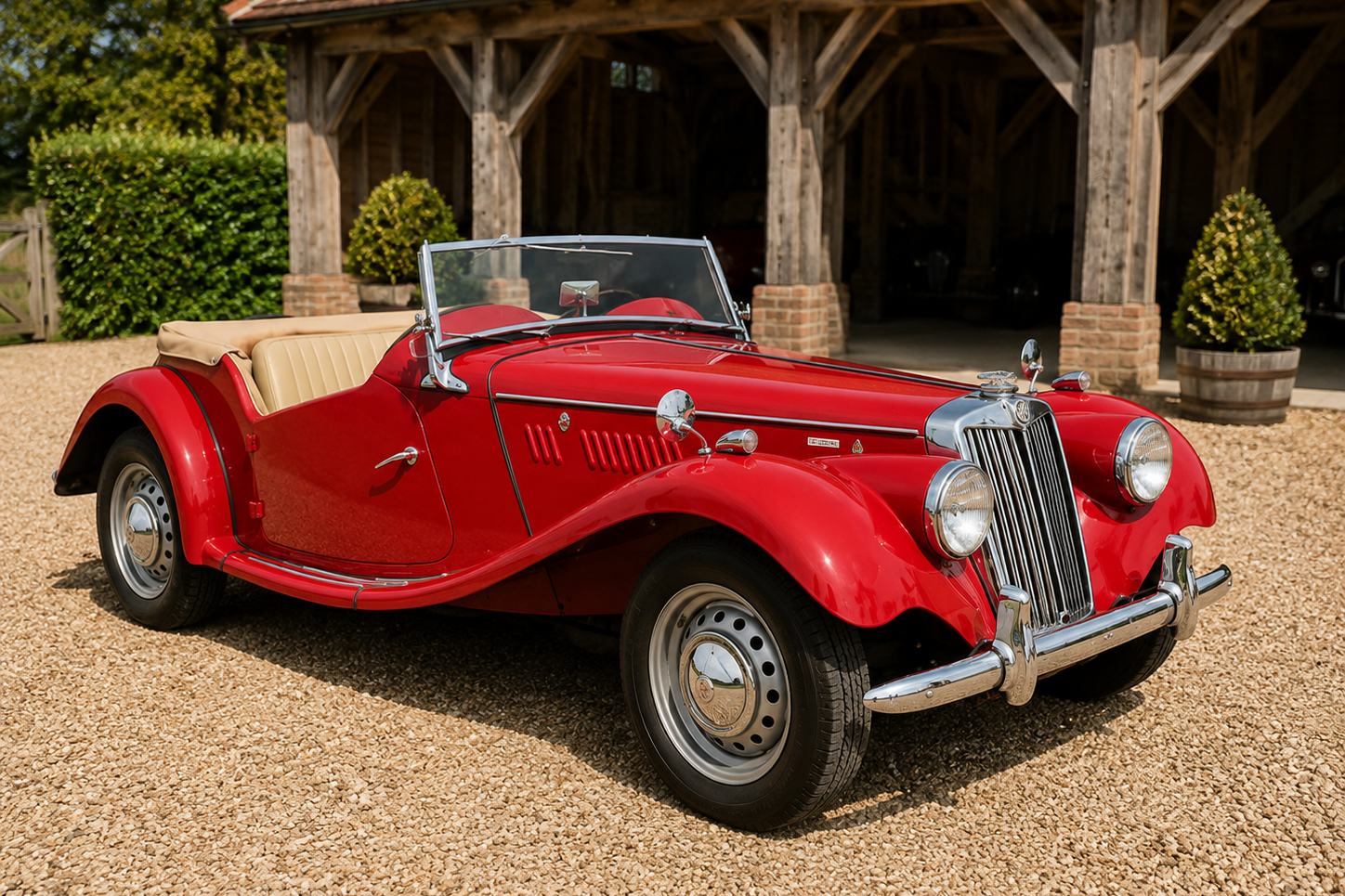
Announced in October 1953 as a rework of the outgoing TD, the MG TF was Abingdon's holding action while the modern MGA was finalised. It kept the TD's separate chassis, ash-framed body, IFS front suspension and rear leaf springs, but restyled the front end with a sloping radiator grille, faired-in headlights and a lower bonnet line — a car self-consciously updated rather than redesigned.
The original TF (retrospectively 'TF 1250') used the 1,250 cc XPAG four-cylinder rated at 57 bhp. In July 1954 the 1,466 cc XPEG engine arrived, giving 63 bhp and creating the 'TF 1500', identifiable by badging and, on most cars, minor trim changes. Production ended in April 1955 with the launch of the MGA. Standard sources record 6,200 TF 1250s and 3,400 TF 1500s built — approximately 9,600 cars in total — with the majority exported to the United States.
Contemporary reviewers were unenthusiastic: the TF looked outdated against the more modern Triumph TR2 and Austin-Healey 100. In hindsight the same qualities that dated it — hand-built body, cutaway doors, wire wheels, an upright driving position — are what make it the most fully-formed and collectible of the T-Series MGs today.
The TF is the last MG to be built in the pre-war idiom — separate chassis, hand-formed body, cutaway doors, exposed wire wheels — and the direct ancestor of the modern British sports-car market that the MGA and MGB then created. Its short production run and the introduction of the larger XPEG engine mid-life give it a defined shape as a collector object: the TF 1500 is the definitive T-Series MG, and clean, honest examples are increasingly recognised as such by an ageing owner-driver market.