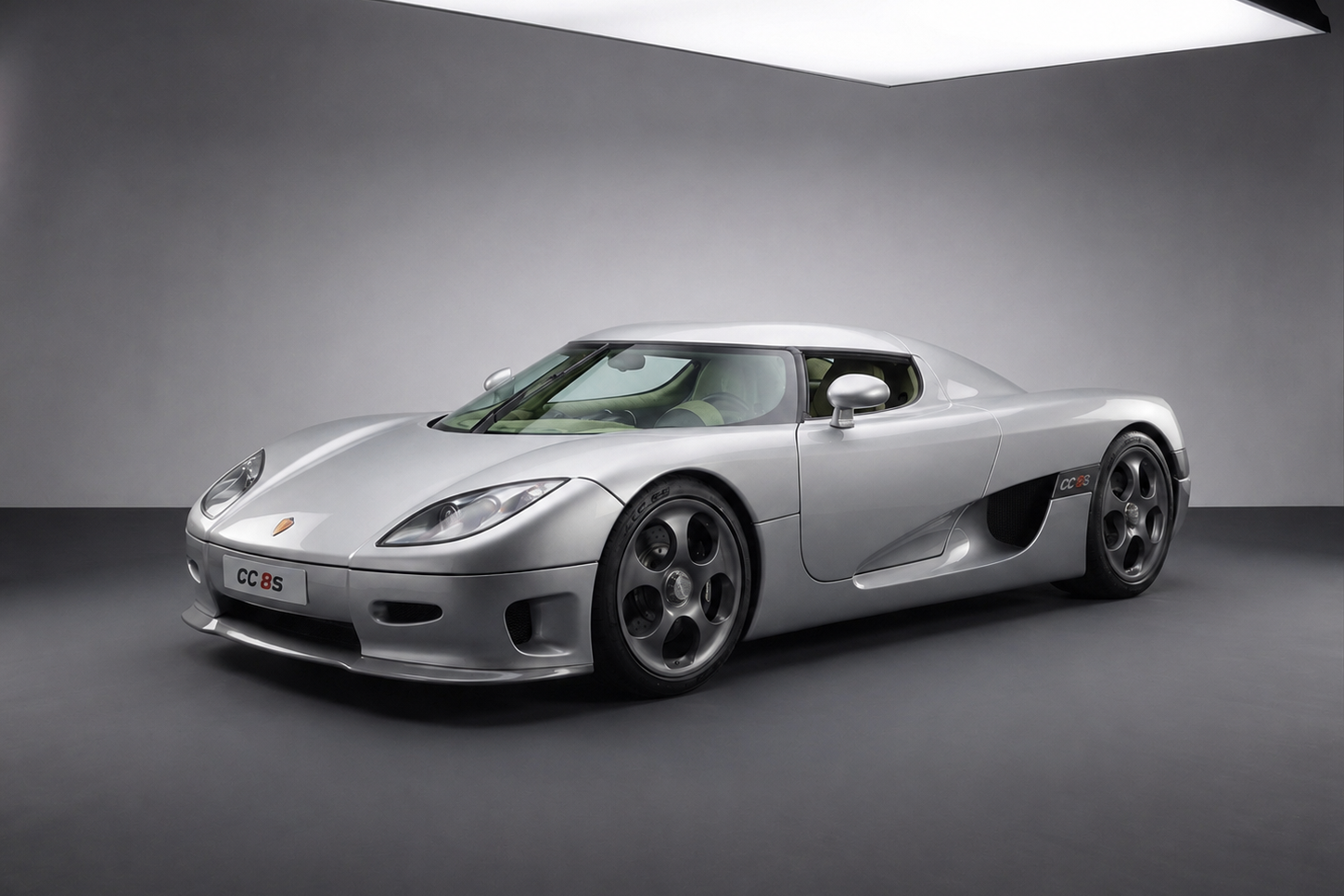
The founding production Koenigsegg — six cars from Ängelholm, a supercharged V8 in a carbon tub, and the engineering template every later Koenigsegg descends from.
The CC8S is the car that turned Koenigsegg from a Swedish prototype programme into a production hypercar manufacturer. Six customer cars were built at Ängelholm across the 2002 and 2003 model years — the majority in European specification and one understood in the marque community to have been built or later configured with US-facing bodywork detailing — around a carbon-fibre monocoque tub carrying a supercharged 4.7-litre V8 quoted at 655 bhp / 664 PS. Kerb weight was approximately 1,175 kg, giving the car a power-to-weight number that stood at the very top of the series-production print at launch, and Koenigsegg's engine received Guinness World Records recognition in 2002 as the most powerful series-production engine of its time. Every architectural decision on the CC8S — carbon-fibre monocoque, dihedral synchro-helix doors, removable targa roof stowing under the front lid, supercharged V8 with in-house engine management, Ängelholm assembly at the former Swedish Air Force base — became the template that the CCR, CCX, Agera, Regera and Jesko cars are direct evolutions of. Chassis history is individually tracked in the marque enthusiast community; every car is known and the customer print has changed hands only in single-digit numbers since delivery.
The CC8S matters for two reasons that are entirely inseparable. First, it is the founding production Koenigsegg — the moment a small Ängelholm engineering programme became a series-production hypercar manufacturer. Every subsequent Koenigsegg model line is a direct engineering evolution of the architectural choices made on this car: carbon-fibre monocoque, dihedral synchro-helix doors, removable targa roof stowed under the front lid, in-house supercharged V8, Ängelholm assembly. Second, it is one of the smallest customer production runs of any modern-era hypercar — six cars total. That combination of founding-model historical significance and absolute production rarity places the CC8S in a very small category of hypercars whose collector value is anchored to marque-origin status rather than to headline performance or race-programme provenance. The market for the CC8S is correspondingly thin, private-treaty-dominated and paperwork-driven; continuous factory service history at Ängelholm is the primary axis on which value moves at the top of the model. A single car is understood in the marque community to carry US-facing bodywork detailing, but this is a community-sourced distinction rather than a factory-confirmed separate market spec; the CC8S was never officially sold or certified for the US.
Variants
Range and production
Variant
Years
Production
Notes
CC8S — European specification
2002–2003
Not separately recorded
Five of the six customer cars. Carbon-fibre monocoque tub with carbon-fibre bodywork, supercharged 4.7-litre V8 quoted at 655 bhp / 664 PS, six-speed manual transaxle, removable carbon targa roof stowing under the front lid, dihedral synchro-helix doors, European-specification lighting and bumper detailing. Chassis history is individually tracked in the marque enthusiast community and continuous factory service history at Ängelholm is the primary provenance axis on any customer car.
CC8S — US-facing bodywork configuration
2003
Not separately recorded
One car — understood in the marque community to be the sole CC8S with US-facing bodywork detailing (revised front-end lighting and bumper treatment). This is a community-sourced distinction, not a factory-confirmed official US-market spec: the CC8S was never formally sold or certified for the US. The mechanical package (supercharged 4.7-litre V8, six-speed manual, carbon-fibre monocoque) is unchanged from European specification. Chassis identity is tracked in the marque enthusiast community. Some secondary print also references an additional development / prototype chassis outside the six-car customer figure, though Koenigsegg's own model heritage material quotes production as six customer cars.
Buyer's Guide
What to look for
Configuration — European majority print, US-facing bodywork distinction, and the price consequence
Configuration is the largest structural axis on the six-car print. The majority of cars are European specification and share a common bodywork print; one car is understood in the marque community to carry US-facing bodywork detailing (revised front-end lighting and bumper treatment). This is a community-sourced distinction rather than a factory-confirmed official US-market spec — the CC8S was never formally sold or certified for the US — so verify configuration against the factory build sheet and the Ängelholm chassis record before any purchase. The car with US-facing detailing is tracked in the marque enthusiast community and any confusion between the European and US-facing bodywork prints is immediately identifiable from either side of the front end.
Carbon-fibre monocoque tub and bodywork — accident history, repair provenance
The CC8S carbon-fibre monocoque and carbon bodywork are the primary structural inspection surface. Any accident-repair history, resin re-lamination, section repair or bodywork panel replacement must be reconciled against Ängelholm factory records; unrecorded structural repair on a carbon-tub hypercar of this vintage is the most consequential single value-damaging discovery at PPI. Full body-off inspection with carbon-composite non-destructive testing by a specialist familiar with early carbon-tub construction is the standing PPI reference on the model.
Engine — supercharged 4.7 V8, matching numbers, factory service history at Ängelholm
Engine identity is the second structural axis on value after configuration. Verify engine block number and cylinder-head numbers against the factory build sheet, and cross-check every stamping against the Ängelholm chassis service record. The supercharger installation, engine management calibration and ancillaries are Koenigsegg-specific and any deviation from factory specification — non-original supercharger, aftermarket engine management, non-original intake or fuelling — is immediately visible on inspection and downgrades the car materially. Continuous factory service history at Ängelholm from delivery to present is the reference paperwork chain and materially the largest single value-underwriting factor at the top of the market.
The six-speed manual transaxle is a low-volume unit and specialist knowledge is required for any rebuild. Verify transaxle number against the factory build sheet, inspect clutch condition, driveshaft integrity and final-drive fit, and cross-check every service intervention against the Ängelholm factory record. Any prior transmission work outside the factory or a factory-approved specialist is a material item on any PPI and must be reconciled against paperwork before purchase.
Cooling, intake and forced-induction system — supercharger, intercooler, ancillaries
The supercharger installation, intercooler and forced-induction ancillaries on the CC8S are hand-built low-volume components and are the primary reliability and maintenance surface on the powertrain. Verify supercharger service history, intercooler integrity, correct intake-tract specification and factory-specification ancillary fit at PPI, and confirm every service intervention against the Ängelholm factory record. Aftermarket supercharger pulleys, non-factory calibration or non-original intake componentry each downgrade a matching-numbers car.
Suspension, brakes and wheels — factory specification, service history
Verify suspension, brake and wheel specification against the factory build sheet and Ängelholm service record. Original-specification dampers, correct brake componentry, correct factory-supplied wheels and correct-specification tyre fitment are the standing reference; any non-factory componentry must be documented and, on a concours-represented car, treated as reversible against a return to factory specification.
Targa roof, dihedral synchro-helix doors and body-electrical
The removable carbon targa roof, dihedral synchro-helix door mechanism and associated body-electrical systems are hand-built low-volume assemblies unique to the CC-generation cars and are the primary body-mechanical inspection surface. Verify correct roof-panel fit and stowage under the front lid, correct door-mechanism operation on both sides, and correct electrical fit throughout at PPI. Any prior body-mechanical work outside the factory or an approved specialist is a material item and must be reconciled against paperwork before purchase.
The CC8S cabin is hand-trimmed and hand-assembled at Ängelholm. Verify original trim material, correct instrument specification, correct steering-wheel and shifter fit, and correct centre-console and switch-gear componentry against the factory build sheet and against period reference photography for the individual chassis. Retrimmed cabins and non-original componentry on a hand-built six-car production hypercar are materially damaging to value and each item must be reconciled against paperwork on any concours-represented car.
Provenance — chassis record, Ängelholm factory service history, marque-registry tracking
Provenance documentation is the primary axis on which CC8S market value moves after configuration and engine. The Ängelholm chassis record, continuous factory service history from delivery to present, and marque-enthusiast community tracking of the individual chassis are the standing reference. Any gap in factory service history — a period where the car was serviced privately, at a non-approved workshop, or is undocumented — is priced as a materially wide discount even on drivetrain-correct cars, and any car represented at top-condition tier without complete Ängelholm paperwork must be treated as unresolved on provenance until the paperwork chain is confirmed.
Pre-purchase inspection — Ängelholm factory or factory-approved specialist required
PPI must be conducted at Koenigsegg's Ängelholm factory or by a factory-approved specialist with direct CC-generation carbon-tub experience — not a generalist hypercar workshop and not a modern-Koenigsegg (Agera / Regera / Jesko) specialist without CC-generation knowledge. Insist on: full carbon-tub inspection with composite NDT; matching-numbers verification of engine, transmission and driveline against the factory build sheet; independent inspection of the supercharger installation, targa roof, dihedral door mechanism and body-electrical systems; full drivetrain compression, oil-pressure and road-test verification on the supercharged V8; and a complete review of the Ängelholm factory service record.
Insurance, storage and event access
The CC8S is a natural agreed-value classic-policy car with Hagerty, Chubb Masterpiece or a comparable HNW carrier familiar with early-carbon-tub hypercar risk profiles. Climate-controlled storage is the standing reference and marque-factory transport for major service intervals is the ownership pattern on most of the six-car print. Event access includes Goodwood Festival of Speed, top-tier concours (Villa d'Este, Salon Privé), and marque-organised Koenigsegg owner events at Ängelholm.
Ownership
Living with it
Typical mileage
200–1,500 miles / 300–2,400 km typical on a matching-numbers CC8S in active use; several cars in the customer print are museum-condition and see essentially no annual mileage between event outings.
Service interval
Annual service at Koenigsegg's Ängelholm factory or a factory-approved specialist with direct CC-generation carbon-tub experience. Carbon-tub, bodywork and forced-induction system inspection at the same interval.
Annual running cost
USD $30,000 – $90,000+ typical annual budget for a matching-numbers CC8S in active use with continuous factory service — dominated by Ängelholm factory service intervals, forced-induction system inspection, and marque-factory transport to and from Sweden for major service work.
Fuel economy
~10–14 mpg (US) / ~12–17 mpg (imp) / ~17–24 L/100 km on typical use with the supercharged 4.7 V8.
Insurance
Agreed-value classic-policy cover through Hagerty, Chubb Masterpiece or a comparable HNW carrier is the standing channel; premiums vary materially by configuration and by continuous factory service history. The car understood to carry US-facing bodywork detailing is a community-sourced distinction rather than a factory-confirmed separate spec.
Ängelholm factory service — the reference channel
Route all major service and any powertrain, carbon-tub or body-electrical work through Koenigsegg's Ängelholm factory or a factory-approved specialist with direct CC-generation experience. Generalist hypercar workshops and modern-Koenigsegg specialists without CC-generation knowledge are not the reference on this model, and any period of non-factory service is priced as a paperwork deduction against continuous factory history.
Chassis record and marque-community tracking
Every one of the six customer chassis is individually tracked in the marque enthusiast community and publicly known. Provenance verification is a matter of confirming continuous chassis identity from delivery to present against the Ängelholm chassis record and against marque-community records; any chassis represented at reference tier without confirmed chassis-record correspondence must be treated as unresolved on provenance until the record is confirmed.
Forced-induction system — supercharger service discipline
The supercharger installation, intercooler and forced-induction ancillaries are hand-built low-volume Koenigsegg-specific components and are the primary powertrain-service surface on the model. Continuous supercharger service documented at Ängelholm from delivery to present is the reference paperwork chain and any gap in that history is a distinct paperwork item at PPI and at sale.
Common Problems
Known issues by system
Carbon-fibre monocoque tub and bodywork — accident history, undocumented structural repair
The CC8S carbon-fibre monocoque tub and carbon bodywork are the primary structural inspection surface and any accident-repair history, resin re-lamination, section repair or bodywork panel replacement outside Ängelholm factory records is the most consequential single value-damaging discovery on the model. Every one of the six chassis is individually tracked in the marque community; any structural repair should be reconcilable against public chassis history.
CriticalCase-by-case — Ängelholm-level composite structural repair is factory-priced and specific to each intervention; no public band exists for this work on the model.
Symptoms — Evidence of prior bodywork repair not documented in Ängelholm records, resin or paint signature inconsistent with factory finish, panel-fit anomalies, non-destructive-test signature indicating internal composite damage or repair.
Inspection — Full body-off inspection with carbon-composite non-destructive testing at PPI; documented restoration paperwork covering any structural or bodywork work; reconciliation of chassis identity against the Ängelholm chassis record and the marque-community chassis history for the individual car.
Matching-numbers supercharged 4.7 V8 — non-original engine, non-factory supercharger work
The supercharged 4.7 V8 is a Koenigsegg-specific installation and any deviation from factory engine, supercharger or engine-management specification is immediately visible at inspection and downgrades the car materially. Non-original engines, aftermarket supercharger pulleys, non-factory engine management calibration and non-original intake or fuelling componentry are all documented at inspection and each disqualifies a matching-numbers car.
CriticalUSD $60,000 – $180,000+ for a factory-level engine and supercharger inspection and rectification programme at Ängelholm; sourcing a chassis-correct replacement engine on a six-car production model is a distinct factory exercise.
Symptoms — Engine number does not match the factory build sheet; supercharger pulley or drive specification non-factory; engine-management calibration non-factory; intake or fuelling componentry non-original.
Inspection — Cross-check every engine stamping against the factory build sheet at PPI; independent inspection by an Ängelholm-approved specialist; documented service paperwork covering the engine and supercharger specifically.
The six-speed manual transaxle is a low-volume unit with specialist rebuild knowledge concentrated at Ängelholm. Any prior transmission work outside the factory or a factory-approved specialist is a material item on any PPI and undocumented transmission intervention is priced as a paperwork deduction and a rebuild-cost provision.
MajorUSD $30,000 – $80,000+ for a factory-level transaxle inspection and rebuild programme at Ängelholm.
Symptoms — Transmission number does not match the factory build sheet, evidence of prior non-factory transmission work, gear-selection anomalies, clutch or driveshaft wear inconsistent with documented mileage.
Inspection — Cross-check transaxle number against the factory build sheet at PPI; independent inspection by an Ängelholm-approved specialist; documented service paperwork covering the transmission specifically.
Targa roof, dihedral synchro-helix doors and body-electrical
The removable carbon targa roof, dihedral synchro-helix door mechanism and associated body-electrical systems are hand-built low-volume assemblies unique to the CC-generation cars and are the primary body-mechanical failure and inspection surface after the powertrain. Non-original componentry, prior non-factory repair and undocumented electrical work each require reconciliation at PPI.
MajorUSD $15,000 – $60,000+ for factory-level body-mechanical inspection and rectification at Ängelholm.
Symptoms — Targa panel fit anomaly, dihedral door mechanism operating asymmetrically or with hydraulic weep signature, body-electrical fault codes or intermittent operation, evidence of prior body-mechanical work outside factory records.
Inspection — Specialist inspection of the targa mechanism, door hydraulics and body-electrical systems at PPI; documented service paperwork covering body-mechanical work; reconciliation against Ängelholm chassis record.
Cooling and forced-induction ancillaries — supercharger, intercooler, oil-cooling
The supercharger installation, intercooler and cooling ancillaries are hand-built low-volume components and are the primary powertrain-service surface. On unmodified factory-specification cars in continuous factory service the system is well-characterised, but any non-factory ancillary fit, non-original intercooler or non-standard cooling-system componentry each disqualify a factory-specification car.
ModerateUSD $8,000 – $25,000 for a factory-level cooling and forced-induction system inspection and refresh at Ängelholm.
Symptoms — Coolant temperature climbs in traffic, supercharger drive noise inconsistent with factory reference, intercooler or plumbing signature non-factory, evidence of prior non-factory cooling-system work.
Inspection — Cooling and forced-induction pressure test and hot-idle observation at PPI; documented service paperwork covering the supercharger, intercooler and cooling system.
Interior trim and hand-assembled cabin componentry
The CC8S cabin is hand-trimmed and hand-assembled at Ängelholm. Retrimmed seats, non-original steering-wheel or shifter fit, replacement instrument componentry and non-original centre-console or switch-gear fit are each material items on a hand-built six-car production hypercar and must be documented and, on a concours-represented car, treated as reversible against a return to factory specification.
MinorUSD $20,000 – $60,000+ for correct-specification interior sourcing and refit at Ängelholm or an approved trim specialist.
Symptoms — Non-original trim material or pattern, non-original steering wheel or shifter, replacement instruments or switch-gear, non-original centre-console componentry.
Inspection — Verify original trim and instrument specification against the factory build sheet and against period reference photography for the individual chassis at PPI.
Auctions
Recent results
No verified public auction results are currently available for this model. We publish sale figures only from examples we have confirmed against auction house records, and will update this guide as results appear.
Investment
Long-term outlook
Strong HoldHorizon: 10+ years
Three factors underwrite the CC8S investment case. First, absolute production rarity: six customer cars total — a smaller print than almost any other modern-era hypercar and one that constrains available supply structurally. Second, founding-model marque significance: the CC8S is the first production Koenigsegg and the architectural template every subsequent Koenigsegg model line descends from, and that founding-model status is now the primary long-horizon value anchor on the car. As the Koenigsegg model range has broadened through the CCR, CCX, Agera, Regera, Jesko and One:1 generations, the retrospective significance of the founding car has consolidated rather than diluted, and the CC8S is increasingly the marque-origin reference point for Koenigsegg collectors moving up from later-generation cars. Third, factory-service discipline: continuous Ängelholm service history from delivery to present is the reference paperwork chain and the largest single value-underwriting factor at the top of the market, and the concentration of specialist knowledge at Ängelholm gives the marque itself effective long-term control of the reference-tier market. Best hold: a matching-numbers CC8S with continuous Ängelholm factory service history from delivery. Watch items over the horizon: whether the private-treaty market continues to price above public-auction print as the six-car customer population changes hands, whether the car understood to carry US-facing bodywork detailing attracts a sustained configuration premium, and whether the reference tier continues to consolidate around continuous Ängelholm factory service as the primary paperwork axis.
Our view, not advice. This section is Car Collector International's editorial judgement on where this model sits in the collector market, based on the production, specification and market data set out in this guide. It is not a recommendation to buy or sell and it is not investment advice. Values can fall as well as rise.
Recommended
The trusted network
Specialists
Koenigsegg Automotive AB — Ängelholm factory service
The reference factory service and restoration channel for the CC8S — the only source of continuous factory paperwork on any customer chassis and the standing PPI reference at the top of the market.
Factory-approved specialist workshops with direct CC-generation carbon-tub experience — the acceptable channel for service work outside the Ängelholm factory itself.