
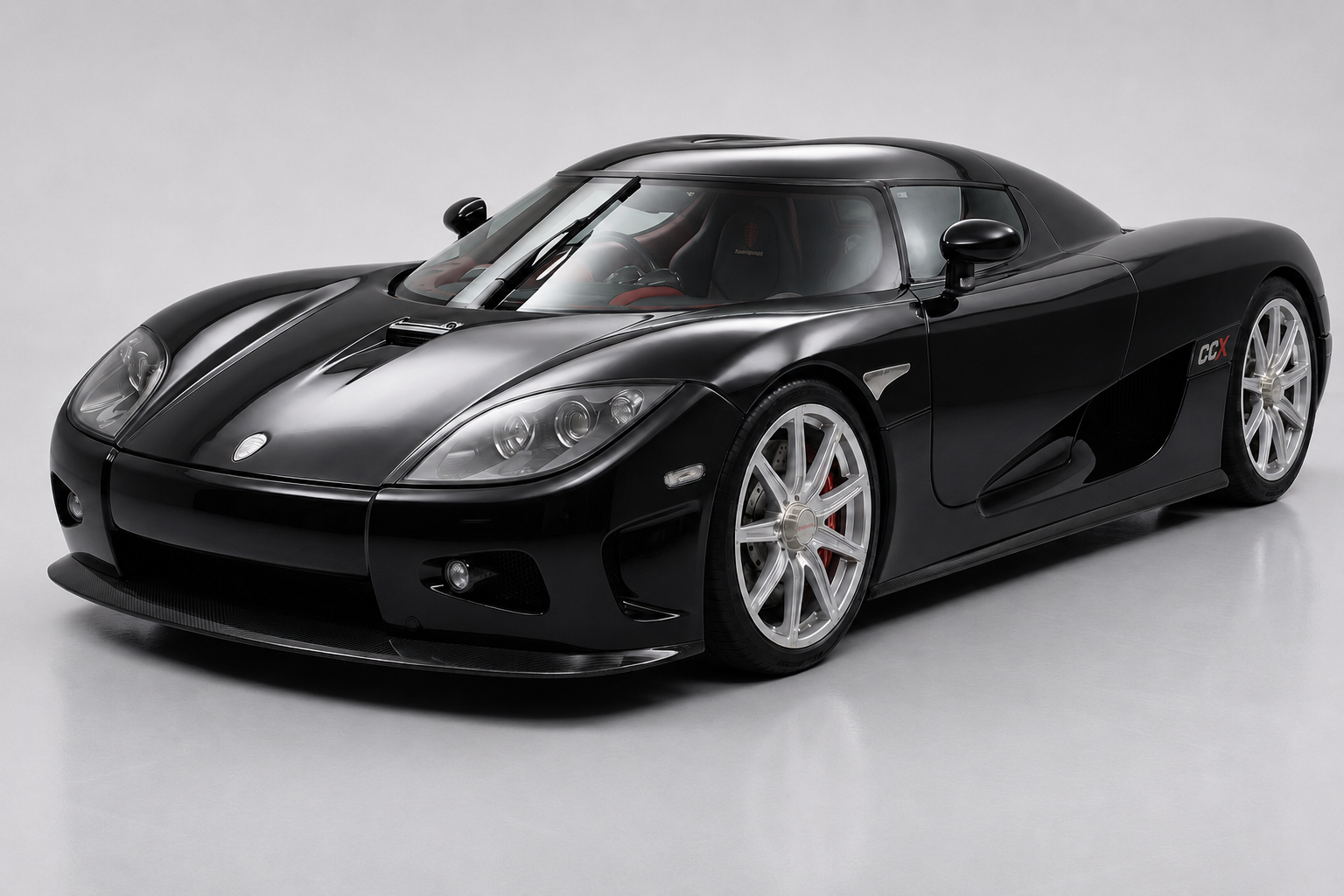
The first in-house-V8 Koenigsegg and the first US-legal Koenigsegg — a small CC-generation family that includes the two-car Trevita, one of the rarest factory Koenigseggs ever built.
The CCX is the car on which Koenigsegg stopped being a small Swedish supercar programme and became a manufacturer with its own engine. Introduced at Geneva 2006, the CCX carried the CC-generation carbon-fibre monocoque platform forward from the CC8S and CCR, but replaced the Ford Modular-derived V8 of the earlier cars with an all-new in-house aluminium-block 4.7-litre twin-supercharged V8 designed at Ängelholm — 795 bhp / 806 PS at 7,000 rpm on 91-octane US pump fuel and 920 Nm of torque at 5,500 rpm, deliberately detuned from the earlier CCR (806 bhp / 817 PS on higher-octane fuel) so the CCX would run on US pump petrol. It was also the first Koenigsegg engineered from the outset to meet US federal regulations, and the model that put the marque on sale in the United States. The CCXR followed in 2007 as the E85/biofuel evolution, running approximately 1,018 bhp on ethanol-blended fuel. Alongside the base CCX and CCXR, small factory-built runs of the CCX Edition, CCXR Edition and CCXR Special Edition track-focused specifications were produced, and — at the very top of the family — the CCXR Trevita, the only Koenigsegg ever built with a unique white-diamond-weave carbon-fibre bodywork treatment, of which just two cars were delivered against a planned run of three. Family-level production totals 49 cars, itemised as CCX 30, CCXR 6–9 (sources differ), CCX Edition 2, CCXR Edition 4, CCXR Special Edition 2, CCXR Trevita 2 — approximately two of which were non-customer cars (a crash-test CCX and a factory-test CCXR).
The CCX family matters for three reasons. First, it is the first Koenigsegg built around the marque's own in-house V8 — the moment Ängelholm stopped depending on a Ford Modular-derived engine block and became a full-line hypercar manufacturer with its own powertrain, and the direct engineering ancestor of every Koenigsegg V8 built since (Agera, Regera, Jesko, One:1). Second, it is the first US-legal Koenigsegg, and every US-market Koenigsegg CC-generation car in the American collector base descends from the CCX programme. Third, the CCX family contains two extraordinary two-car factory runs: the CCXR Trevita — the only Koenigseggs ever built with the unique white-diamond-weave carbon-fibre bodywork treatment — and the CCXR Special Edition, the factory send-off model for the CCX line, with all-clear-carbon bodywork, a distinctive double-F1 rear wing and the first paddle-shift gearbox Koenigsegg ever fitted. Both sit at their own price planes materially above every other CC-generation car and are the category-defining collector variants of the family. Alongside them, the CCXR Edition and CCX Edition track-focused specifications are small-run factory variants that carry a distinct market premium over base CCX and CCXR chassis. Every car in the family is individually tracked in the marque enthusiast community and continuous Ängelholm factory service history is the primary provenance axis.
Variants
Range and production
Variant
Years
Production
Notes
CCX — production customer car (2006–2010)
2006–2010
—
30 cars, the largest single variant in the CCX family. CC-generation carbon-fibre monocoque, in-house Koenigsegg 4.7-litre twin-supercharged aluminium-block V8 quoted at 795 bhp / 806 PS at 7,000 rpm on 91-octane US pump fuel and 920 Nm at 5,500 rpm — detuned from the CCR (806 bhp / 817 PS) to run on US pump petrol as the first US-legal Koenigsegg. Six-speed manual transaxle, removable carbon targa roof stowing under the front lid, dihedral synchro-helix doors. Optional factory rear-wing aero package materially reduced Nürburgring and Top Gear track times. One of the 30 was a factory crash-test car. Chassis history is individually tracked in the marque enthusiast community; continuous factory service history at Ängelholm is the primary provenance axis on any customer car.
CCXR — E85/biofuel evolution (2007 onward)
2007–2010
—
6–9 cars — sources differ (Koenigsegg factory tallies and Wikipedia disagree on this figure specifically). Same 4.7-litre twin-supercharged in-house V8 architecture as the CCX with revised fuelling and calibration for E85 operation, producing approximately 1,018 bhp on E85 (materially lower on standard pump petrol). One of the run was a factory-test car. Otherwise mechanically and structurally common with the CCX. Chassis history individually tracked.
CCX Edition — track-focused factory variant
2008
—
2 cars. Factory-built low-volume variant with revised aero (fixed rear wing, revised front splitter and diffuser), revised chassis calibration and higher-output engine specification. Not promoted to collectorVariant status: treated as a higher-output spec package on the CCX platform rather than a category-defining distinct model.
CCXR Edition — track-focused factory variant on the CCXR biofuel platform
2008
—
4 cars. Factory-built low-volume variant with revised aero, higher-output engine specification on the CCXR E85 platform. Not promoted to collectorVariant status: treated as a higher-output spec package on the CCXR platform rather than a category-defining distinct model.
CCXR Special Edition — the two-car send-off model for the CCX line
2008–2009
—
2 cars — the factory send-off model for the CCX generation. All-clear-carbon bodywork, distinctive double-F1 rear wing and the FIRST Koenigsegg with a paddle-shift gearbox (a first for the marque, later carried forward into the Agera generation). Same 2-car rarity as the Trevita, genuinely distinct from the CCX/CCXR platform rather than a spec package. Promoted below as a collector variant.
CCXR Trevita — the two-car white-diamond-weave-carbon Koenigsegg
2009–2010
—
2 cars delivered against a planned run of 3 — the third was not completed. The only Koenigseggs ever built with the factory-developed white-diamond-weave carbon-fibre bodywork treatment ('Trevita' — 'three whites'), a Ängelholm-proprietary process that has not been repeated on any subsequent Koenigsegg model. Mechanically a CCXR (E85/biofuel, ~1,018 bhp on E85). Category-defining collector variant of the CCX family, sitting at its own price plane materially above every other CC-generation car. Individually tracked in the marque enthusiast community; every transaction on either car would be a market-defining event on the model.
Collector Variants
Limited & special editions
The models below represent the most significant limited and special edition variants — factory-produced cars that command meaningful premiums over standard examples and warrant specific attention from serious collectors.
CCXR Trevita · 2009–2010
2 cars delivered (originally planned 3)
Distinguishing features
The only Koenigseggs ever built with the factory-developed white-diamond-weave carbon-fibre bodywork treatment ('Trevita' — 'three whites'), an Ängelholm-proprietary process that has not been repeated on any subsequent Koenigsegg model. Mechanically a CCXR (E85, approximately 1,018 bhp on E85), with bespoke Trevita-specification cabin componentry.
Value premium
Case-by-case at individual chassis level; sits at its own price plane materially above every other CC-generation Koenigsegg and any public transaction would be a market-defining event on the model.
Inspection points
Trevita bodywork integrity: the white-diamond-weave carbon-fibre treatment is uniquely Ängelholm-proprietary and any bodywork repair or refinishing must be executed at the factory to preserve the Trevita treatment. Verify Trevita bodywork continuity across every panel against period reference photography for the individual chassis, and confirm Ängelholm chassis documentation. Otherwise mechanical inspection as a CCXR (E85 fuel system, twin-supercharger installation, in-house V8, six-speed manual transaxle).
Authentication
Every one of the two Trevita chassis is individually identified in the marque enthusiast community and in the Ängelholm chassis record; authentication is a matter of matching the specific chassis identity against the Ängelholm record and against marque-community chassis tracking. There is no other Koenigsegg with the Trevita white-diamond-weave bodywork treatment, so retrofit or replication does not exist as a market category.
CCXR Special Edition · 2008–2009
2 cars
Distinguishing features
The factory send-off model for the CCX line. All-clear-carbon bodywork (no paint over the weave), a distinctive double-F1 rear wing on the CCXR E85 platform, and the first Koenigsegg ever fitted with a paddle-shift gearbox — a first for the marque that was subsequently carried into the Agera generation. Mechanically a CCXR (E85, approximately 1,018 bhp on E85). Same 2-car rarity as the Trevita and genuinely distinct from the CCX / CCXR / Edition specifications rather than a spec package.
Value premium
Case-by-case at individual chassis level; sits at its own price plane materially above the CCX / CCXR / Edition tier and any public transaction would be a market-defining event on the model.
Inspection points
All-clear-carbon bodywork continuity: verify weave alignment, lacquer condition and absence of over-paint against period reference photography for the individual chassis. Verify factory paddle-shift transmission installation and confirm the double-F1 rear-wing specification against the Ängelholm build sheet. Otherwise mechanical inspection as a CCXR (E85 fuel system, twin-supercharger installation, in-house V8).
Authentication
Both Special Edition chassis are individually identified in the marque enthusiast community and in the Ängelholm chassis record; authentication is a matter of matching the specific chassis identity against the Ängelholm record. Retrofitted double-F1 aero or aftermarket paddle-shift installation on a base CCXR does not confer Special Edition status and must be reconciled against factory build documentation.
Production figures sourced from official marque records and specialist registers. Verify chassis documentation with the relevant marque register before purchase.
Buyer's Guide
What to look for
Variant identity — CCX, CCXR, Edition specifications and the CCXR Trevita
Variant identity is the largest structural axis on the CCX-family market. Base CCX and base CCXR sit at one plane; the factory-built Edition and Special Edition track-focused specifications sit at a distinct premium above the base cars; and the two-car CCXR Trevita sits at its own price plane materially above every other CC-generation Koenigsegg. Verify variant identity against the Ängelholm factory build sheet and chassis record before any purchase — retrofitted Edition-style aero or non-factory 'tribute' specification does not confer the market position of a factory-built Edition car, and any chassis represented as an Edition variant must carry the Ängelholm build documentation. Every one of the two Trevita chassis is individually identified in the marque community.
Carbon-fibre monocoque tub and bodywork — accident history, repair provenance
The CCX carbon-fibre monocoque and carbon bodywork are the primary structural inspection surface. Any accident-repair history, resin re-lamination, section repair or bodywork panel replacement must be reconciled against Ängelholm factory records; unrecorded structural repair on a CC-generation carbon-tub hypercar is the most consequential single value-damaging discovery at PPI. Full body-off inspection with carbon-composite non-destructive testing by a specialist familiar with CC-generation construction is the standing PPI reference on the model. On the CCXR Trevita, the white-diamond-weave carbon-fibre bodywork treatment is uniquely Ängelholm-proprietary and any bodywork repair must be executed at the factory to preserve the Trevita treatment integrity.
In-house twin-supercharged 4.7 V8 — matching numbers, factory service history at Ängelholm
Engine identity is the second structural axis on value after variant identity. The CCX is the first Koenigsegg with the in-house-designed aluminium-block V8, and engine identity, twin-supercharger installation, engine management calibration and ancillaries are entirely Ängelholm-specific. Verify engine block number and cylinder-head numbers against the factory build sheet, and cross-check every stamping against the Ängelholm chassis service record. Any deviation from factory specification — non-original superchargers, aftermarket engine management, non-original intake or fuelling, retrofitted E85 fuelling on a car represented as CCX-specification — is immediately visible on inspection and downgrades the car materially. Continuous factory service history at Ängelholm from delivery to present is the reference paperwork chain and the largest single value-underwriting factor at the top of the market.
The six-speed manual transaxle is a low-volume unit and specialist rebuild knowledge is concentrated at Ängelholm. Verify transaxle number against the factory build sheet, inspect clutch condition, driveshaft integrity and final-drive fit, and cross-check every service intervention against the Ängelholm factory record. Any prior transmission work outside the factory or a factory-approved specialist is a material item on any PPI and must be reconciled against paperwork before purchase.
Cooling, intake and forced-induction system — twin superchargers, intercoolers, ancillaries
The twin-supercharger installation, intercoolers and forced-induction ancillaries on the CCX and CCXR are hand-built low-volume components and are the primary reliability and maintenance surface on the powertrain. Verify supercharger service history on both chargers, intercooler integrity, correct intake-tract specification and factory-specification ancillary fit at PPI, and confirm every service intervention against the Ängelholm factory record. On the CCXR specifically, the E85 fuelling calibration and the fuel-system componentry are E85-specification from the factory and must be documented; on CCX chassis, any retrofitted E85 componentry disqualifies a CCX-specification car.
The optional factory rear-wing aero package on the base CCX / CCXR materially reduced Nürburgring and Top Gear track times and is a distinguishing spec item; verify factory documentation of the rear-wing package on any chassis represented as so-equipped. The Edition-specification aero (revised front splitter, diffuser and fixed rear wing) is factory-built and must be documented in the Ängelholm chassis record for any chassis represented as an Edition car. On the CCXR Trevita, the entire body treatment is uniquely factory-proprietary and any bodywork intervention must be at the factory.
Suspension, brakes and wheels — factory specification, service history
Verify suspension, brake and wheel specification against the factory build sheet and Ängelholm service record. Original-specification dampers, correct brake componentry, correct factory-supplied wheels and correct-specification tyre fitment are the standing reference; any non-factory componentry must be documented and, on a concours-represented car, treated as reversible against a return to factory specification.
Targa roof, dihedral synchro-helix doors and body-electrical
The removable carbon targa roof, dihedral synchro-helix door mechanism and associated body-electrical systems are hand-built low-volume assemblies unique to the CC-generation cars and are the primary body-mechanical inspection surface. Verify correct roof-panel fit and stowage under the front lid, correct door-mechanism operation on both sides, and correct electrical fit throughout at PPI. Any prior body-mechanical work outside the factory or an approved specialist is a material item and must be reconciled against paperwork before purchase.
The CCX cabin is hand-trimmed and hand-assembled at Ängelholm. Verify original trim material, correct instrument specification, correct steering-wheel and shifter fit, and correct centre-console and switch-gear componentry against the factory build sheet and against period reference photography for the individual chassis. Retrimmed cabins and non-original componentry on a hand-built low-volume production hypercar are materially damaging to value and each item must be reconciled against paperwork on any concours-represented car. On the CCXR Trevita, the cabin specification is bespoke to the two Trevita chassis and correct-specification cabin componentry is a distinct paperwork item.
Provenance — chassis record, Ängelholm factory service history, Trevita/Edition tracking
Provenance documentation is the primary axis on which CCX-family market value moves after variant identity and engine. The Ängelholm chassis record, continuous factory service history from delivery to present, and marque-enthusiast community tracking of the individual chassis are the standing reference. Every one of the two CCXR Trevita chassis is individually identified in the marque community; any chassis represented as a Trevita must reconcile against the Ängelholm chassis record for that specific chassis, and any chassis represented as an Edition or Special Edition variant must carry the factory build documentation for that specific variant.
Pre-purchase inspection — Ängelholm factory or factory-approved specialist required
PPI must be conducted at Koenigsegg's Ängelholm factory or by a factory-approved specialist with direct CC-generation carbon-tub experience — not a generalist hypercar workshop and not a modern-Koenigsegg (Agera / Regera / Jesko) specialist without CC-generation knowledge. Insist on: full carbon-tub inspection with composite NDT; matching-numbers verification of engine, transmission and driveline against the factory build sheet; independent inspection of the twin-supercharger installation, targa roof, dihedral door mechanism and body-electrical systems; full drivetrain compression, oil-pressure and road-test verification on the twin-supercharged in-house V8; and a complete review of the Ängelholm factory service record including any Edition or Trevita build documentation on those chassis.
Insurance, storage and event access
The CCX family is a natural agreed-value classic-policy insurance risk with Hagerty, Chubb Masterpiece or a comparable HNW carrier familiar with CC-generation-carbon-tub hypercar risk profiles. Climate-controlled storage is the standing reference and marque-factory transport for major service intervals is the ownership pattern on most of the family print. Event access includes Goodwood Festival of Speed, top-tier concours (Villa d'Este, Salon Privé, The Quail), and marque-organised Koenigsegg owner events at Ängelholm. The CCXR Trevita is a natural top-tier concours entry on the strength of its two-car status alone.
Pricing
What to pay
CCXR Trevita — two-car reference tier
USDUSD $8,000,000 – $15,000,000+ private-treaty basis; case-by-case at the individual chassis level. Two-car factory production, unique Ängelholm-proprietary white-diamond-weave carbon-fibre bodywork treatment, mechanically CCXR (E85), continuous Ängelholm factory service history. Any public transaction on either Trevita chassis would be a market-defining event on the model and pricing at this tier is set by direct owner-to-owner negotiation rather than by public auction print.
GBPGBP £6,500,000 – £12,300,000+ private-treaty basis. Authored independently per region — NOT FX-converted.
EUREUR €7,400,000 – €13,800,000+ private-treaty basis. Authored independently per region — NOT FX-converted.
Basis: authored independently per region — NOT FX-converted. The two-car Trevita is a market of its own within the CCX family and within the Koenigsegg range as a whole; there is no meaningful public transaction print at this tier and the band above is a case-by-case reference for indicative purposes only.
CCXR Special Edition — two-car send-off reference tier
USDUSD $6,000,000 – $10,000,000+ private-treaty basis; case-by-case at individual chassis level. Two-car factory production, all-clear-carbon bodywork, double-F1 rear wing, first Koenigsegg paddle-shift gearbox, mechanically CCXR (E85), continuous Ängelholm factory service history. Sits materially above the Edition tier and materially below the Trevita.
GBPGBP £4,900,000 – £8,200,000+ private-treaty basis. Authored independently per region — NOT FX-converted.
EUREUR €5,500,000 – €9,200,000+ private-treaty basis. Authored independently per region — NOT FX-converted.
Basis: authored independently per region — NOT FX-converted. The two-car CCXR Special Edition is a category-defining send-off model with genuine engineering firsts (paddle-shift, double-F1 aero, all-clear-carbon); there is no meaningful public transaction print at this tier and the band above is a case-by-case reference for indicative purposes only.
USDUSD $3,500,000 – $6,500,000 private-treaty basis at reference marque specialists. Matching numbers, factory-built Edition specification documented in the Ängelholm chassis record, continuous factory service history, complete factory paperwork and marque-registry chassis tracking.
GBPGBP £2,850,000 – £5,300,000 private-treaty basis. Authored independently per region — NOT FX-converted.
EUREUR €3,250,000 – €6,000,000 private-treaty basis. Authored independently per region — NOT FX-converted.
Basis: authored independently per region — NOT FX-converted. Factory-built Edition specifications (CCX Edition 2 cars, CCXR Edition 4 cars) sit at a distinct premium above base CCX and CCXR chassis on the strength of low-volume factory-built specification and factory-built aero and calibration.
CCXR — E85/biofuel base car
USDUSD $2,200,000 – $3,500,000 private-treaty basis at reference marque specialists. Matching numbers, continuous Ängelholm factory service history, correct E85 fuelling and calibration documented from the factory, complete paperwork.
GBPGBP £1,800,000 – £2,850,000 private-treaty basis. Authored independently per region — NOT FX-converted.
EUREUR €2,050,000 – €3,250,000 private-treaty basis. Authored independently per region — NOT FX-converted.
Basis: authored independently per region — NOT FX-converted. Base CCXR reference: ~6-car generally cited variant on the E85 platform, sitting at a premium above base CCX on the strength of the biofuel programme.
CCX — reference base car, matching numbers with continuous Ängelholm factory service history
USDUSD $1,700,000 – $2,600,000 private-treaty basis at reference marque specialists. Matching numbers, continuous factory service history from delivery, correct factory specification, complete factory paperwork and marque-registry chassis tracking. Cars with the optional factory rear-wing aero package documented from the factory sit at the top of this band.
GBPGBP £1,400,000 – £2,150,000 private-treaty basis. Authored independently per region — NOT FX-converted.
EUREUR €1,600,000 – €2,400,000 private-treaty basis. Authored independently per region — NOT FX-converted.
Basis: authored independently per region — NOT FX-converted. Reference top of the base-CCX market: a matching-numbers car with continuous Ängelholm factory service history from delivery.
Restoration required — carbon-tub damage, non-original drivetrain, or major paperwork gap
USDCase-by-case; any CCX-family chassis with structural carbon-tub damage, non-original drivetrain, undocumented major work, or a substantial gap in Ängelholm paperwork must be priced against a factory-level restoration budget and paperwork-reconciliation exercise. Pricing at this tier is not a public-market discipline.
GBPCase-by-case; authored independently per region — NOT FX-converted.
EURCase-by-case; authored independently per region — NOT FX-converted.
Basis: authored independently per region — NOT FX-converted. Case-by-case only. A CCX-family chassis with structural, drivetrain or paperwork issues is priced against Ängelholm-level restoration budgets and a return-to-factory-specification exercise.
Regional ranges authored independently — each reflects its local market, not an FX conversion
Ownership
Living with it
Typical mileage
300–2,000 miles / 500–3,200 km typical on a matching-numbers CCX-family car in active use; several cars in the customer print are museum-condition and see essentially no annual mileage between event outings. The two CCXR Trevita chassis are static-display condition.
Service interval
Annual service at Koenigsegg's Ängelholm factory or a factory-approved specialist with direct CC-generation carbon-tub experience. Carbon-tub, bodywork and twin-supercharger system inspection at the same interval.
Annual running cost
USD $35,000 – $120,000+ typical annual budget for a matching-numbers CCX-family car in active use with continuous factory service — dominated by Ängelholm factory service intervals, twin-supercharger system inspection, and marque-factory transport to and from Sweden for major service work.
Fuel economy
~9–13 mpg (US) / ~11–16 mpg (imp) / ~18–26 L/100 km on typical use with the twin-supercharged 4.7 V8 (CCXR on E85 broadly comparable with different fuel-availability considerations).
Insurance
Agreed-value classic-policy cover through Hagerty, Chubb Masterpiece or a comparable HNW carrier is the standing channel; premiums vary materially by variant (base CCX, base CCXR, Edition specifications, CCXR Trevita) and by continuous factory service history. The two-car CCXR Trevita is a bespoke insurance risk and typically underwritten on a case-by-case basis at the individual chassis level.
Ängelholm factory service — the reference channel
Route all major service and any powertrain, carbon-tub or body-electrical work through Koenigsegg's Ängelholm factory or a factory-approved specialist with direct CC-generation experience. Generalist hypercar workshops and modern-Koenigsegg specialists without CC-generation knowledge are not the reference on this model, and any period of non-factory service is priced as a paperwork deduction against continuous factory history. Trevita bodywork intervention must be at the factory.
Chassis record and marque-community tracking
Every one of the CCX-family customer chassis is individually tracked in the marque enthusiast community. Provenance verification is a matter of confirming continuous chassis identity from delivery to present against the Ängelholm chassis record and against marque-community records; any chassis represented at reference tier without confirmed chassis-record correspondence must be treated as unresolved on provenance until the record is confirmed. The two CCXR Trevita chassis are individually identified.
Twin-supercharger system — service discipline
The twin-supercharger installation, intercoolers and forced-induction ancillaries are hand-built low-volume Koenigsegg-specific components and are the primary powertrain-service surface on the model. Continuous supercharger service documented at Ängelholm from delivery to present is the reference paperwork chain and any gap in that history is a distinct paperwork item at PPI and at sale. On the CCXR, E85 fuel-system componentry is a distinct service focus.
Common Problems
Known issues by system
Carbon-fibre monocoque tub and bodywork — accident history, undocumented structural repair
The CCX carbon-fibre monocoque tub and carbon bodywork are the primary structural inspection surface and any accident-repair history, resin re-lamination, section repair or bodywork panel replacement outside Ängelholm factory records is the most consequential single value-damaging discovery on the model. Every one of the CCX-family chassis is individually tracked in the marque community; any structural repair should be reconcilable against public chassis history. Trevita bodywork repair outside Ängelholm is a category-defining problem for that specific pair of chassis.
CriticalCase-by-case — Ängelholm-level composite structural repair is factory-priced and specific to each intervention; no public band exists for this work on the model.
Symptoms — Evidence of prior bodywork repair not documented in Ängelholm records, resin or paint signature inconsistent with factory finish, panel-fit anomalies, non-destructive-test signature indicating internal composite damage or repair, non-factory bodywork surface treatment on a Trevita.
Inspection — Full body-off inspection with carbon-composite non-destructive testing at PPI; documented restoration paperwork covering any structural or bodywork work; reconciliation of chassis identity against the Ängelholm chassis record and the marque-community chassis history for the individual car.
Matching-numbers in-house twin-supercharged 4.7 V8 — non-original engine, non-factory work
The in-house twin-supercharged 4.7 V8 is entirely Ängelholm-specific and any deviation from factory engine, supercharger or engine-management specification is immediately visible at inspection and downgrades the car materially. Non-original engines, aftermarket supercharger pulleys, non-factory engine management calibration, non-original intake or fuelling componentry, and retrofitted E85 fuelling on a car represented as CCX-specification (or vice versa) each disqualify a matching-numbers car.
CriticalUSD $80,000 – $240,000+ for a factory-level engine and twin-supercharger inspection and rectification programme at Ängelholm; sourcing a chassis-correct replacement engine on a low-volume CC-generation Koenigsegg is a distinct factory exercise.
Symptoms — Engine number does not match the factory build sheet; supercharger pulley or drive specification non-factory on either charger; engine-management calibration non-factory; intake or fuelling componentry non-original; unrecorded fuel-system conversion between CCX and CCXR specification.
Inspection — Cross-check every engine stamping against the factory build sheet at PPI; independent inspection by an Ängelholm-approved specialist; documented service paperwork covering the engine, both superchargers and (on CCXR) the E85 fuel system specifically.
The six-speed manual transaxle is a low-volume unit with specialist rebuild knowledge concentrated at Ängelholm. Any prior transmission work outside the factory or a factory-approved specialist is a material item on any PPI and undocumented transmission intervention is priced as a paperwork deduction and a rebuild-cost provision.
MajorUSD $35,000 – $95,000+ for a factory-level transaxle inspection and rebuild programme at Ängelholm.
Symptoms — Transmission number does not match the factory build sheet, evidence of prior non-factory transmission work, gear-selection anomalies, clutch or driveshaft wear inconsistent with documented mileage.
Inspection — Cross-check transaxle number against the factory build sheet at PPI; independent inspection by an Ängelholm-approved specialist; documented service paperwork covering the transmission specifically.
Aero package — non-factory 'Edition-style' aero or non-original rear wing
The Edition-specification aero (fixed rear wing, revised front splitter and diffuser) and the optional factory rear-wing package on base CCX/CCXR are distinguishing structural features and factory-built provenance is a material paperwork item. Aftermarket 'Edition-style' aero retrofitted to a base CCX or CCXR does not confer the market position of a factory-built Edition car and is priced accordingly.
MajorUSD $22,000 – $80,000+ for correct-specification aero sourcing and refit at Ängelholm.
Symptoms — Aero specification inconsistent with the factory build sheet for the individual chassis; undocumented aero modification; retrofitted Edition-style componentry on a base CCX/CCXR without Ängelholm build documentation.
Inspection — Verify aero specification against the factory build sheet and the Ängelholm chassis record at PPI; treat undocumented modification as reversible against a return to factory specification.
Targa roof, dihedral synchro-helix doors and body-electrical
The removable carbon targa roof, dihedral synchro-helix door mechanism and associated body-electrical systems are hand-built low-volume assemblies unique to the CC-generation cars and are the primary body-mechanical failure and inspection surface after the powertrain. Non-original componentry, prior non-factory repair and undocumented electrical work each require reconciliation at PPI.
MajorUSD $18,000 – $70,000+ for factory-level body-mechanical inspection and rectification at Ängelholm.
Symptoms — Targa panel fit anomaly, dihedral door mechanism operating asymmetrically or with hydraulic weep signature, body-electrical fault codes or intermittent operation, evidence of prior body-mechanical work outside factory records.
Inspection — Specialist inspection of the targa mechanism, door hydraulics and body-electrical systems at PPI; documented service paperwork covering body-mechanical work; reconciliation against Ängelholm chassis record.
Cooling and forced-induction ancillaries — twin superchargers, intercoolers, oil-cooling, E85 fuel system
The twin-supercharger installation, intercoolers and cooling ancillaries are hand-built low-volume components and are the primary powertrain-service surface. On the CCXR the E85 fuel-system componentry is a distinct service focus and any non-factory ancillary fit, non-original intercooler or non-standard cooling-system componentry each disqualify a factory-specification car.
ModerateUSD $10,000 – $35,000 for a factory-level cooling and forced-induction system inspection and refresh at Ängelholm.
Symptoms — Coolant temperature climbs in traffic or on sustained load, supercharger drive noise inconsistent with factory reference on either charger, intercooler or plumbing signature non-factory, evidence of prior non-factory cooling-system or E85 fuel-system work.
Inspection — Cooling and forced-induction pressure test and hot-idle observation at PPI; documented service paperwork covering both superchargers, both intercoolers, the cooling system and (on CCXR) the E85 fuel system.
Interior trim and hand-assembled cabin componentry
The CCX cabin is hand-trimmed and hand-assembled at Ängelholm. Retrimmed seats, non-original steering-wheel or shifter fit, replacement instrument componentry and non-original centre-console or switch-gear fit are each material items on a hand-built low-volume production hypercar and must be documented and, on a concours-represented car, treated as reversible against a return to factory specification. Trevita cabin specification is bespoke to the two Trevita chassis.
MinorUSD $25,000 – $75,000+ for correct-specification interior sourcing and refit at Ängelholm or an approved trim specialist.
Symptoms — Non-original trim material or pattern, non-original steering wheel or shifter, replacement instruments or switch-gear, non-original centre-console componentry.
Inspection — Verify original trim and instrument specification against the factory build sheet and against period reference photography for the individual chassis at PPI.
Valuation
Current value bands by region
Concours
USD
USD $1,700,000 – $15,000,000+ (variant-dependent: base CCX at the low end, Edition specifications in the mid range, CCXR Trevita at the top)
GBP
GBP £1,400,000 – £12,300,000+
EUR
EUR €1,600,000 – €13,800,000+
▲ +8% 12-mo
Excellent
USD
USD $1,400,000 – $3,000,000 (matching numbers, documented service history — base CCX and CCXR)
GBP
GBP £1,150,000 – £2,450,000
EUR
EUR €1,300,000 – €2,800,000
▲ +5% 12-mo
Good
USD
USD $1,100,000 – $1,700,000 (matching numbers, partial service documentation — base CCX)
GBP
GBP £900,000 – £1,400,000
EUR
EUR €1,050,000 – €1,600,000
▬ +2% 12-mo
Fair
USD
Case-by-case (documentation or specification issues)
GBP
Case-by-case
EUR
Case-by-case
▬ 0% 12-mo
Project
USD
Case-by-case (carbon-tub damage or major drivetrain non-originality)
GBP
Case-by-case
EUR
Case-by-case
▬ 0% 12-mo
Each region quoted in its local currency — independent market readings, not FX conversions
The CCX-family market is dominated by four structural facts. First, variant identity — the family spans base CCX, base CCXR, the CCX Edition and CCXR Edition track-focused factory specifications, and two two-car category-defining runs (the CCXR Trevita and the CCXR Special Edition). Each variant sits at its own price plane; the Trevita and Special Edition each sit materially above every other CC-generation Koenigsegg and are markets of their own. Second, first-in-house-V8 significance — the CCX is the founding car for the Koenigsegg in-house V8 architecture that runs unbroken through the Agera, Regera, Jesko and One:1 generations, and that founding-engine-architecture status is a durable long-horizon value anchor at the top of the family. Third, US-legal status — the CCX was the first Koenigsegg engineered from the outset to meet US federal regulations and the model that introduced the marque to the US collector base, and the US CCX population is a distinct and active market. Fourth, factory-service discipline — continuous Ängelholm service history from delivery to present is the reference paperwork chain and materially the largest single axis on which value moves between two otherwise-equivalent chassis. Reference top of the family: the two CCXR Trevita chassis and the two CCXR Special Edition chassis, each priced case-by-case at individual chassis level. Reference top of the non-Trevita / non-Special-Edition family: a matching-numbers CCX Edition or CCXR Edition with continuous Ängelholm factory service history. Reference base-CCX market: a matching-numbers CCX with continuous factory service. Cases outside those bands are case-by-case exercises priced against factory-level restoration budgets and paperwork reconciliation at Ängelholm.
Auctions
Recent results
Date
Auction
Car
Mileage
Result
2022-08-20
RM Sotheby's
Monterey 2022 (public-print reference)
2008 CCX — matching numbers, documented service history
Public-print reference band for a matching-numbers base CCX at Monterey. CCI has NOT independently re-fetched the specific RM Sotheby's lot page during this review — the entry is treated as a public-print reference band and should be verified against the specific lot record at rmsothebys.com before use as a firm market anchor.
—
USD $1,400,000 – $1,900,000 (public-print band)
Sold
2023-01-27
Mecum
Kissimmee 2023 (public-print reference)
2009 CCXR Edition — matching numbers, documented factory service history
Public-print reference band for a CCXR Edition at Mecum Kissimmee. CCI has NOT independently re-fetched the specific Mecum lot page during this review — the entry is treated as a public-print reference band and should be verified against the specific lot record at mecum.com before use as a firm market anchor.
—
USD $2,500,000 – $3,500,000 (public-print band)
Bid To
2024-05-01
Private treaty
European marque specialist (public-print reference)
2010 CCXR Trevita (one of two) — continuous Ängelholm factory service history
Public-print reference band for a CCXR Trevita transaction context through a European marque specialist. CCI has NOT independently verified an individual public transaction on either Trevita chassis during this review — the two-car Trevita market is set by direct owner-to-owner negotiation and there is no meaningful public print at this tier. The band above is treated as a case-by-case reference for indicative purposes only and any use as a firm anchor requires direct specialist consultation.
The results above are cited as public-print reference bands for Koenigsegg CCX-family sales at reference international auction houses and specialist private-treaty channels. The CCX family is a small-volume production programme and public auction transactions are correspondingly thin — most transactions have been private-treaty and are not part of the public record. CCI has NOT independently re-fetched the individual auction-house lot pages or verified individual private-treaty transactions during this specific review — each entry should be verified against the specific lot record at the naming auction house or against direct specialist listings before use as a firm market anchor. Reference market pricing on the CCX family must be built from the Ängelholm factory chassis record, continuous factory service history and direct specialist consultation rather than from secondary auction reporting. The two-car CCXR Trevita in particular has no meaningful public transaction print.
Investment
Long-term outlook
Strong HoldHorizon: 10–25 years
Four factors underwrite the CCX-family investment case. First, first-in-house-V8 significance: the CCX is the founding car for the Koenigsegg in-house V8 architecture that runs unbroken through the Agera, Regera, Jesko and One:1 generations, and that founding-engine-architecture status is a durable long-horizon value anchor as the modern Koenigsegg range reaches the collector market. Second, absolute production rarity: family-level total of 49 cars (2006–2010), with two two-car runs — the CCXR Trevita and the CCXR Special Edition — sitting at some of the smallest production numbers of any modern-era hypercar, and the Edition specifications at 2–4 cars each. Third, first-US-legal Koenigsegg status: the CCX introduced the marque to the US collector base and the US population is a durable, active market. Fourth, factory-service discipline: continuous Ängelholm service history from delivery to present is the reference paperwork chain and materially the largest single value-underwriting factor at the top of the market. Best holds: (i) the two CCXR Trevita chassis and the two CCXR Special Edition chassis as blue-chip category-defining objects; (ii) a matching-numbers CCX Edition or CCXR Edition with continuous Ängelholm factory service history; (iii) a matching-numbers base CCX with the optional factory rear-wing aero package documented from the factory. Watch items over the horizon: whether the CCXR production figure resolves firmly between 6 and 9, whether either Trevita or Special Edition chassis transacts publicly, and whether factory-executed post-delivery upgrade work at Ängelholm on CC-generation cars sustains its own reference band.
Recommended
The trusted network
Specialists
Koenigsegg Automotive AB — Ängelholm factory service
The reference factory service and restoration channel for the CCX family — the only source of continuous factory paperwork on any customer chassis, the only correct source of Trevita bodywork work, and the standing PPI reference at the top of the market.
Factory-approved specialist workshops with direct CC-generation carbon-tub experience — the acceptable channel for service work outside the Ängelholm factory itself.
Reference international auction houses appropriate to matching-numbers CCX-family consignment at Monterey, Pebble Beach, Kissimmee and top-tier European sales.