
Car Collector International
Classic · 1951–1953

Jaguar C-Type

Jaguar's first purpose-built competition car — two Le Mans wins in three years, and the first car to win the race on disc brakes.

Roadster
Car Collector International Editorial
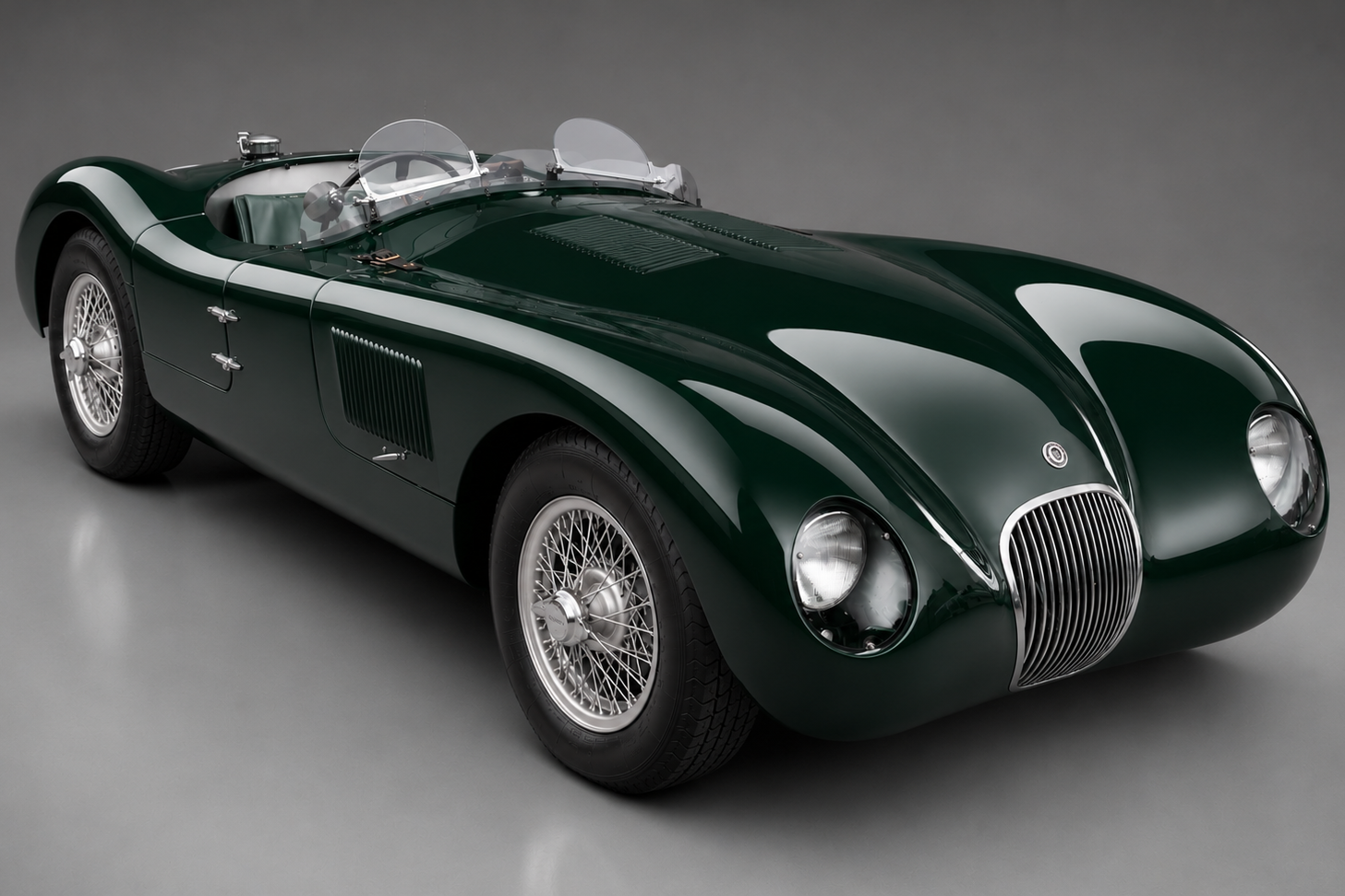
Jaguar C-Type (XK120C) in British Racing Green, front three-quarter view on a gravel apron with race numbers 18 and registration LSF 420, wire wheels and low aero-screens visible.
Overview

Why this car matters

Officially the Jaguar XK120-C, the C-Type was developed in 1951 as a competition-only derivative of the XK120 road car, aimed squarely at the Le Mans 24 Hours. Malcolm Sayer designed the aluminium body over a triangulated steel-tube spaceframe by chief engineer Bill Heynes, powered by a race-tuned 3.4-litre XK twin-cam inline-six with high-lift cams, larger valves and twin SU carburettors — around 200 bhp in road tune, 220 bhp in works specification. Kerb weight sat at approximately 900 kg.

The C-Type won the Le Mans 24 Hours on debut in June 1951 (Peter Walker / Peter Whitehead, chassis XKC 003) and again in 1953 (Tony Rolt / Duncan Hamilton, chassis XKC 051), the latter victory achieved with the Dunlop disc brakes that Jaguar had developed with the works C-Types over the preceding season — the first Le Mans win on disc brakes. The 1953 works cars also ran triple Weber carburettors, a lighter body and revised aerodynamics. Fifty-three C-Types were built in total across works and customer chassis (XKC 001 – XKC 053), the majority delivered to customer teams and privateer drivers.

The C-Type is the founding Jaguar sports-racing car — the bridge from the XK120 road car to the D-Type and, ultimately, the E-Type — and a chassis-finite Le Mans winner with published production of 53 units.

Variants

Range and production

VariantYearsProductionNotes
Customer C-Type1951–195343Twin SU carburettors, drum brakes, aluminium body over steel spaceframe. Sold to privateer teams and drivers worldwide; the majority of the 53-car run.
Works C-Type (1952 spec)19523Factory team cars for the 1952 season with revised long-nose/long-tail aerodynamics. All three retired at Le Mans 1952 with overheating.
Works C-Type (1953 spec, 'Lightweight')19533Dunlop disc brakes, triple Weber carburettors, lighter aluminium body and revised aerodynamics. Won Le Mans 1953 outright (Rolt/Hamilton, XKC 051) and finished 2nd and 4th (Moss/Walker, Whitehead/Stewart). Included within the 53-car total.
Collector Variants

Limited & special editions

The models below represent the most significant limited and special edition variants — factory-produced cars that command meaningful premiums over standard examples and warrant specific attention from serious collectors.

C-Type 1953 Works Le Mans specification ('Lightweight' / disc-brake works car) · 1953

3
Distinguishing features
The three factory-entered 1953 works C-Types built for that year's Le Mans 24 Hours: Dunlop disc brakes (the first Le Mans win on discs), triple Weber 40 DCO3 carburettors in place of the customer cars' twin SU set-up, a lighter aluminium body with revised aerodynamics, works-tuned XK twin-cam producing approximately 220 bhp, and works-specification suspension and cooling. XKC 051 (Rolt / Hamilton) won Le Mans 1953 outright; XKC 053 (Moss / Walker) finished 2nd; the third works car finished 4th. All three sit within the standard XKC 001 – XKC 053 chassis sequence.
Value premium
Effectively an eight-figure premium over a documented customer C-Type in equivalent condition. The public reference is XKC 052 (Ecurie Ecosse, ex-1953 works Le Mans entry) at $13.2m, RM Sotheby's Monterey 2015 — no subsequent public sale has displaced it. Any hypothetical current sale of a 1953 works chassis with Le Mans podium history would be negotiated privately rather than at open auction.
Inspection points
Confirm chassis identity against the Jaguar Heritage Trust (JDHT) archive and the international C-Type register; verify the Dunlop disc brake system is period-original (calipers, discs, master cylinder) rather than a later fitment; verify the triple Weber 40 DCO3 induction is period-correct and matched to the works engine specification; check the aluminium body for post-period re-shelling and the spaceframe tub for later welding at the node joints. Continuous documented ownership from period, plus period photography from the 1953 Le Mans entry, are essential supporting evidence.
Authentication
Only three 1953 works cars exist and each is individually known and registered with Jaguar Heritage. A car claiming 1953 works / Le Mans specification is either one of the three documented chassis (XKC 051, XKC 052, XKC 053 — the three cars Jaguar entered at Le Mans 1953) or it is a customer C-Type upgraded to works specification post-period, in which case it must be priced as a customer car with modifications rather than as a works car. Demand a JDHT certificate that names the car in the 1953 Le Mans works entry, not just as a 1953-built chassis; period FIA papers and continuous racing documentation are supporting evidence, not proof of works identity.

Production figures sourced from official marque records and specialist registers. Verify chassis documentation with the relevant marque register before purchase.

Buyer's Guide

What to look for

Provenance and originality

Start with identity, paperwork and originality. For the Jaguar C-Type, the strongest cars have continuous ownership history, matching numbers where applicable, original books and tools, factory build documentation and evidence of work by manufacturer-approved specialists. Chassis identity within XKC 001–XKC 053, JDHT / Jaguar Heritage archive verification, continuous ownership and documented period race history — Le Mans, Reims, Goodwood, Sebring — are the dominant value inputs. Original tub, original engine block and original body panels each carry material weight; post-period re-shells and replacement engines discount sharply against a comparable original car.

Mechanical inspection priorities

The race-tuned 3.4 XK twin-cam is well-supported through the Jaguar specialist network, but authenticity of the head, block casting numbers and induction (twin SU on customer cars, triple Weber on 1953 works cars) drives value. A specialist strip-and-inspection of the engine and gearbox by a recognised Jaguar competition-car engineer is essential before purchase. A proper pre-purchase inspection includes cold-start behaviour, ECU diagnostics and fault-code history (where applicable), leak-down or compression testing, underbody photography, suspension and chassis inspection, brake condition and a long enough road test to expose heat-related faults. Deferred maintenance on a car of this class is almost always more expensive than buying a better-sorted example.

Body, paint and accident history

Use a paint-depth gauge, lift access and a specialist familiar with the model's factory panel gaps and finish standards. Collector value is dramatically affected by structural repairs, refinished panels, poor paintwork and missing factory trim or option content. Documented cosmetic refresh is acceptable; concealed accident or fire damage must be priced severely.

Specification strategy

A documented C-Type from the XKC 001–XKC 053 chassis sequence, with continuous ownership history, JDHT/Jaguar Heritage records and — where claimed — corroborated period race history. 1953 works-specification (disc brake, triple Weber) cars are a separate market from customer cars, and any 'works' or Le Mans claim must be checked against Jaguar Heritage records, not accepted on seller narrative. Specification, colour, options and limited-build variants move values significantly. Buy the best-documented example in the most desirable specification you can justify, rather than a tired example of a rarer derivative that will need years of corrective work.

Pricing

What to pay

1953 Works Le Mans-provenance C-Type
USD$12,000,000 – $22,000,000+
GBP£9,500,000 – £17,500,000+
EUR€10,800,000 – €19,800,000+
The three 1953 works cars — disc brake, triple Weber, Le Mans-podium history. Museum-tier and effectively by private negotiation; XKC 052 (Ecurie Ecosse, ex-Le Mans works) set the public reference at $13.2m in 2015.
Customer C-Type with strong period race history
USD$6,500,000 – $9,500,000
GBP£5,150,000 – £7,500,000
EUR€5,850,000 – €8,600,000
Original tub, original engine, JDHT-verified, with documented period racing at Le Mans, Reims, Sebring or Goodwood in privateer hands.
Customer C-Type, documented, no headline race history
USD$4,500,000 – $6,000,000
GBP£3,550,000 – £4,750,000
EUR€4,050,000 – €5,400,000
Original chassis and engine, continuous ownership, national-level period competition rather than a headline race entry.
Restored / re-shelled / non-matching-numbers
USD$2,750,000 – $4,000,000
GBP£2,175,000 – £3,175,000
EUR€2,475,000 – €3,600,000
Later replacement body panels, non-original engine, or a documented post-period rebuild. Priced strictly against register condition, not against original cars.
Continuation / recreation (not a C-Type)
USD$400,000 – $1,600,000
GBP£315,000 – £1,275,000
EUR€360,000 – €1,440,000
Jaguar Classic 2020 Continuation series (8 cars, non-VIN) and Proteus/RAM/Realm recreations. Separate market from original XKC chassis — do not confuse the two.

Regional ranges authored independently — each reflects its local market, not an FX conversion

Ownership

Living with it

Typical mileage
1,000–4,000 miles typical for collector use
Service interval
12 months; mileage interval varies by model and use
Annual running cost
$5,000 – $18,000
Fuel economy
15–28 mpg depending on use
Insurance
Use an agreed-value collector or specialist supercar policy with limited mileage, secure storage, documented photography and an annual value review. Premiums vary sharply by age, storage location, declared value and driver profile.

Maintenance planning

Budget annually even if the car is used sparingly. Fluids age, tyres and date-coded rubber components must be replaced regardless of mileage, and stored cars need exercise. A documented maintenance rhythm protects both reliability and resale value.

Parts and specialist access

A small worldwide network — Jaguar Classic Works at Browns Lane, Pearsons Engineering, CKL Developments, JD Classics and a handful of US-based Jaguar competition specialists — handles serious C-Type work. Restoration timescales run in years, not months, and parts for period-correct specification are sourced rather than ordered. Before purchase, confirm parts availability for model-specific bodywork, electronics, gearbox and engine components. A discounted car waiting on unobtainable parts or a factory service slot is rarely a saving in collector ownership.

Common Problems

Known issues by system

Identity

Chassis outside the XKC 001 – XKC 053 range or missing from JDHT records

CriticalValue impact: a genuine C-Type trades against original chassis, not against tribute or continuation.
Symptoms — Chassis stamping does not match Jaguar Heritage records; seller relies on narrative rather than a JDHT certificate.
Inspection — Require JDHT / Jaguar Heritage Trust certificate and cross-reference with the C-Type register before deposit.
Originality

Replacement aluminium bodywork / re-shelled tub

Major$300,000 – $900,000 to correct properly
Symptoms — Panel gaps and rivet patterns inconsistent with period factory work; weld repairs at the spaceframe nodes.
Inspection — Specialist body-off survey by a Jaguar competition-car engineer; check tub for post-period welding and panel replacement.
Engine

Non-original engine block or head

Major$80,000 – $200,000 (period-correct engine rebuild)
Symptoms — Casting numbers do not match the JDHT record for that chassis; engine number sits outside the period C-Type range.
Inspection — Verify block and head casting numbers against JDHT record; specialist strip inspection before purchase.
Braking (customer cars)

Drum brake fade / master cylinder wear

Moderate$8,000 – $18,000
Symptoms — Long pedal, pull under braking, poor performance after a warm-up lap.
Inspection — Static and dynamic brake test; inspect drums, shoes and hydraulic circuit.
Braking (1953 works cars)

Dunlop disc brake authenticity and condition

Major$25,000 – $60,000
Symptoms — Discs, calipers or master cylinder are later replacements rather than period Dunlop items.
Inspection — Specialist inspection of the Dunlop disc system; verify period-correct components.
Gearbox

Moss 4-speed synchro wear (2nd and 3rd)

Moderate$15,000 – $35,000
Symptoms — Baulk into 2nd, jumping out of 3rd on the overrun, crunch on quick downshifts.
Inspection — Full road test through all gears cold and hot; specialist inspection.
Provenance

Le Mans or works claims without JDHT corroboration

CriticalValue impact: works vs. customer differential runs to eight figures
Symptoms — Seller cites period competition history that is not corroborated in JDHT records or the C-Type register.
Inspection — Independent verification against JDHT and the international C-Type register; period photographs are supporting evidence, not proof.
Valuation

Current value bands by region

Concours
USD
$7,500,000
GBP
£5,950,000
EUR
€6,750,000
+1% 12-mo
Excellent
USD
$5,800,000
GBP
£4,600,000
EUR
€5,200,000
0% 12-mo
Good
USD
$4,200,000
GBP
£3,325,000
EUR
€3,780,000
0% 12-mo
Fair
USD
$3,100,000
GBP
£2,450,000
EUR
€2,790,000
-1% 12-mo
Project
USD
$2,200,000
GBP
£1,740,000
EUR
€1,980,000
0% 12-mo

Each region quoted in its local currency — independent market readings, not FX conversions

C-Type trade is small and chassis-specific — with only 53 cars built, few change hands publicly in any given year and most transactions run through marque specialists and private treaty rather than at open auction. The XKC 052 (Ecurie Ecosse, 1953 works) result of $13.2m at RM Sotheby's Monterey 2015 remains the public benchmark for a works Le Mans-history car, and no subsequent public sale has displaced it. For customer cars, JDHT verification of chassis, engine and body, plus continuity of documented period race history, are the dominant value drivers; recreations and the 2020 Continuation series trade on a separate curve entirely.

Auctions

Recent results

DateAuctionCarMileageResult
2015-08-15
RM Sotheby's
Monterey 2015
1953 C-Type (XKC 052, ex-Ecurie Ecosse works Le Mans)
Public benchmark for a 1953 works C-Type with Le Mans works entry. Included for reference — no subsequent public sale has displaced it.
$13,200,000
Sold

The C-Type market is thin at public auction and heavily private. Where claimed public results circulate outside the JDHT / marque register, treat them as unverified until corroborated against the auction house's own published archive.

Investment

Long-term outlook

Blue ChipHorizon: 10+ years

Finite chassis-numbered production (53), two Le Mans wins, the first Le Mans victory on disc brakes and a decisive place in the Jaguar competition lineage all support a durable floor. The 1953 works cars are effectively unrepeatable and trade as such; customer cars with original tub, original engine and JDHT verification form the strong second tier. Principal risk is confusion with 2020 Continuation cars and independent recreations, which authentication solves rather than mitigates.

Recommended

The trusted network

Specialists

  • Jaguar factory-approved specialist
    View →
    UK / Europe
    Jaguar C-Type inspections, major service planning and originality reviews.
  • Model-focused independent
    View →
    United States
    Pre-purchase inspections, scheduled service and market-correct preparation for the C-Type.
  • Concours preparation studio
    View →
    International
    Paint correction, PPF, detailing, preservation and sale preparation for premium collector cars.
  • Hagerty
    View →
    USA / UK / EU
    Agreed-value collector and supercar insurance with global recognition.
  • Lockton Performance
    View →
    UK / EU
    Specialist agreed-value cover for modern hypercars and limited-production supercars.

Storage

  • Windrush Car Storage
    View →
    Cotswolds, UK
    Climate-controlled storage and collection management for high-value classic and supercars.
  • Autovault
    View →
    Bicester, UK
    Secure climate-controlled storage at Bicester Heritage with inspection programmes.
  • Classic Car Club Manhattan
    View →
    New York, NY
    Secure urban storage for collector and modern performance cars.

Transport

  • CARS UK
    View →
    UK & Europe
    Enclosed event, concours and collection transport across Europe.
  • Reliable Carriers
    View →
    USA (national)
    Enclosed coast-to-coast transport for premium supercars and classics.
  • FERRLOG
    View →
    Italy / Europe
    Air-ride enclosed transport for Italian and European collector cars.

Own a Jaguar C-Type?

Join Car Collector International's owners register for valuation updates, auction alerts and members-only events.

Register interest

The valuation figures in this guide are for research purposes only and do not constitute financial or investment advice. See our full disclaimer.