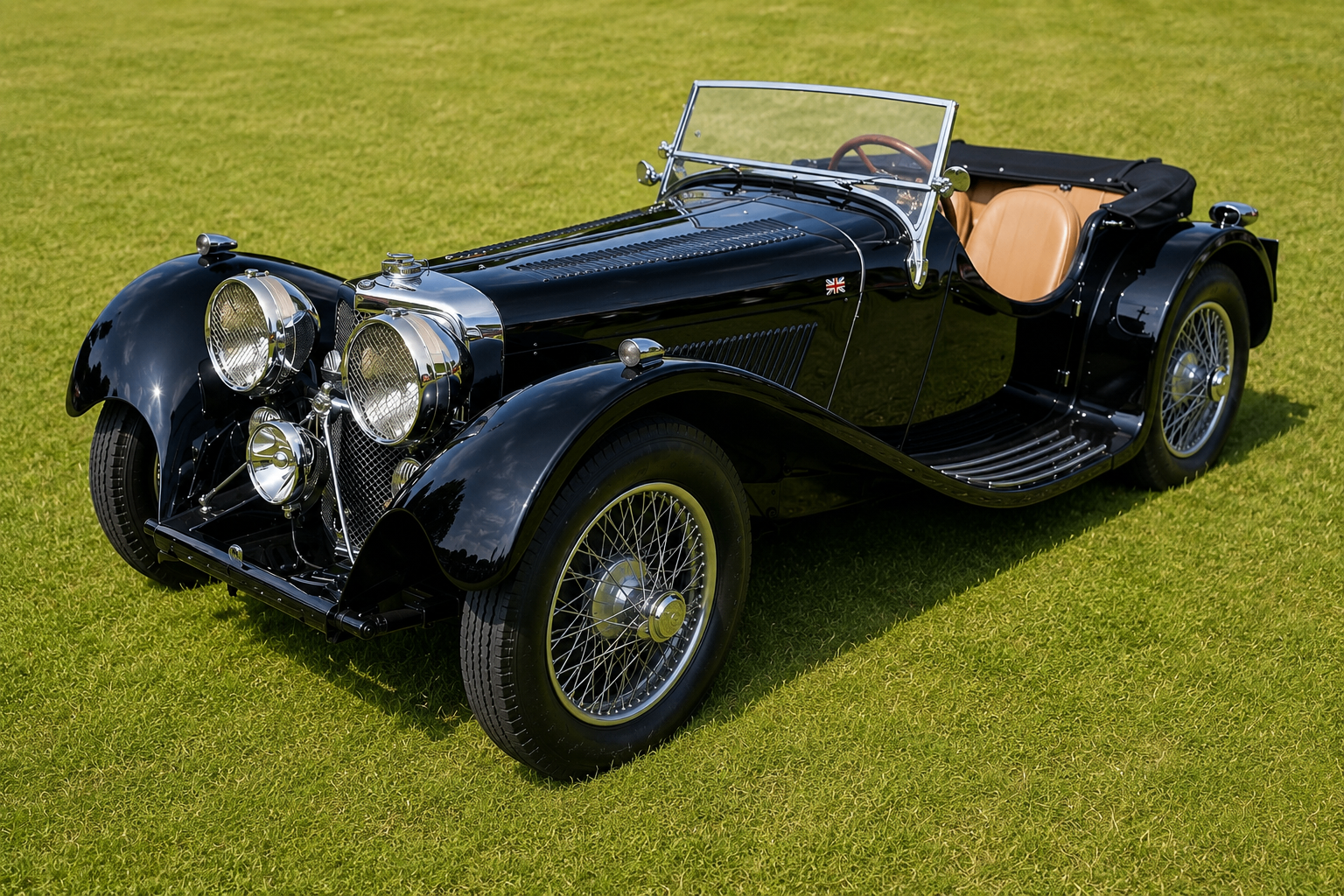
The pre-war Jaguar — a short-chassis two-seat open roadster on a 104-inch wheelbase, built by SS Cars Ltd. of Coventry between 1936 and 1940 in 2½-Litre and (from 1938) 3½-Litre form; the direct forebear of every Jaguar sports car that followed and the definitive British pre-war open sports car.
The Jaguar SS 100 was introduced by SS Cars Ltd. of Coventry as the sporting counterpart to the SS Jaguar saloon range unveiled by William Lyons at the autumn 1935 Olympia Motor Show. Where the SS 90 that preceded it (1935) had used a 2,663 cc side-valve Standard engine, the SS 100 took the same 104-inch short-chassis platform and paired it with the new Harry Weslake / William Heynes overhead-valve conversion of the Standard 2½-litre six, producing 125 bhp (per the RM Sotheby's Arizona 2014 lot description for chassis 39039, verified via rmsothebys.com/auctions/az14/lots/r176-1938-ss-100-jaguar-3litre-roadster on 6 July 2026, quoting the factory 3½-Litre figure; the 2½-Litre car produced approximately 105 bhp per the RM Sotheby's Arizona 2021 catalogue text for chassis 39032).
The car was produced in two engine capacities: the original 2½-Litre from 1936 through the outbreak of war in 1940, and the 3½-Litre added in 1938 using an enlarged 3,485 cc version of the OHV six, twin SU carburettors and low-restriction exhaust manifolds. The chassis was a ladder frame with solid front axle, live rear axle on semi-elliptic leaf springs and four-wheel drum brakes; the four-speed manual gearbox had synchromesh on the top three gears; the shortened 104-inch wheelbase and approximately 1,180 kg (2,600 lb) kerb weight made it competitive in period rally and short-circuit events at Brooklands, Donington, Silverstone, Prescott, and on the RAC Scottish Rally.
Production is conventionally cited as 198 2½-Litre and 116 3½-Litre examples — 314 in total — although some auction catalogues quote 118 3½-Litre cars, giving a total of 316. Of the cars built, 49 were exported and the majority remained in the UK home market. Individual chassis authentication is the province of the Jaguar Daimler Heritage Trust (JDHT), which holds the factory build records; a JDHT certificate is the standing primary source for any specific car and takes precedence over any aggregate production figure.
Production ceased in 1940 with the wartime conversion of the SS Cars factory to armament work. The 'SS' name was dropped in the post-war reorganisation to Jaguar Cars Ltd. in 1945 for its unavoidable wartime associations, but every Jaguar sports car that followed — the XK 120 of 1948, the C-Type, D-Type and E-Type — traces its line directly from this 1936–1940 short-chassis roadster.
The SS 100 is the pre-war Jaguar, and every later Jaguar sports car — the XK 120, C-Type, D-Type, E-Type — descends directly from William Lyons' 1936 short-chassis two-seat roadster. Three factors anchor its permanent collector position: (1) it is the direct genetic forebear of the entire Jaguar sports-car line, unique to a four-year 1936–1940 production window that ended with the outbreak of war; (2) production was small — approximately 314 examples were built (198 2½-Litre and 116 3½-Litre, with some catalogues quoting 118 of the latter); of these, 49 were exported and the majority stayed in the UK home market; (3) survivorship is high relative to production because the model was recognised as significant almost immediately post-war, but a meaningful fraction of surviving cars have been rebodied, re-engined or built up from spare-parts chassis, which places heavy weight on JDHT-verified originality. Genuine matching-numbers original-body cars with a full JDHT certificate and unbroken UK-registration history are a materially smaller universe than the raw production total suggests and command a substantial primary-market premium over ordinary restored examples.
Variants
Range and production
Variant
Years
Production
Notes
SS 100 2½-Litre
1936–1940
198
The original SS 100, in production from 1936 to 1940 with a 2,663 cc overhead-valve six developed by Harry Weslake from the Standard 20 HP block; approximately 105 bhp. 198 built.
SS 100 3½-Litre
1938–1940
116
The larger-engined SS 100, introduced 1938 with the enlarged 3,485 cc OHV six; approximately 125 bhp. 116 built, with some catalogues quoting 118. Of the roughly 314 SS 100s in total, 49 were exported and the majority stayed in the UK home market.
Buyer's Guide
What to look for
Chassis, engine and body-number authentication — JDHT certificate is essential
The primary due-diligence item on any SS 100 transaction is a current Jaguar Daimler Heritage Trust (JDHT) certificate for the specific chassis, cross-referenced against the physical chassis, engine and body numbers on the car. SS Cars used discrete chassis-, engine- and body-number series; each is stamped on the physical car and each is recorded on the JDHT factory build sheet. The RM Sotheby's lot pages for chassis 39039 (Arizona 2014), 39032 (Arizona 2021) and 39011 (Paris 2020) each publish the physical chassis, engine and body numbers exactly as recorded on the car — that is the format any offered car should present, ideally backed by a current JDHT certificate. A replacement engine is not necessarily a value catastrophe (the RM Sotheby's Arizona 2021 catalogue for chassis 39032 notes an early-life replacement 3.5-litre engine from an SS Jaguar saloon, number M 499 E; the RM Sotheby's Paris 2020 catalogue for chassis 39011 carries an addendum noting the engine is not original) but any deviation from JDHT-recorded numbers must be disclosed, understood and priced.
Body originality — coachwork, timber frame and rebuild history
The SS 100 body is a hand-formed sheet-steel outer skin over an ash timber frame on a steel scuttle and floor sub-structure; the fuel tank is part of the body structure and subject to the same stresses. A meaningful proportion of surviving cars have had their coachwork rebuilt, sometimes wholesale, and any rebuild history must be documented in the file. Inspection priorities: verify that the original body number matches JDHT; inspect the ash frame for rot at the sill-to-scuttle junction, along the rear body hoop and under the fuel tank; check panel-gap consistency against period photographs; verify that the fenders are the original pressings (the RM Sotheby's Arizona 2021 catalogue text for chassis 39032 records that its original fenders were replaced during a mid-1960s restoration — a common but disclosable modification); confirm any replacement panels are correctly formed and correctly aged. Rebodied cars (period-correct coachwork on a genuine chassis) or 'built-up' cars (assembled from spare parts) trade at a material discount to genuine untouched-original examples and must be identified as such in any transaction.
Engine and mechanical inspection — Weslake OHV six, twin SU, drum brakes
PPI priorities on the OHV six: cold-start behaviour and warm-oil pressure; head-gasket integrity around the Weslake OHV conversion; twin SU carburettor synchronisation and float-chamber condition; ignition timing, distributor drive and vacuum-advance operation. The transmission's non-synchromesh first gear is normal for the period. Drum brakes are mechanically actuated on early cars — a full period-correct rebuild, with correct linings and correct adjuster function, is essential; any conversion to hydraulic operation must be disclosed and is a period modification, not a factory specification. Rear axle, differential and half-shaft inspection is standard pre-war practice. Confirm the entire wiring loom has been renewed within the ownership record — original 1930s cloth-covered looms are a fire risk and should not be left in service.
Provenance, competition history and ownership record
A period competition history — RAC Scottish Rally, Brooklands, Donington, Prescott hill climbs, Bournemouth / Buxton / Scarborough rallies — is a material value factor and must be documented at primary-source level (period programme entries, photographs, timing sheets, first-owner correspondence). The RM Sotheby's Arizona 2014 catalogue for chassis 39039 documents an unbroken period competition file with Harold C. Goozee from 1938 through the 1950s; that level of documentation is the reference standard. Post-war ownership records, JDHT certification, JCNA concours scoring, and rally participation (Flying Scotsman, Mille Miglia Storica, Louis Vuitton China Run, Peking to Paris) are all value-supporting where documented. An SS 100 offered without a coherent chain-of-ownership file, and without a JDHT certificate, should be priced against the possibility of significant undisclosed rebuild history.
Concours specification vs rally / tour specification
The market splits cleanly into two buyer pools: concours-restored cars (JCNA 100-point or equivalent — see the RM Sotheby's Arizona 2021 lot for chassis 39032 recording a perfect JCNA 100-point score at the May 2014 Jaguar Owners Club of Los Angeles Concours d'Elegance) and rally-ready cars discreetly upgraded for long-distance touring (overdrive gearbox from a later Jaguar, pressurised cooling, hidden electrical master switch, discreet turn signals in original lighting fixtures — all modifications documented on the RM Sotheby's Arizona 2014 lot for chassis 39039). Concours cars command a premium in the show market; rally cars command a premium in the event market. A car with a coherent single specification and full disclosure of every modification will sell more readily than a car with an inconsistent mix of concours and rally modifications.
Ownership
Living with it
Typical mileage
500–3,000 miles typical — a well-sorted SS 100 is a genuine long-distance vintage rally car (Flying Scotsman, Mille Miglia Storica, Peking to Paris) and a concours mount; expect event-driven annual use rather than commuter mileage.
Service interval
Annual pre-season service by a recognised UK or US pre-war Jaguar specialist (CMC of Bridgnorth, Pearsons of Duxford, Guy Broad, Terry Larson); full mechanical inspection every 3–5 years or before any major long-distance rally.
Annual running cost
£6,000 – £18,000+ / $8,000 – $24,000+ (dominated by agreed-value insurance, secure climate-controlled storage, annual pre-war-specialist service, and the periodic body-and-timber inspection intrinsic to a 1930s ash-framed coachbuilt car).
Fuel economy
Approximately 15–18 mpg imperial on the 3½-Litre in fast touring use; period-typical.
Insurance
Agreed-value coverage via Hagerty Bespoke, Lockton Private Client or Footman James; on an exceptional 3½-Litre at $700k–$950k agreed value, expect $6,000–$14,000 / £4,500–£10,500 annual premium with mileage limit, secure-storage warranty and rally-endorsement clauses.
JDHT certificate is the standing reference
A current Jaguar Daimler Heritage Trust certificate cross-referenced against the physical chassis, engine and body numbers on the car is the standing reference for any SS 100 in ownership. Renew the JDHT check at any change of ownership and on any material mechanical or bodywork intervention. Contact JDHT directly via jaguarheritage.com.
Route all work through a recognised pre-war Jaguar specialist
The SS 100's ash-framed body, Weslake OHV six, twin SU carburettors and mechanically-actuated drum brakes are all pre-war British specialist territory. Route body, mechanical, electrical and trim work through Classic Motor Cars of Bridgnorth, Pearsons of Duxford, Guy Broad Restorations (UK) or Terry Larson (US) — non-specialist intervention will show in any subsequent inspection and be treated as a valuation deduction.
Event calendar
An SS 100 is materially more valuable when actively campaigned on the pre-war event circuit — Flying Scotsman, Mille Miglia Storica, Peking to Paris, Louis Vuitton concours, RAC Rally of the Tests, Goodwood Revival paddock display. Event participation is a documented value factor across the verified RM Sotheby's lot record and should be maintained during ownership rather than the car being left in static storage.
Common Problems
Known issues by system
Chassis and body — ash timber frame, sheet-steel skin, structural fuel tank
Ash frame rot at sill-to-scuttle junction, under fuel tank and along rear body hoop; panel-gap deterioration; fuel tank corrosion (the tank is part of the body structure)
Major£25,000 – £150,000+ for a full body-and-ash-frame rebuild routed through a recognised UK pre-war specialist (Bicester Heritage / Coventry-area trade); minor repairs from £3,000.
Symptoms — Uneven door gaps, sagging rear body, visible rot at the sill line, fuel weep or staining under the tank, panel fit that has moved since the last restoration.
Inspection — Full ash-frame inspection by a pre-war British specialist; body-off inspection is often required to properly assess; verify original body number against JDHT; the RM Sotheby's Arizona 2014 catalogue for chassis 39039 records that an aluminium core was fitted inside the fuel tank during restoration to isolate it from body stresses — a period-correct remediation.
Engine — Weslake OHV six (2,663 cc / 3,485 cc)
Head-gasket weep at the OHV conversion joint; oil-pressure loss at temperature; twin SU carburettor synchronisation; non-original replacement engines (documented on both the RM Sotheby's Arizona 2021 chassis 39032 and Paris 2020 chassis 39011 lot pages)
Major£8,000 – £45,000 for a full OHV six rebuild by a pre-war specialist; £2,500 – £6,000 for twin-SU rebuild.
Symptoms — Low warm-oil pressure, coolant weep around the head, uneven idle from the twin SUs, poor cold-start behaviour, engine number that does not match the JDHT-recorded original.
Inspection — Full compression and leak-down test; JDHT check on the physical engine number vs the factory-recorded number; SU carburettor float-chamber and needle inspection; distributor drive and vacuum-advance function check.
Brakes — four-wheel drum, mechanically actuated on early cars
Mechanical brake linkage wear and adjustment; lining condition; period modifications to hydraulic operation
Major£4,000 – £12,000 for a full four-corner drum-brake rebuild.
Symptoms — Uneven pedal, brake pull, poor cold-brake bite, any evidence of unauthorised hydraulic conversion.
Inspection — Full period-correct rebuild status check; linkage adjustment; lining wear inspection; disclose any hydraulic conversion as a period modification, not factory specification.
Electrics — original 1930s cloth-covered wiring loom
Loom deterioration and fire risk; instrument function; original lighting condition
Major£3,500 – £8,500 for a full period-correct loom renewal.
Symptoms — Original 1930s cloth-covered loom still in service, intermittent instrument function, non-period electrical fittings.
Inspection — Verify the entire loom has been renewed within the ownership record; confirm any hidden master switch (as fitted to RM Sotheby's Arizona 2014 chassis 39039 during restoration) is documented; verify that any turn-signal installation is discreet and reversible.
Gearbox and driveline — four-speed synchro on top three, live rear axle
First-gear (non-synchro) engagement wear; synchro deterioration on 2nd/3rd/4th; rear-axle whine; period overdrive conversions
Moderate£5,000 – £18,000 for gearbox rebuild; £3,500 – £9,000 for rear-axle rebuild.
Symptoms — Baulky shifts into 1st, synchro grind on downshifts, rear-axle whine at cruise, any documented overdrive conversion (the RM Sotheby's Arizona 2014 lot for chassis 39039 records an XK140 four-speed overdrive gearbox fitted in the mid-1950s — a period modification, disclosed).
Inspection — Standard pre-war gearbox and rear-axle inspection; verify any overdrive conversion is documented; verify differential oil condition and any noise history.
Provenance — JDHT certificate, chain of ownership, period competition file
Missing JDHT certificate; broken chain of ownership; undocumented period competition claims
Critical£150 – £400 for a current JDHT certificate application, routed through JDHT directly (jaguarheritage.com).
Symptoms — No current JDHT certificate presented, gaps in the UK / US ownership record, period competition claimed without primary-source documentation (period programme entries, photographs, timing sheets, first-owner correspondence).
Inspection — Insist on a current JDHT certificate cross-referenced against the physical chassis, engine and body numbers; verify UK V5 and DVLA / equivalent ownership record; verify any period competition claim against primary-source documentation, not secondary-source assertion.
Auctions
Recent results
No verified public auction results are currently available for this model. We publish sale figures only from examples we have confirmed against auction house records, and will update this guide as results appear.
Investment
Long-term outlook
Blue ChipHorizon: 10+ years
Three anchored facts underwrite the SS 100's permanent blue-chip position: (1) it is the direct genetic forebear of every Jaguar sports car that followed, unique to a four-year 1936–1940 production window closed by the outbreak of war; (2) production is small — total production is disputed between 308 and 316 across the primary-source RM Sotheby's lot record, with the 3½-Litre variant at 116 or 118 cars; (3) the genuine matching-numbers original-body universe with a full JDHT certificate is a materially smaller subset of the total production, and the primary-source auction record (verified via RM Sotheby's on 6 July 2026) puts an exceptional example of that subset at approximately $850k with a coherent step-down structure into the wider market. Best long-term holds: a 3½-Litre with matching numbers, a current JDHT certificate, an unbroken chain of ownership, original body coachwork and a documented period competition or first-owner file. Rebodied cars, built-up cars, and 2½-Litre cars with partial documentation are trading vehicles rather than long-term investment positions.
Our view, not advice. This section is Car Collector International's editorial judgement on where this model sits in the collector market, based on the production, specification and market data set out in this guide. It is not a recommendation to buy or sell and it is not investment advice. Values can fall as well as rise.
The marque's own factory heritage and records office — the standing primary source for individual SS 100 chassis, engine and body-number authentication. Every SS 100 transaction should be routed through a current JDHT certificate check.