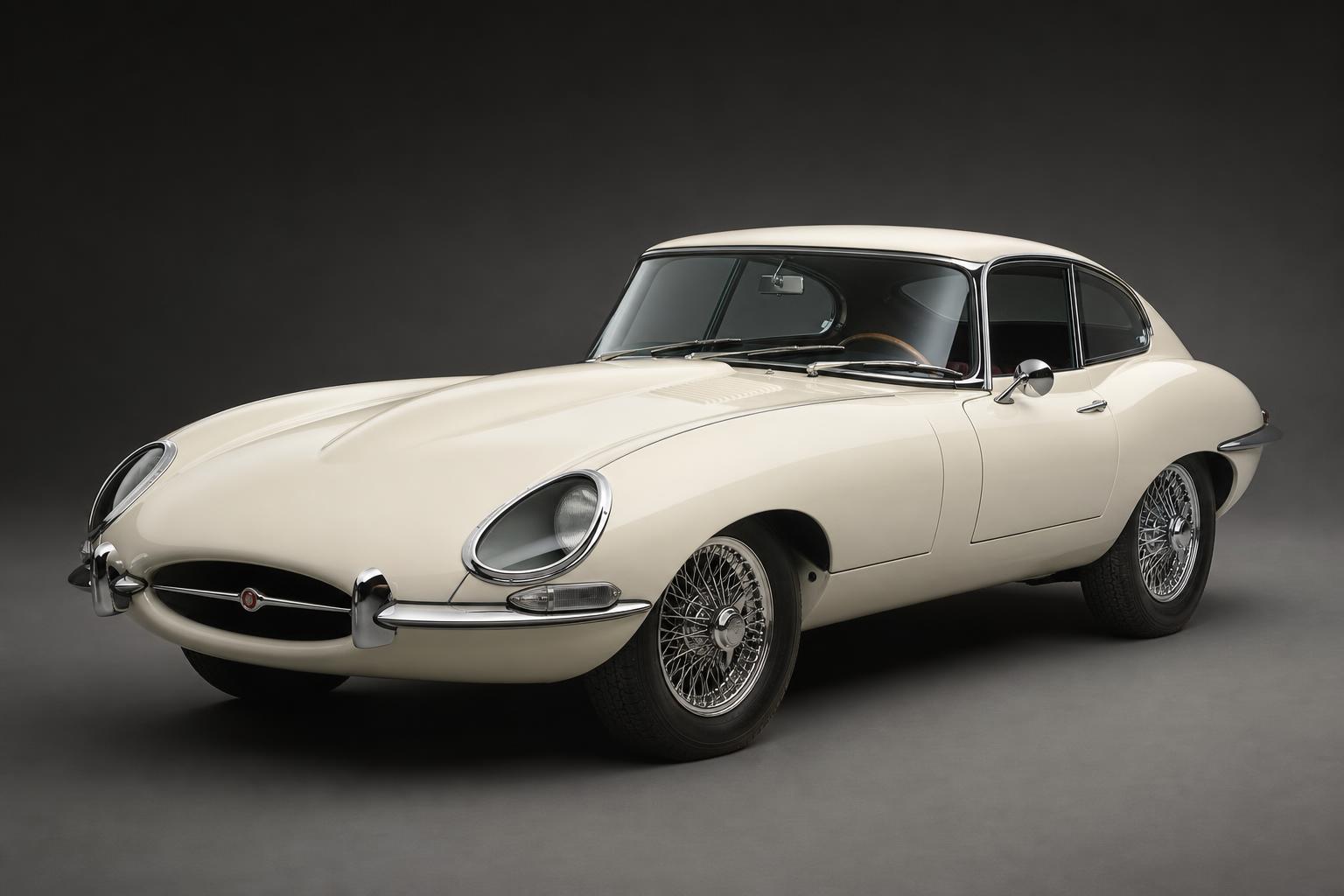
Launched at the Geneva Motor Show in March 1961, the Jaguar E-Type set a new benchmark for road-going sports cars: independent rear suspension, four-wheel disc brakes, a twin-cam straight-six derived from the Le Mans–winning D-Type, and a body styled by Malcolm Sayer that combined aerodynamic discipline with a sculptural elegance unmatched by anything else on the road. It was offered initially as a fixed-head coupé and an open two-seater roadster, with the longer-wheelbase 2+2 following in 1966.
The car evolved across three distinct series over fourteen years of production. The Series 1 (1961–1968) covers the original 3.8-litre cars, the improved 4.2-litre cars with a fully synchromesh gearbox, and the transitional 'Series 1.5' cars built for the 1968 US market. The Series 2 (1968–1971) brought open headlights, larger wraparound bumpers, revised switchgear and a repositioned air intake — a more civilised, US-market-adapted car. The Series 3 (1971–1975) introduced Jaguar's new 5.3-litre V12 on the long 2+2 wheelbase for both body styles, ending production in 1975 with the 50-off 'Commemorative' Roadster. Total production across all three series was approximately 72,500 cars.
The E-Type is one of the most universally recognised car designs of the twentieth century and a fixture of major design retrospectives — including a permanent example in the Museum of Modern Art's design collection in New York. Period road tests recorded near-150 mph performance at a price that undercut comparable Ferraris and Aston Martins by a wide margin. Early 3.8-litre 'flat-floor' Series 1 roadsters and matching-numbers 4.2-litre cars with full provenance anchor the collector market and have appreciated steadily over the past two decades; Series 2 and Series 3 V12 cars sit in progressively more accessible tiers and offer meaningfully different ownership propositions across the range.
Variants
Range and production
Variant
Years
Production
Notes
S1 3.8 Roadster (OTS)
1961–1964
Not separately recorded
Original 'flat-floor' and later cars; Moss four-speed gearbox; covered headlights; the foundation of the E-Type market.
S1 3.8 Fixed Head Coupe (FHC)
1961–1964
Not separately recorded
Side-opening tailgate, fastback profile; Moss gearbox; the design icon.
S1 4.2 Roadster (OTS)
1964–1968
Not separately recorded
All-synchromesh gearbox, improved seats and brakes; covered headlights retained.
S1 4.2 Fixed Head Coupe (FHC)
1964–1968
Not separately recorded
Best-developed Series 1 coupé; the volume S1 collector car today.
Open headlights, rocker switches, twin Stromberg carburettors on US cars; bridge to the Series 2.
S1 Lightweight (competition)
1963–1964
Not separately recorded
12 original aluminium-bodied racing cars built for competition; referenced for pedigree, not road-market comparables.
S2 4.2 Roadster (OTS)
1968–1971
Not separately recorded
Approximately 8,628 units. Open headlights, larger wraparound bumpers, revised air intake, twin Stromberg carburettors on US cars.
S2 4.2 Fixed Head Coupe (FHC)
1968–1971
Not separately recorded
Approximately 4,855 units. Same mechanical package as the S2 Roadster in the short-wheelbase coupé body.
S2 4.2 2+2 Coupe
1968–1971
Not separately recorded
Approximately 5,326 units. Long-wheelbase 2+2; the most numerous S2 body style.
S3 V12 Roadster (OTS)
1971–1975
Not separately recorded
7,990 Roadster / 7,297 2+2 (SuperCars.net cites 7,992 for the Roadster; Robson's production history gives a Series 3 total of 15,290 versus 15,287 here — differences of a few units are consistent with the fragmented factory record-keeping noted below). 5.3-litre V12, long 2+2 wheelbase applied to both bodies, quad exhaust, ventilated front discs, power steering standard.
S3 V12 2+2 Coupe
1971–1973
Not separately recorded
Figure included in the Series 3 Roadster / 2+2 split above; 2+2 coupé withdrawn ahead of the Roadster.
S3 V12 Commemorative Roadster
1974–1975
50
50-off end-of-production run: 49 in black with cinnamon leather and one in British Racing Green. See Collector Variants.
Collector Variants
Limited & special editions
The models below represent the most significant limited and special edition variants — factory-produced cars that command meaningful premiums over standard examples and warrant specific attention from serious collectors.
E-Type Lightweight (Series 1) · 1963–1964
12 (of 18 chassis allocated)
Distinguishing features
All-aluminium body and aluminium block 3.8 with dry-sump lubrication, ZF five-speed gearbox, Plexiglas windows and competition interior. 6 unbuilt chassis were completed by Jaguar Classic in 2014–2015 as 'continuation' Lightweights.
Value premium
$5m+ for originals; continuation Lightweights typically £1.5–2m new.
Inspection points
Verify chassis number against the published Lightweight register. Aluminium body magnet test; confirm dry-sump engine and ZF gearbox.
Authentication
Many tribute cars exist. Only the 12 original chassis and the 6 continuation chassis (S850657 onwards) built by Jaguar Classic are genuine.
E-Type Low Drag Coupé (Series 1) · 1962
1 (CUT 7)
Distinguishing features
Unique Sayer-designed coupé prototype intended to lower drag at Le Mans. Aluminium body, fixed-head fastback profile.
Value premium
Single car — treated as a unique lot.
Inspection points
Demand full Jaguar Heritage Trust documentation.
E-Type Series 3 V12 Commemorative Roadster · 1974–1975
50 (49 in black with cinnamon leather; 1 in British Racing Green)
Distinguishing features
50-off end-of-production run marking the close of E-Type manufacture. Standard specification: 5.3-litre V12, manual or automatic, dashboard commemorative plaque, cinnamon leather interior. 49 cars finished in black; a single BRG car was built at the request of Sir William Lyons for his personal use.
Value premium
20–40% over a comparable standard S3 V12 Roadster; concours Commemoratives with verified chassis have traded well into the $200,000+ / £150,000+ band. The single BRG car is treated as a unique lot.
Inspection points
Verify commemorative plaque presence and correct chassis range (1S 2823BW–1S 2872BW). Confirm original colour, cinnamon leather trim and matching numbers via Jaguar Heritage Certificate.
Authentication
The single Commemorative chassis series is documented by the Jaguar Heritage Trust and cross-referenced by the JEC and XKEDATA register. Any car marketed as a Commemorative must be verified against those registers — standard S3 Roadsters have been dressed as Commemoratives in the past.
Buyer's Guide
What to look for
Provenance, matching numbers and the Jaguar Heritage Certificate
An E-Type is bought on its documentation. The Jaguar Heritage Trust issues a Heritage Certificate confirming original engine and chassis numbers, factory colour, trim and delivery destination — an essential reference for any serious purchase, at any series. Matching-numbers cars command a clear premium, and a continuous ownership history with invoices from recognised specialists such as Classic Motor Cars (CMC), Eagle, RS Panels or JD Classics is decisive at the upper end of the market. Note that Jaguar's period production records are fragmented across some 20 separate chassis-number sequences by body style and market, and reputable sources differ by small margins on Series 2 and Series 3 body-style splits (see Variants).
Bodywork, monocoque and bonnet — the dominant cost
The E-Type's monocoque tub and one-piece front-hinged bonnet are notoriously expensive to restore correctly across every series. Inspect the front bulkhead, floors, sills, A-posts, rear wheel arches, boot floor and the bonnet's internal structure (particularly around the headlight bowls and bonnet hinges) for filler, weld repairs and corrosion. A full bare-metal restoration on a sound car routinely runs £150,000–£300,000 in the UK at recognised specialists; on a structurally compromised car it can comfortably exceed that. Always commission a paint-depth survey and an underbody inspection as part of any pre-purchase inspection.
Series 1 vs Series 2 vs Series 3 — three different cars
The Series 1 is the design icon and the top of the market: early 3.8-litre 'flat-floor' covered-headlight roadsters sit in a class of their own, and 4.2-litre coupés and roadsters with matching numbers form the most actively traded blue-chip band. The Series 2 is a more civilised, US-adapted car and has historically traded at a discount to the Series 1 — that gap has narrowed as buyers priced out of Series 1 have moved down, but it remains meaningful. The Series 3 V12 is a fundamentally different car: a long-wheelbase grand tourer with a smooth 5.3-litre V12, and the only E-Type body style that offered the V12 for both roadster and 2+2. Concours S3 V12 Roadsters — and especially the 50-off Commemorative cars — have re-rated visibly over the last five years.
Mechanical service items and the rear suspension cage
The XK straight-six (S1/S2) and the 5.3-litre V12 (S3) are both durable but neither tolerates neglect. On six-cylinder cars verify oil pressure when hot, listen for timing-chain rattle, and confirm a recent cooling system refresh. On V12 cars pay particular attention to cooling-system condition (V12s run hot and were often driven by owners who under-maintained them), ignition, and the twin electric fuel pumps. The independent rear suspension cage is common to all series — bushes, radius arms, inboard discs and handbrake mechanism are all serviced as a unit, and a full rebuild is straightforward but not cheap. Budget £600–£1,200 for a PPI by an established marque specialist.
Ownership
Living with it
Typical mileage
1,500–4,000 miles typical
Service interval
Annual oil and inspection service; major service every 6,000–10,000 miles
Annual running cost
$2,000 – $6,000 (excluding restoration or major mechanical work); V12 running costs sit at the top of that range
Fuel economy
S1/S2: 17–22 mpg on a sympathetic carburettor setup; S3 V12: 12–16 mpg combined
Insurance
Agreed-value classic policies from Hagerty, Adrian Flux, Footman James or Lockton typically run $1,200–$2,800/yr on a $180k Series 1, and $900–$1,900/yr on a $120k Series 3 V12, both with limited mileage.
Parts supply is excellent across all three series
Sixty-plus years of continuous specialist support means almost every mechanical, trim and body part for every series of E-Type is available new from the UK marque specialist network (SNG Barratt, Martin Robey, David Manners, Welsh Enterprises in the US). The constraint is rarely parts availability — it is the labour required to fit them to factory standard.
Restoration economics differ sharply by series
A well-bought, mechanically sound car of any series is a relatively inexpensive car to live with. A cosmetically tired or structurally compromised car is not: full body restorations at recognised specialists routinely exceed the value of all but the rarest Series 1 variants — and comfortably exceed the value of most Series 2 and Series 3 cars. The most predictable ownership across the range comes from buying a car that has already had its restoration done, and verifying it properly.
Common Problems
Known issues by system
Body — Monocoque and bonnet corrosion
Front bulkhead, floors, sills, rear arches and bonnet structure corrode, often hidden under filler or recent paint
Critical$15,000 – $80,000+ depending on extent; a full bare-metal restoration can exceed $250,000
Symptoms — Bubbling at sill seams and arches; uneven panel gaps; flexing bonnet; previous weld repairs visible from underneath.
Inspection — Paint-depth survey across all panels; underbody inspection on a lift; inspection of bonnet's internal structure and hinges.
Engine — XK straight-six (S1/S2)
Oil-pressure decline, timing-chain wear, head-gasket failure on neglected cars
Major$8,000 – $20,000 for a full engine rebuild at a marque specialist
Symptoms — Low hot oil pressure, timing-chain rattle on cold start, coolant loss, blue smoke under load.
Inspection — Compression test, hot oil-pressure check, coolant pressure test, review of recent invoices.
Engine — 5.3-litre V12 (S3)
Cooling-system fragility, ignition faults and fuel-system age on neglected V12 cars
Major$3,500 – $18,000 depending on scope; a full V12 rebuild at a specialist can exceed $25,000
Symptoms — High operating temperatures, misfire on one bank, weeping coolant, hot-start difficulty, twin electric fuel-pump noise.
Inspection — Verify cooling-system refresh, radiator condition, hoses and header tank; check ignition and both fuel pumps; scan invoices for recent V12 top-end work.
Transmission — Moss gearbox (3.8 cars)
Non-synchromesh first gear and ageing synchros make the Moss gearbox an acquired taste and a known wear item
Moderate$3,500 – $7,000 for a Moss gearbox rebuild
Symptoms — Crunching downshifts, vague selection, whining in lower gears.
Inspection — Road test through all gears cold and hot; verify any rebuild history.
Suspension — Independent rear cage
Bushes, radius arms, inboard disc brakes and handbrake mechanism all wear and are serviced as an assembly
Major$4,500 – $9,000 for a full IRS cage rebuild
Symptoms — Clunks over bumps, ineffective handbrake, brake judder, oil leaks from inboard discs.
Inspection — Inspect IRS cage on a lift; verify documented rebuild history.
Brakes — Dunlop / Girling system
Ageing master cylinder, servo and inboard rear discs lose effectiveness; brake bias issues common on unrestored cars
Major$2,500 – $5,500 for a full braking refresh
Symptoms — Long pedal travel, pulling under braking, fluid leaks at the servo or master cylinder.
Inspection — Inspect master cylinder, servo and all calipers; road test under firm braking.
Electrical — Lucas wiring and instruments
Original Lucas looms, fuse boxes and instrument voltage stabilisers age and become unreliable
Moderate$1,500 – $6,000 depending on extent of rewire and instrument refurbishment
Inspection — Cycle all electrical functions; inspect loom condition; verify any rewire.
Interior — Trim, leather and weather equipment
Original leather, headlining and (on roadsters) hood frame and fabric are expensive to retrim correctly
Moderate$3,500 – $12,000 for a full interior retrim or hood replacement
Symptoms — Cracked leather, sagging headlining, torn or shrunken hood, mismatched retrim work.
Inspection — Inspect leather, carpets, headlining and (roadsters) hood frame and fabric; verify retrim quality.
Auctions
Recent results
Date
Auction
Car
Mileage
Result
2026-01-27
Artcurial
Automobile Legends
1965 Series I 4.2 Roadster (Lot 16)
—
€190,720
Sold
2026-01-17
Barrett-Jackson
2026 Scottsdale
1967 Series I Fixed Head Coupe (Lot 1036)
—
$192,500
Sold
2025-11-08
Iconic Auctioneers
The Iconic Sale at the NEC
1963 Series I 3.8 Coupe, offered from Rowan Atkinson (Lot 268)
—
£78,750
Sold
2025-08-15
RM Sotheby's
Monterey
1961 Series I 3.8 Roadster (Lot 112)
—
$324,000
Sold
2025-08-15
Gooding Christie's
Pebble Beach Auctions
1966 Series I 4.2 Roadster (Lot 37)
—
$184,800
Sold
2025-02-27
RM Sotheby's
Miami
1974 Series III V12 Roadster, manual (Lot 223)
—
$112,000
Sold
2024-04-14
Bonhams
Goodwood Members' Meeting
1974 Series III V12 Commemorative Roadster (Lot 176)
—
£120,750
Sold
2024-01-25
RM Sotheby's
Arizona
1970 Series II 4.2 Roadster (Lot 113)
—
$145,600
Sold
Series 2 and Series 3 body-style production figures shown in Variants remain unsettled: reputable sources differ by small margins because Jaguar's period production records are split across roughly 20 separate chassis-number sequences by body style and market. See the Variants section for the specific S3 source discrepancy and Jaguar's fragmented factory record-keeping.
Investment
Long-term outlook
Blue ChipHorizon: 10+ years
The E-Type is one of a small number of post-war classics with secure long-term collector status, supported by universal design recognition, deep specialist infrastructure and a global owner base. Early Series 1 3.8 flat-floor roadsters and matching-numbers 4.2 cars with full provenance behave as defensive store-of-value assets and have proven resilient through multiple market cycles.
For buyers focused on usability and value, well-documented Series 1 4.2 coupés represent the strongest risk-adjusted entry into blue-chip E-Type ownership. Excellent Series 2 Roadsters offer a real quality-adjusted discount to Series 1 equivalents. The Series 3 V12 has re-rated visibly over the past five years, with Commemorative Roadsters and concours manual V12 cars leading the move; standard S3 V12 2+2 coupés remain the most accessible way into E-Type ownership at any series.
Our view, not advice. This section is Car Collector International's editorial judgement on where this model sits in the collector market, based on the production, specification and market data set out in this guide. It is not a recommendation to buy or sell and it is not investment advice. Values can fall as well as rise.
Recommended
The trusted network
Specialists
Classic Motor Cars (CMC)
Bridgnorth, UK
Concours-grade Jaguar restoration; recognised E-Type and XK authority.
Eagle E-Types
East Sussex, UK
Restoration and the renowned Eagle re-engineered E-Type programmes.
RS Panels
Nuneaton, UK
Specialist E-Type bodywork, panel fabrication and structural restoration.
JD Classics (successor firms)
Essex, UK
Long-established Jaguar restoration and historic competition preparation.
Classic Showcase
Oceanside, CA, USA
Full Jaguar restoration and sales for the US market.
Storage
Windrush Car Storage
London & Cotswolds, UK
Climate-controlled long-term storage for significant classics.
AutoVault
Essex, UK
Dehumidified storage at 55% RH in purpose-built sealed buildings, with maintenance programmes and individual motor-trade insurance cover.
Classic Remise
Düsseldorf, DE
Showroom-style enthusiast storage in continental Europe.
Transport
CARS UK
UK & Europe
Enclosed event and concours transport.
Reliable Carriers
USA (national)
Enclosed coast-to-coast transport for collector cars.