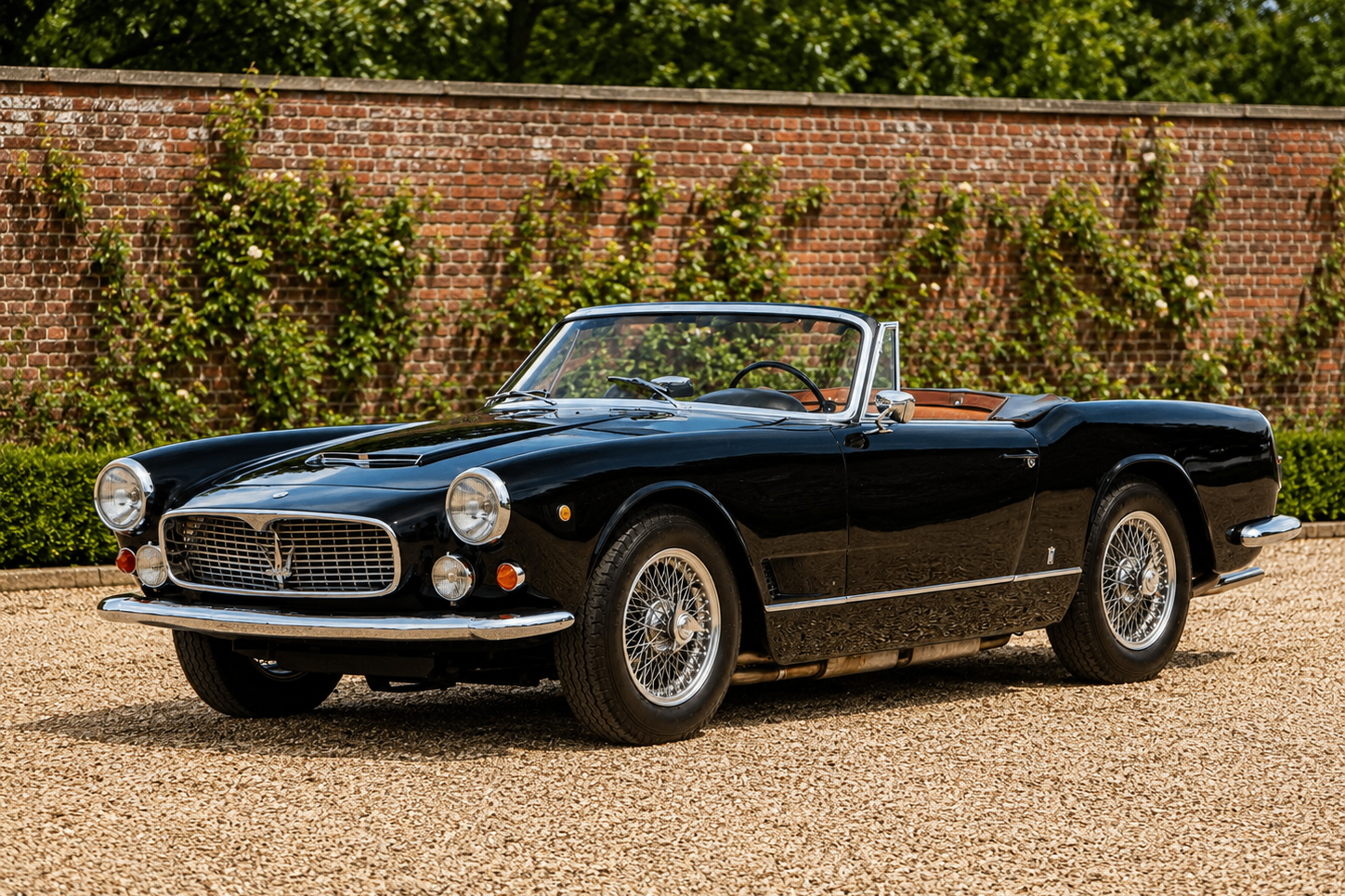
Maserati's first series-production road car — a hand-built Modenese GT with a detuned 350S-derived twin-cam 3.5-litre six, produced 1957–1964 in Touring Superleggera coupé, Vignale Spyder and a handful of coachbuilt one-off forms; the car that transitioned Maserati from a boutique racing constructor into a viable road-car manufacturer.
The Maserati 3500 GT (works designation Tipo 101, chassis prefix AM101) was introduced at the 1957 Geneva Salon as Maserati's first series-production road car — the deliberate strategic pivot from decades of loss-making sports-car racing into a viable production business. It carried a detuned twin-cam 3.5-litre inline-six directly derived from the 350S sports-racer, initially fed by triple Weber 42 DCOE carburettors and later, from 1961, by a Lucas mechanical fuel-injection system on the '3500 GTi' (per the RM Sotheby's Monterey 2025 lot description for chassis AM101 1115, verified 6 July 2026 from rmsothebys.com/auctions/mo25/lots/r0127-1961-maserati-3500-gt-spyder-by-vignale).
The standard coachwork was a Superleggera aluminium-over-steel-tube 2+2 coupé bodied by Touring of Milan. Customer demand for an open-top variant led Maserati to commission design studies from Frua and Touring, but the production Spyder that emerged in 1959 was a Giovanni Michelotti-drawn body built in series by Carrozzeria Vignale on a shortened chassis; that Vignale Spyder was produced in a total of 242 examples through 1964 (quoted directly on the RM Sotheby's Monterey 2025 lot page for chassis AM101 1115 and again on the RM Sotheby's Paris 2026 lot page for chassis AM101 1391, both verified 6 July 2026 from rmsothebys.com). Alongside the two main body styles, a small number of true one-offs and short-run bodies were built on the AM101 chassis by Frua, Allemano, Boneschi and other Italian carrozzerie — those are individual coachbuilt cars rather than a factory-cataloged sub-series and are addressed only briefly in this guide.
Mechanically, the car evolved substantially across the seven-year production run: 12-inch finned drum brakes at all four corners at introduction (per the RM Sotheby's Monterey 2025 lot text), Girling front discs from around 1959, four-wheel discs from around 1960; a ZF four-speed gearbox initially, replaced from around 1960–1961 by a ZF five-speed as standard (again per the RM Sotheby's Monterey 2025 lot page: 'Later cars are particularly desirable for being equipped with front disc brakes and a ZF five-speed gearbox'). Suspension was independent by wishbones and coils at the front, live axle on semi-elliptic leaf springs at the rear on the coupé; the shorter-wheelbase Vignale Spyder shares the same layout on a shortened frame.
Total production is commonly cited at approximately 2,226 cars across the 1957–1964 run — roughly 2,000 Touring coupés, 242 Vignale Spyders and a small tail of coachbuilt one-offs. Specialist chassis-registry sources put the Touring-coupé total considerably lower, at approximately 1,402 cars, and Maserati's own figures give a GT and GTi split of 937 and 441. The Vignale Spyder count is quoted between 242 and 250 depending on source. These discrepancies remain unresolved, and any individual chassis should be authenticated through the Maserati Classiche department in Modena.
The 3500 GT is the car that turned Maserati into a road-car manufacturer. Three factors anchor its collector position: (1) it is a genuine landmark model — the first series-production Maserati road car, and the direct predecessor to the Sebring, Mistral, Mexico, Ghibli and Indy that followed; (2) it is a coachbuilt Italian GT of the late-1950s / early-1960s Modena golden era, hand-built alongside contemporaneous Ferrari 250-series cars but at a fraction of surviving Ferrari money, with individual chassis-number identity, Borrani wire wheels, and Superleggera aluminium coachwork; (3) the market is cleanly split — the Touring coupé is the volume, accessible entry into 1950s Modena coachwork, while the 242-unit Vignale Spyder is a genuinely small-production factory-cataloged variant that trades at a materially higher multiple. Both bodies are recognised at every major concours (Pebble Beach, Villa d'Este, Amelia Island, Salon Privé) and eligible for every relevant historic event (Mille Miglia Storica, Tour Auto, Colorado Grand). Values on Vignale Spyders have re-rated visibly through 2022–2025 on the strength of public-auction data (see auction results); the Touring coupé remains a stable, well-defined market with wide public-sale coverage.
Variants
Range and production
Variant
Years
Production
Notes
3500 GT Coupé by Touring (Superleggera)
1957–1964
1,981
The volume body of the model line — a Superleggera aluminium-over-steel-tube 2+2 coupé bodied in series by Carrozzeria Touring of Milan. Approximately 1,981 units — the commonly cited figure; RM Sotheby's Cliveden House 2024 lot 346 for chassis AM101 998 describes the coupé as 'thought to be one of around 2,000 examples made'. However, specialist chassis-registry sources put the Touring-coupé total considerably lower: the AM101 registry and Maserati Classiche's Fabio Collina indicate ~1,402 Touring cars, with the registry keeper stating no more than ~1,429 were built; Maserati's own official figures give a GT + GTi split of 937 + 441 = 1,378. Presented as a rough 1,400–1,981 range; chassis-level confirmation via Maserati Classiche is recommended. Early cars carry triple Weber carburettors and a ZF four-speed gearbox with front drum brakes; later cars carry Lucas mechanical fuel injection ('3500 GTi', from 1961), a ZF five-speed gearbox and four-wheel disc brakes.
3500 GT Spyder by Vignale (Michelotti design)
1959–1964
242
The factory-approved open variant — a Giovanni Michelotti-drawn body built in series by Carrozzeria Vignale on a shortened AM101 chassis for superior agility. 242 units total 1959–1964, quoted directly on the RM Sotheby's Monterey 2025 lot page for chassis AM101 1115 ('the delectable Vignale Spyder was built in a modest quantity of just 242 examples through 1964') and again on the RM Sotheby's Paris 2026 lot page for chassis AM101 1391 ('One of only 242 examples of the 3500 GT Spyder by Vignale built from 1959 to 1964'). Both pages verified via rmsothebys.com on 6 July 2026. Alternative counts: 245 units per some compilations and 250 units per Maserati.com / the Gene Ponder Collection lot summary. The full dispute range is 242–250; 242 is the standing consensus on the two most recent RM lot pages and is used here as the headline figure.
3500 GT coachbuilt one-offs / short-run bodies
1957–1964
Not separately recorded
A small number of true one-offs and short-run bodies were built on the AM101 chassis outside the Touring and Vignale series production — a Frua Coupé and Frua Spyder (single-digit numbers), Allemano, Boneschi ('Tight' coupé), and a handful of other Italian carrozzeria studies. RM Sotheby's London 2022 lot 55 (chassis AM101 268) documents a 1958 3500 GT Spyder by Frua as a specific example. These are individual coachbuilt cars rather than a factory-cataloged sub-series; each must be authenticated on a chassis-specific basis via Maserati Classiche and valued on its own merits rather than against any series-production comparable.
Buyer's Guide
What to look for
Chassis and engine number authentication — Maserati Classiche is the standing reference
The primary due-diligence item on any AM101 3500 GT transaction is authentication of the physical chassis, engine and body numbers against the factory record. The Maserati Classiche department in Modena is the standing primary source for chassis-level authentication; the RM Sotheby's Monterey 2025 lot page for chassis AM101 1115 explicitly cites 'its numbers-matching engine, as shown on accompanying Maserati S.p.A certificate', which is the reference format any offered car should ideally carry. The AM101 chassis prefix should appear as stamped on the chassis and on the engine; on numbers-matching cars the chassis number and engine number will correspond (RM Sotheby's Monterey 2025 records both as AM101 1115 on that car). Replaced engines are relatively common on cars of this period and are not necessarily a value catastrophe — the RM Sotheby's Paris 2026 lot for chassis AM101 1391 records a non-matching engine (chassis AM101 1391 / engine AM101 1718) and still sold at €320,000 — but any deviation from Classiche-recorded numbers must be disclosed, understood and reflected in the price.
Body originality — Superleggera aluminium coachwork and chassis-length identity
The Touring coupé's Superleggera construction (aluminium panels over a steel-tube substructure) is a rebuild-intensive body style; verify that the aluminium skin is original where possible, that any replacement panels have been correctly formed, and that the sub-structure tubes are sound and free of corrosion where they meet the main chassis. On the Vignale Spyder, verify that the car is on the correct shortened Spyder chassis (a Touring-coupé chassis rebodied as a Spyder is not the same car and does not carry Spyder value); the shortened chassis is documented on the Monterey 2025 RM Sotheby's lot page. Confirm the body number against the Maserati Classiche record. Rebodied cars, or cars whose Vignale identity cannot be traced back to the factory Spyder chassis series, must be identified as such and are trading vehicles rather than proper 242-unit Spyders.
PPI priorities on the Tipo 101 six: cold-start behaviour and warm-oil pressure; cam-cover and head-gasket integrity; on Weber cars, condition and synchronisation of the three DCOEs; on the injected 3500 GTi, condition and calibration of the Lucas mechanical injection pump and metering unit (a specialist item — parts and rebuild expertise are Italian-specialist-only). ZF four-speed and five-speed gearboxes are generally robust but suffer from synchro wear on second gear; verify shift quality cold and warm. Rear axle: the Salisbury-type live axle is durable; check for whine and pinion-seal weep. Verify braking-system generation matches the chassis-number era — front drums on early cars, front discs from ~1959, four-wheel discs later — and confirm any brake conversion is either factory-generation-correct or fully disclosed.
Provenance, ownership record and Vignale Spyder rarity premium
A coherent chain-of-ownership file back to first delivery is a material value factor on all AM101 cars and a decisive factor on the Vignale Spyder. The RM Sotheby's Monterey 2025 lot for chassis AM101 1115 sold at $863,000 on the strength of a 30-year barn-find provenance, matching-numbers original engine, Maserati S.p.A. authentication certificate and a documented ~5,000-hour, ~$1 million restoration by Classic Investments; the RM Sotheby's Gene Ponder Collection lot for chassis AM101.1007 (also a Vignale Spyder) sold at $770,000 on the strength of a comparable restoration; the RM Sotheby's Paris 2026 Vignale Spyder (chassis AM101 1391) with a non-original engine sold at €320,000 — the same body style trading at less than half the money on documentation grounds. On the Touring coupé, the RM Sotheby's Cliveden House 2024 lot 346 for chassis AM101 998 sold at £143,750 — a fair mid-market print for a well-presented Touring coupé and a useful anchor for the accessible entry into the model line.
Concours specification vs rally / tour specification
As with other 1950s / 1960s Italian coachbuilt GTs, the market splits between concours-restored cars (correct Borrani wire wheels, correct Weber jetting or Lucas injection calibration, correct paint code and interior specification per Maserati records) and quietly upgraded rally / long-distance touring cars (five-speed gearbox retro-fitted to earlier drum-brake chassis, disc-brake conversion, uprated cooling, hidden battery cut-off, discreet turn signals). Both specifications trade — but a car with a coherent single specification and full disclosure of every deviation from factory sells more readily than a car with an inconsistent mix. Any mechanical upgrade must be disclosed; concealed conversions are a valuation deduction.
Ownership
Living with it
Typical mileage
1,000–4,000 miles typical — a well-sorted 3500 GT is a genuine long-distance Italian GT (Mille Miglia Storica, Tour Auto, Colorado Grand, Modena Cento Ore) and a concours mount; expect event-driven annual use rather than commuter mileage.
Service interval
Annual pre-season service by a recognised Italian-classic specialist (McGrath Maserati, Bill McGrath, Emilia Auto Classica, Maserati Classiche direct); full mechanical inspection every 3–5 years or before any major long-distance event; Lucas mechanical injection on the GTi requires specialist calibration.
Annual running cost
£4,000 – £14,000+ / $5,500 – $18,000+ (dominated by agreed-value insurance, secure climate-controlled storage, annual Italian-specialist service, and the periodic body / aluminium / trim work intrinsic to a Superleggera coupé or coachbuilt Spyder).
Fuel economy
Approximately 14–18 mpg imperial on Weber cars in fast touring use; period-typical.
Insurance
Agreed-value coverage via Hagerty Bespoke, Lockton Private Client or Footman James; on an exceptional Vignale Spyder at $700k–$950k agreed value, expect $6,000–$14,000 / £4,500–£10,500 annual premium with mileage limit, secure-storage warranty and rally-endorsement clauses.
Maserati Classiche is the standing reference
A current Maserati S.p.A. (Classiche) certificate cross-referenced against the physical chassis, engine and body numbers on the car is the standing reference for any AM101 3500 GT in ownership. The RM Sotheby's Monterey 2025 lot for chassis AM101 1115 explicitly cites its Maserati S.p.A. numbers-matching certificate as a value factor. Renew the Classiche check at any change of ownership and on any material mechanical or bodywork intervention.
Route all work through a recognised Maserati specialist
The Tipo 101 twin-cam six, Weber DCOE bank / Lucas mechanical injection, ZF four-/five-speed gearbox and Superleggera aluminium coachwork are all Italian-classic specialist territory. Route body, mechanical, electrical and trim work through McGrath Maserati / Bill McGrath (UK), Emilia Auto Classica or equivalent Modenese specialists (Italy), or through Maserati Classiche directly. Non-specialist intervention will show in any subsequent inspection and be treated as a valuation deduction.
Event calendar
A 3500 GT is materially more valuable when actively campaigned or shown — Mille Miglia Storica, Tour Auto, Colorado Grand, Modena Cento Ore, Villa d'Este / Concorso d'Eleganza, Pebble Beach, Salon Privé. Event participation is a documented value factor and should be maintained during ownership rather than the car being left in static storage.
Common Problems
Known issues by system
Body — Superleggera aluminium over steel-tube sub-structure (Touring coupé) / steel body on shortened tubular chassis (Vignale Spyder)
Electrolytic corrosion at aluminium-to-steel joints; sub-structure tube corrosion; rebodied cars and cars whose Vignale Spyder identity cannot be traced to the correct shortened factory chassis
Major£25,000 – £150,000+ for a full body / aluminium coachwork rebuild routed through a recognised UK or Italian Maserati specialist; minor work from £3,000.
Symptoms — Bubbling paint at panel edges, panel gaps that have moved since last restoration, unexplained weight variation vs a comparable car, any inconsistency between the body number and the Maserati Classiche record.
Inspection — Full body-off or panel-off inspection at any comprehensive restoration; independent verification of body and chassis numbers against Maserati Classiche; on Vignale Spyder, confirm the shortened factory chassis identity — a Touring coupé rebodied as a Spyder is not a 242-unit Vignale Spyder.
Engine — Tipo 101 3.5-litre DOHC six, aluminium block, twin-plug, triple Weber DCOE or Lucas mechanical injection
Aluminium head-gasket weep; cam-timing chain / tensioner wear; Lucas mechanical injection pump / metering unit calibration on GTi cars; non-original replacement engines (as documented on the RM Sotheby's Paris 2026 chassis AM101 1391 lot)
Major£10,000 – £45,000 for a full Tipo 101 six rebuild by a specialist; £3,000 – £7,500 for triple-Weber rebuild; £4,000 – £12,000 for Lucas MFI overhaul.
Symptoms — Low warm-oil pressure; coolant weep around the head; uneven idle from the three Webers; poor cold-start on GTi injection cars; engine stamp that does not match the Classiche-recorded engine number.
Inspection — Full compression and leak-down test; Classiche check on the physical engine number vs the chassis number; Weber DCOE synchronisation and float-chamber inspection; on GTi, Lucas injection pump calibration by an Italian-specialist injection house; distributor drive and twin-plug ignition timing.
Second-gear synchro wear; input-shaft bearing noise; period retro-fits of the five-speed to earlier four-speed chassis (as noted on the RM Sotheby's Monterey 2025 Vignale Spyder lot)
Moderate£4,500 – £14,000 for ZF gearbox rebuild by a specialist.
Symptoms — Grind on 1–2 downshift; noise on the overrun; disclosed or undisclosed five-speed retrofit on an early four-speed chassis.
Inspection — Verify shift quality cold and warm on all gears; confirm gearbox identity (four-speed vs five-speed) matches the chassis-number-era specification, or that any retrofit is fully documented; check driveshaft phase and rear-axle mount condition.
Drum-brake pull and lining condition on early cars; disc-brake caliper seal and rotor condition on later cars; undisclosed brake generation retrofits
Major£3,500 – £12,000 for full four-corner brake overhaul.
Symptoms — Uneven pedal or brake pull; cold-brake bite deterioration; visible non-period brake components on a car sold as concours; documentation gap on when disc brakes were fitted.
Inspection — Full four-corner brake inspection; verify brake generation matches the chassis-number era or is fully disclosed as a retrofit; on disc-brake cars, verify Girling-correct componentry.
Electrics — 1950s / 1960s Italian wiring loom, twin-plug ignition, period instrumentation
Original loom deterioration and fire risk; intermittent instrument function; incorrect replacement instruments; non-period electrical fittings
Major£3,500 – £9,000 for a full period-correct loom renewal.
Symptoms — Original 1950s cloth-covered loom still in service; instrument needles that stick or vary at constant speed; non-period switchgear.
Inspection — Verify the entire loom has been renewed within the ownership record; confirm any hidden battery cut-off or discreet turn-signal installation is fully documented and reversible; verify twin-plug ignition system function on both coils.
Provenance — Maserati Classiche certificate, chain of ownership, matching-numbers documentation
Missing Maserati Classiche certificate; broken chain of ownership; undisclosed engine or body substitution; Vignale Spyder identity that cannot be traced to the correct shortened factory chassis
CriticalClassiche certification: application via Maserati S.p.A. — cost and lead time chassis-specific.
Symptoms — No current Classiche certificate presented; gaps in the ownership record; period documentation that does not correspond to the physical chassis / engine / body numbers on the car.
Inspection — Insist on a current Maserati Classiche certificate cross-referenced against the physical chassis, engine and body numbers; verify UK V5, US title, or German Fahrzeugbrief chain of ownership; verify any first-owner or period competition claim against primary-source documentation.
Auctions
Recent results
Date
Auction
Car
Mileage
Result
2026-05-16
Broad Arrow
Concorso d'Eleganza Villa d'Este Auction
1960 3500 GT Spyder (Lot 241)
—
€681,250
Sold
2026-03-23
Osenat
Automobiles de Collection, Fontainebleau
1961 3500 GT (Lot 56)
—
€235,984
Sold
2026-01-28
RM Sotheby's
Paris
1962 3500 GT Spyder by Vignale (Lot 135)
—
€320,000
Sold
2026-01-06
Mecum
Kissimmee 2026
1960 3500 GT (Lot T304)
—
$181,500
Sold
2025-10-31
Broad Arrow
The Las Vegas Auction
1967 3500 GT Vignale Spyder Prototype (Lot 145)
—
$500,000
Sold
2025-10-18
RM Sotheby's
Munich
1964 3500 GTi (Lot 170)
—
€126,500
Sold
2025-10-10
Broad Arrow
Zoute Concours Auction
1960 3500 GT Spyder (Lot 115)
—
€330,000
Sold
2025-08-15
RM Sotheby's
Monterey
1961 3500 GT Spyder by Vignale (Lot 150)
—
$863,000
Sold
Investment
Long-term outlook
Strong HoldHorizon: 5–10 years
Three anchored facts underwrite the 3500 GT investment case: (1) it is a genuine landmark model — the first series-production Maserati road car, and the direct predecessor of every Modenese GT that followed; (2) the 242-unit Vignale Spyder is a properly small-production factory-cataloged variant that has re-rated visibly on the public-auction record (RM Sotheby's Monterey 2025 chassis AM101 1115 at $863,000 vs RM Sotheby's Gene Ponder 2022 chassis AM101.1007 at $770,000 [AGGREGATOR], both quoted from RM's own lot-page material), and remains at a fraction of contemporaneous Ferrari 250-series open-car money; (3) the Touring coupé remains an accessible, well-defined mid-market entry point into 1950s / 1960s Italian coachbuilt GTs at £120k–£180k, with wide public-sale coverage and consistent Modena / Classiche authentication infrastructure. Best long-term holds: a matching-numbers Vignale Spyder with a current Maserati Classiche certificate, a coherent chain of ownership, and a comprehensive concours-standard restoration by a recognised specialist. Touring coupés are best held for use and enjoyment; the concours-restored matching-numbers Touring coupé segment is a defensible medium-term hold rather than a growth trade.
Our view, not advice. This section is Car Collector International's editorial judgement on where this model sits in the collector market, based on the production, specification and market data set out in this guide. It is not a recommendation to buy or sell and it is not investment advice. Values can fall as well as rise.
The marque's own factory heritage and records department — the standing primary source for individual AM101 3500 GT chassis, engine and body-number authentication. Every 3500 GT transaction should be routed through a current Classiche certificate check.
The recognised UK 1950s / 1960s Maserati specialist — parts, service, restoration and event preparation for the AM101 3500 GT and its Sebring / Mistral / Mexico / Ghibli successors.
US specialist restoration house — the recorded restorer of RM Sotheby's Monterey 2025 chassis AM101 1115 3500 GT Spyder by Vignale (over 5,000 restoration hours, over $1M invested).
Regular consignor of 1950s / 1960s Italian GTs including the 3500 GT; a standing route for public-catalogue transactions. Results not individually verified during this review.